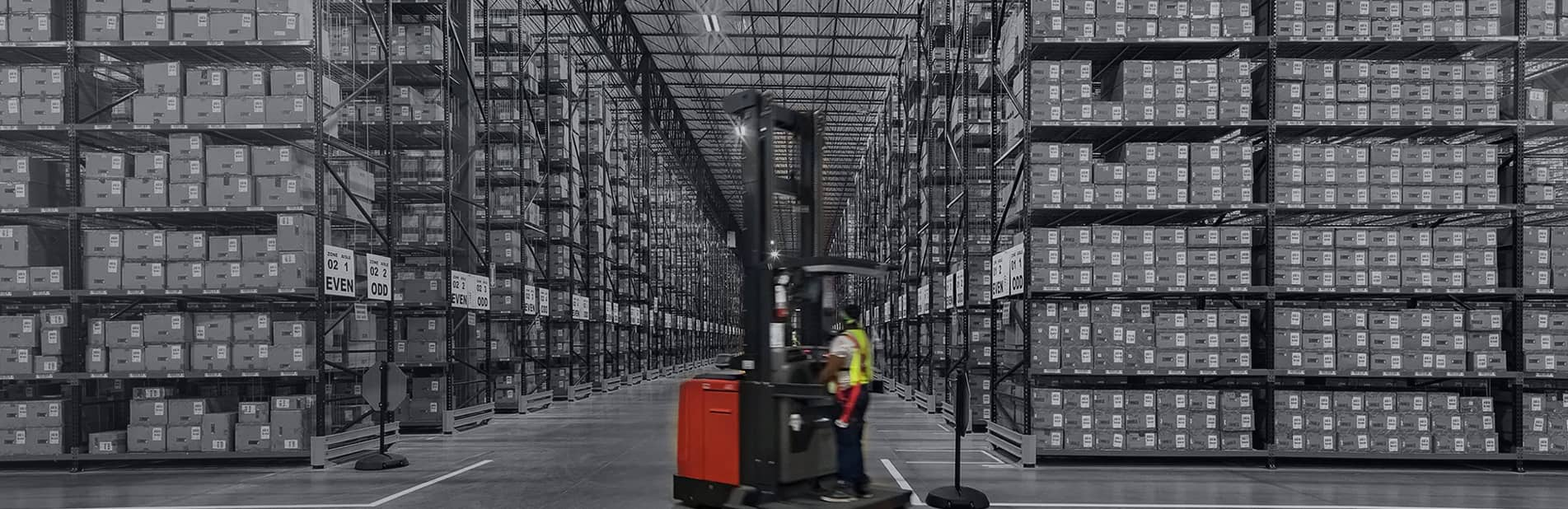
What Is a Reach Truck and How Does It Differ from a Counterbalance Forklift?
Nov 23, 2026A reach truck is an electric forklift designed for narrow warehouse aisles and high-rack storage. Its mast or fork mechanism can extend forward to retrieve or place pallets, allowing the truck to handle loads in racks while keeping its chassis outside the rack area. A counterbalance forklift, by contrast, carries loads in front of the vehicle and uses a rear counterweight to balance the load, making it suitable for a wider range of material handling tasks, including loading docks, production areas, and outdoor operations.
The main difference between a reach truck and a counterbalance forklift is their handling design and working environment. Reach trucks are generally better for warehouses with narrow aisles and high storage racks, while counterbalance forklifts offer greater versatility for handling different loads across multiple work areas.
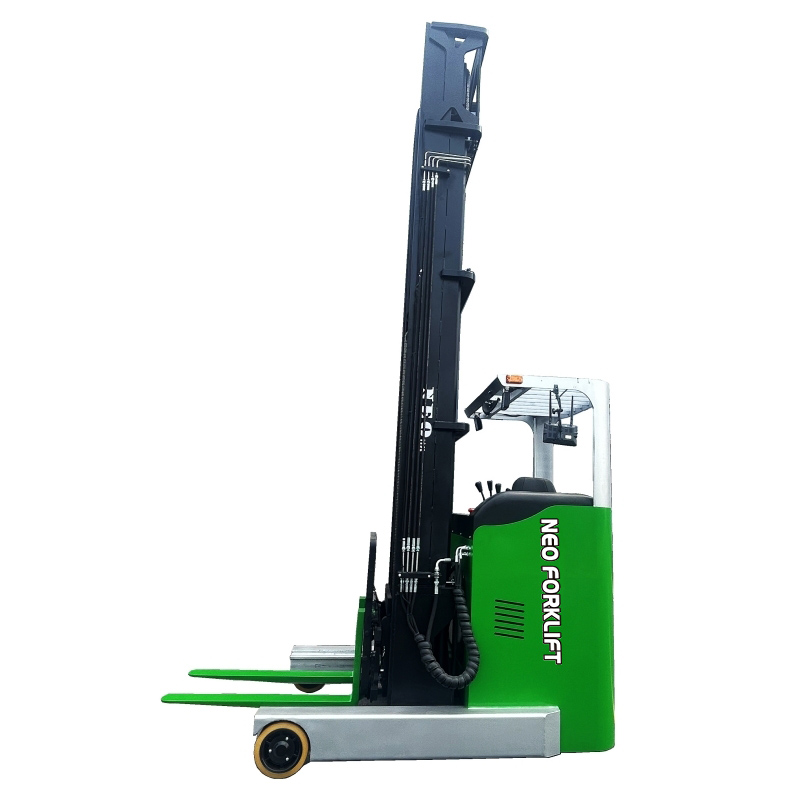
A reach truck is a specialized electric warehouse forklift designed primarily for pallet storage and retrieval in narrow aisles. Unlike a traditional counterbalance forklift, it uses a reach mechanism that allows the mast or forks to move forward when picking up a pallet and retract when transporting the load.
This design helps reduce the truck's overall working footprint and makes it easier to access pallet positions in high-density warehouse racking. Reach trucks are commonly used in distribution centers, logistics warehouses, cold storage facilities, manufacturing plants, and other indoor operations where floor space is limited.
Typical reach truck configurations include:
NEO FORKLIFT offers different reach truck configurations with rated capacities generally ranging from 1 ton to 2.5 tons for conventional warehouse reach truck models, with lifting heights available up to 12 meters depending on configuration. Specialized multi-directional models are designed for long-material handling applications.
For warehouse operators looking for compact electric handling equipment, the NEO FORKLIFT reach truck range includes different designs for narrow-aisle storage, high-rack operations, and specialized material handling.
A counterbalance forklift is a material handling truck that carries its load at the front of the vehicle. A heavy counterweight positioned at the rear balances the load during lifting, transportation, and stacking.
Because it does not rely on front support legs or a reach mechanism, a counterbalance forklift can approach pallets, trucks, loading platforms, and production equipment from different directions. This makes it a practical choice for general material handling applications.
Counterbalance forklifts are available in electric, diesel, gasoline, and LPG configurations. Electric models are frequently used in warehouses and indoor facilities, while internal combustion models are commonly selected for heavier loads, outdoor work, and demanding operating conditions.
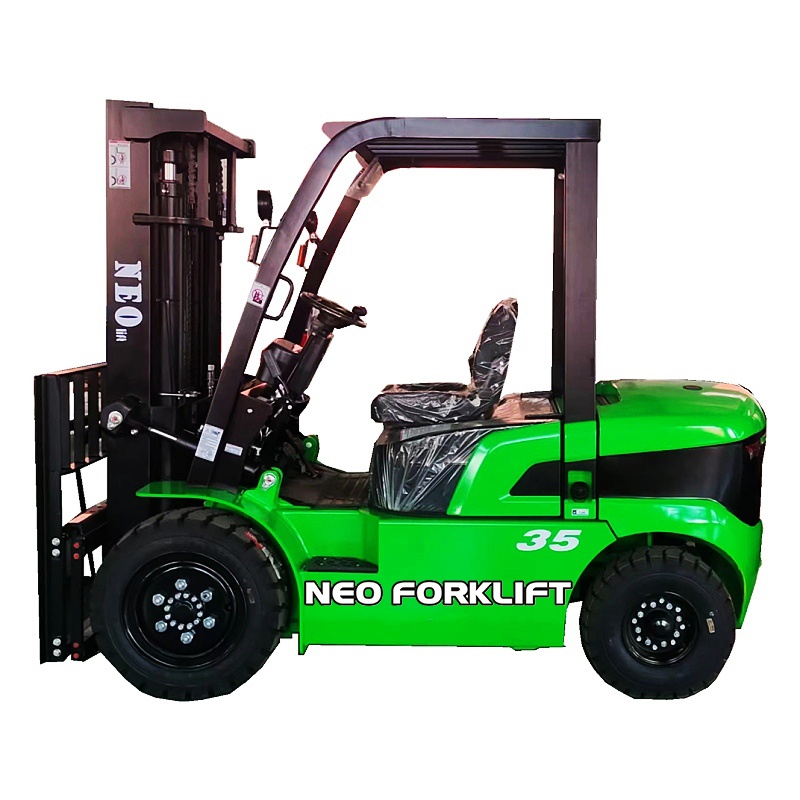
For indoor operations where low noise and zero exhaust emissions during operation are important, an electric counterbalance forklift may be a suitable option. Electric counterbalance models are available in three-wheel and four-wheel configurations, depending on maneuverability, load capacity, and operating requirements.
Although both types of forklifts lift and transport palletized goods, their structures, aisle requirements, load handling methods, and operating environments are different.
| Comparison | Reach Truck | Counterbalance Forklift |
|---|---|---|
| Main design | Reach mechanism and supporting front legs | Rear counterweight balances the front load |
| Load handling | Forks or mast extend to access rack positions | Load is carried directly in front of the front wheels |
| Aisle requirement | Designed for narrower aisles | Generally requires more maneuvering space |
| Storage height | Well suited to high-rack pallet storage | Suitable for conventional stacking and varied lifting tasks |
| Typical power | Electric | Electric, diesel, gasoline, or LPG |
| Operating environment | Primarily indoor warehouse environments | Indoor, outdoor, loading docks, production areas, and yards depending on model |
| Common application | High-density pallet storage and retrieval | General material handling, loading, unloading, and transportation |
| Storage efficiency | Helps increase pallet positions by reducing aisle width | Requires wider aisles in many conventional layouts |
The right choice depends on how your facility is organized. If the primary objective is to store more pallets within the same warehouse footprint, a reach truck is often a better fit. If your operation requires loading and unloading vehicles, moving goods between production areas, and handling different types of loads, a counterbalance forklift may provide more flexibility.
A reach truck uses an extending mast or fork mechanism to access pallets positioned inside warehouse racks. The truck approaches the rack with its supporting legs positioned outside the rack structure. The reach mechanism extends the forks toward the pallet, lifts the load, and then retracts the load before the truck travels.
By retracting the load toward the truck during transportation, the operator can maintain a more compact operating profile. This arrangement is particularly useful when warehouse aisles are narrow and rack spacing is carefully planned.
Most reach trucks are battery-powered and designed for indoor use. Their compact chassis, electric drive system, and relatively small turning radius make them useful for repeated pallet movement in warehouse environments.
Depending on the application, operators may choose a stand-on or seated configuration. A seated electric reach truck may be appropriate for longer shifts or applications where operator comfort is an important consideration.
A counterbalance forklift relies on its rear counterweight and front axle to balance the load carried on the forks. The load center, rated capacity, mast position, and attachment configuration all affect the truck's lifting stability.
When lifting a pallet, the operator positions the forks underneath the load and raises it using the hydraulic lifting system. The forklift then transports the load with the forks lowered to a safe travel height. Since the load is carried in front of the vehicle, the forklift can handle many different pallet sizes and approach loads without requiring a reach mechanism.
Counterbalance forklifts are commonly used for:
For applications requiring different load capacities, tire types, or power sources, buyers can review NEO FORKLIFT's electric counterbalance forklift models and select a configuration according to their facility conditions.
A reach truck is generally the better choice for narrow warehouse aisles because its design allows it to access rack positions without requiring the entire truck to enter the storage bay. Its compact chassis and reach mechanism make it suitable for facilities where aisle space is limited.
In many warehouse layouts, reach trucks can work in aisles around 2.7 to 3.0 meters wide, depending on the truck model, pallet dimensions, rack layout, and required operating clearance. Actual aisle width should always be confirmed using the manufacturer's Ast (working aisle width) specifications for the intended pallet and handling direction.
Counterbalance forklifts usually need more room to turn and position loads. However, three-wheel electric counterbalance forklifts can offer improved maneuverability in smaller spaces compared with some four-wheel configurations.
When planning a warehouse, aisle width should not be based on forklift dimensions alone. Consider pallet size, rack depth, turning radius, load overhang, operator visibility, and safety clearance.
Reach trucks are generally preferred for high-rack warehouses because they are specifically designed for vertical pallet storage. Their mast configuration, compact working profile, and reach mechanism allow operators to retrieve and place pallets at elevated rack positions while using relatively narrow aisles.
NEO FORKLIFT's conventional reach truck range includes models with lifting heights of up to 12 meters, depending on configuration. For high-bay warehouses, buyers should check the maximum lifting height, residual capacity at height, mast type, free lift, closed mast height, and required aisle width before making a selection.
A counterbalance forklift may also be suitable for stacking pallets, but it is often more practical for lower or medium-height storage systems and warehouse layouts with wider aisles.
The operating environment is one of the most important factors when choosing between these two forklift types.
Choose a reach truck when:
Choose a counterbalance forklift when:
For businesses operating both high-density storage areas and loading zones, using both types of forklifts may be more efficient than expecting one machine to perform every task.
Before purchasing a reach truck or counterbalance forklift, warehouse managers should evaluate the actual working conditions rather than choosing based only on rated capacity or purchase price.
For buyers who are unsure which configuration is suitable, providing pallet dimensions, load weights, rack heights, aisle measurements, and working conditions can help the manufacturer recommend a more appropriate forklift.
There is no single forklift that is best for every warehouse. A reach truck is usually the more efficient solution for narrow-aisle storage and high-rack pallet handling, while a counterbalance forklift is a more versatile choice for general lifting, loading, unloading, and transportation tasks.
If your warehouse is designed around high-density pallet storage, a reach truck can help improve space utilization and reduce unnecessary aisle space. If your business handles goods across multiple work areas or frequently works with vehicles, docks, and bulky loads, a counterbalance forklift may be the better investment.
NEO FORKLIFT supplies warehouse handling equipment for different operating conditions. Buyers can review the available reach truck models and counterbalance forklift solutions to compare specifications and identify the equipment that matches their warehouse layout and handling requirements.
If you are planning a new warehouse or upgrading existing equipment, sharing your application details with the supplier before purchasing can help avoid choosing a forklift that is too large, too small, or unsuitable for your aisle layout.
Is a reach truck the same as a forklift?
A reach truck is a type of forklift designed primarily for warehouse pallet storage and retrieval. It uses a reach mechanism to access rack positions and is generally optimized for narrow aisles and high storage racks.
What is the main difference between a reach truck and a counterbalance forklift?
A reach truck uses an extending mast or fork mechanism to access pallets in racks, while a counterbalance forklift carries the load in front of the vehicle and uses a rear counterweight to maintain balance. Reach trucks are typically better for narrow-aisle warehouse storage, while counterbalance forklifts are more versatile for general material handling.
Can a reach truck be used outdoors?
Most conventional reach trucks are designed for indoor warehouse operation on smooth, level floors. Outdoor use depends on the specific model, tires, ground conditions, weather protection, and manufacturer approval. A conventional reach truck is generally not the best choice for rough or uneven outdoor terrain.
Are reach trucks suitable for high-rack warehouses?
Yes. Reach trucks are specifically designed for high-rack pallet storage. Depending on the model and configuration, NEO FORKLIFT reach trucks can provide lifting heights of up to 12 meters for conventional warehouse applications.
Which forklift requires less aisle space?
Reach trucks generally require less working aisle space than conventional counterbalance forklifts because of their compact design and reach mechanism. The exact aisle width depends on the truck model, pallet size, load orientation, and operating clearance.
Are reach trucks electric?
Most conventional reach trucks are electric-powered. Battery-powered operation makes them suitable for indoor warehouses where low noise and zero exhaust emissions during operation are important.
Can a counterbalance forklift handle different types of loads?
Yes. Counterbalance forklifts can handle pallets, bulky materials, and different load types when the truck's rated capacity, load center, forks, and attachments are suitable for the application.
How do I decide which forklift is right for my warehouse?
Evaluate your load weight, pallet dimensions, rack height, aisle width, floor conditions, operating hours, and material flow. Choose a reach truck if high-density rack storage is the priority. Choose a counterbalance forklift if you need versatile handling across loading docks, production areas, and warehouse spaces.
Add:No.609 Tahui Road , Shihudang Town, Songjiang District ,Shanghai, China


Friendly Links :
© 2026 Shanghai Zon-Cho Huge Science And Technology Co., Ltd. All Rights Reserved.
|Sitemap|Xml |Privacy Policy




