
How to Choose Between Stand On and Seated Reach Trucks
Nov 04, 2026Choosing between a stand-on reach truck and a seated reach truck is not simply a matter of whether the operator prefers to stand or sit. The right choice depends on warehouse layout, travel distance, operating hours, pallet handling frequency, lifting height, and the working habits of your operators.
Both types are designed for pallet handling and high-level storage in warehouses where space utilization matters. However, their operator positions and ergonomic designs make them suitable for different working patterns. A stand-on model may be a practical choice for frequent short-distance movements and quick entry and exit, while a seated model can be more suitable for longer operating periods and continuous travel.
For warehouse managers comparing electric reach trucks, this guide explains the practical differences, key selection factors, and product options available from NEOlift.
The main difference is the operator's working position. A stand-on reach truck is operated from a standing platform, while a seated reach truck provides an adjustable seat and a driving position designed for seated operation.
Both designs use a reach mechanism that allows the mast or fork assembly to move forward for pallet handling and retract during travel. This helps the truck work in warehouse aisles where a conventional counterbalance forklift may require more operating space.
The choice is best understood through the daily workflow:
Neither design is automatically better for every warehouse. The more suitable option is the one that matches the actual handling process, aisle dimensions, and operator requirements.
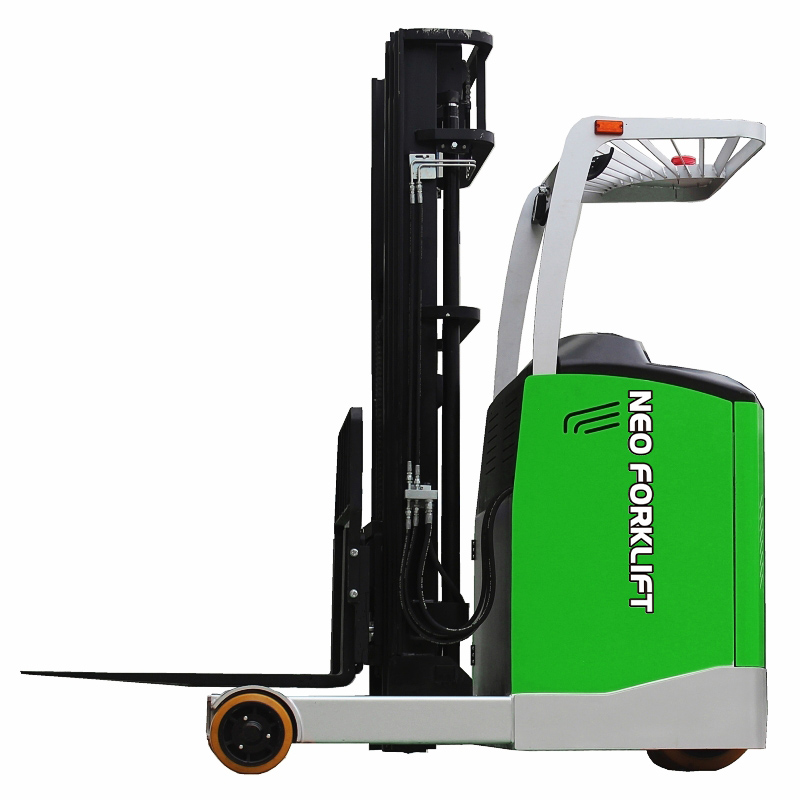
A stand-on reach truck allows the operator to work from a standing platform rather than a fixed driving seat. This arrangement can be useful in warehouses where operators frequently stop, position pallets, and move between handling tasks.
One practical advantage is the ability to get on and off the truck relatively easily. In workflows that involve repeated short-distance movements, this can make daily operations more convenient. The standing position also gives operators a different field of view when positioning the truck and checking nearby working areas.
NEOlift's Standing Type Electric Battery Powered Reach Truck is designed for medium-density storage and high-turnover warehouse conditions. The NRZ series page lists a rated load range of 1.2–2.5 tons and a lifting height range of 3–8 meters.
For example, the NRZ15 and NRZ20 specifications list rated capacities of 1,500 kg and 2,000 kg respectively, with a listed lifting height of 4,500 mm for these configurations. The models also feature electric power steering and a reach mechanism.
Typical applications include:
For buyers who need a compact standing model for smaller warehouse spaces, NEOlift also offers a Standing Type Mini Electric Reach Truck. This product page lists a 1–2 ton load capacity range and lifting heights from 1.6 to 5.5 meters.
A seated reach truck provides an adjustable seat and a dedicated driving position. It is often considered when operators spend longer periods traveling between storage locations or carrying out continuous pallet handling tasks.
Compared with a standing platform, a seated configuration provides a different level of support during extended operation. This may be an important consideration in warehouses where the operator spends much of the shift driving rather than frequently getting on and off the truck.
NEOlift's Seated Type Electric Battery Powered Reach Truck uses the NRS series. The product page describes a rated capacity range of 1.6–2.5 tons and a mast that can move forward or backward as a whole. It also features an adjustable seat, joystick operation, a multifunction display, and an AC drive system.

The published specifications for NRS16 and NRS20 list rated capacities of 1,600 kg and 2,000 kg, with a lifting height of 7,500 mm. Battery configurations are listed as 48V/400Ah and 48V/460Ah respectively.
These specifications make the NRS series worth considering for warehouses that require high-level pallet storage and a seated operating position. Actual suitability still depends on load weight, load center, rack height, aisle width, and the required working cycle.
Typical applications include:
View the NEOlift Seated Type Electric Battery Powered Reach Truck to review its available configurations and technical specifications.
The following comparison summarizes the main factors warehouse buyers should consider. These are general operating considerations rather than universal performance guarantees. Actual results depend on the truck configuration, warehouse conditions, and operator training.
| Comparison Factor | Stand-On Reach Truck | Seated Reach Truck |
|---|---|---|
| Operator position | Standing platform | Adjustable seat |
| Operator movement | Convenient for frequent entry and exit | Better suited to continuous seated operation |
| Typical workflow | Frequent stops and short handling cycles | Longer travel and extended operating periods |
| Operator comfort | Depends on platform design and standing duration | Provides a seated working position |
| Warehouse aisle | Depends on model dimensions and turning radius | Depends on model dimensions and turning radius |
| High-level storage | Available on selected models | Available on selected models |
| Best selection factor | Frequent stops and operator movement | Longer operating periods and seated preference |
A common misunderstanding is that a stand-on reach truck must always be smaller or that a seated reach truck must always require wider aisles. These assumptions are not reliable. Overall width, turning radius, right-angle stacking aisle width, and load dimensions should be checked against the technical data for the exact model.
Before selecting a model, review the actual warehouse operation rather than relying on the operator position alone. The following factors can help narrow down the right configuration.
Warehouse aisle width and turning space
Measure the clear aisle width, rack spacing, end-of-aisle turning area, and the dimensions of the pallets being handled. A reach truck must have enough room to approach, turn, extend its mast, and position the load safely.
Do not select a truck based only on its overall width. Ask the supplier for the right-angle stacking aisle width (Ast) based on your pallet dimensions and load center. The actual aisle requirement can vary between models.
Daily operating hours and travel distance
Consider how much time operators spend driving compared with picking up, positioning, and depositing pallets. If the job involves frequent stops and repeated entry and exit, a stand-on model may be more convenient. If operators travel continuously for longer periods, a seated model may be worth evaluating.
Load capacity and load center
Rated capacity alone does not tell the whole story. The load center, attachment weight, pallet dimensions, and lifting height all affect the truck's actual capacity. Always check the capacity chart for the intended operating height and load configuration.
Rack height and lifting requirements
Measure the highest storage beam and confirm the required fork height, mast type, and overhead clearance. A truck with a suitable rated capacity at floor level may have a different allowable capacity when lifting to higher rack positions.
Operator comfort and working conditions
Consider operator height, visibility, control layout, floor conditions, and the length of each working cycle. If possible, arrange a practical demonstration so operators can test the driving position and controls before purchasing.
Battery capacity and charging arrangements
For electric reach trucks, battery voltage and capacity should match the expected workload. Review the operating cycle, charging time, battery replacement method, and whether opportunity charging or a spare battery is required.
Both stand-on and seated reach trucks can be used in narrow-aisle warehouse environments. The deciding factor is not simply whether the operator stands or sits, but whether the selected truck can safely complete the required stacking operation within the available aisle space.
For example, NEOlift's NRZ standing reach truck specifications list a turning radius of 1,594 mm for the NRZ15 and 1,784 mm for the NRZ20. Its NRS seated reach truck specifications list turning radii of 1,775 mm for the NRS16 and 1,945 mm for the NRS20.
These figures are useful starting points for comparison, but they should not be treated as a direct performance ranking. The models have different configurations and dimensions. Buyers should also compare the right-angle stacking aisle width, pallet size, load center, and turning conditions.
If the warehouse has especially narrow aisles or high storage density, it may also be worth considering other warehouse truck configurations. NEOlift provides a range of electric reach trucks, including mini, stand-on, seated, double-deep, and multidirectional options.
NEOlift offers both standing and seated electric reach truck configurations for different warehouse handling requirements. The following examples show how the two product types can be evaluated based on their published specifications.
Standing Type Electric Battery Powered Reach Truck – NRZ Series
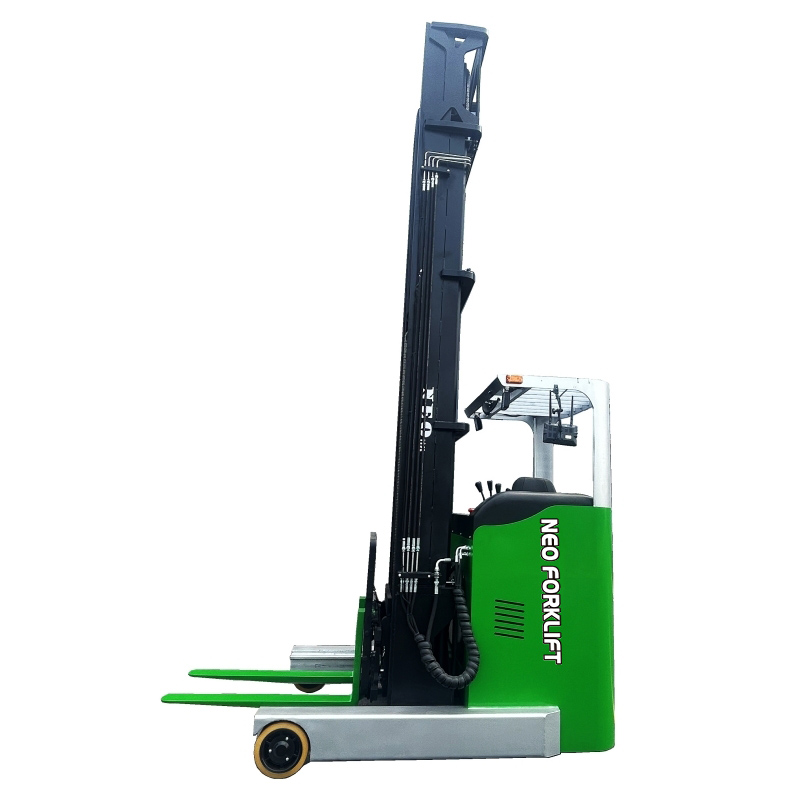
Seated Type Electric Battery Powered Reach Truck – NRS Series

These product examples are not a substitute for a model-specific quotation or capacity chart. The final configuration should be confirmed against the actual load, lifting height, pallet size, aisle dimensions, and working hours.
Even when buyers understand the difference between standing and seated operation, some important details can be overlooked during purchasing.
A clear set of warehouse measurements and operating requirements will help suppliers recommend a more suitable reach truck and reduce the risk of selecting an unsuitable configuration.
NEOlift provides electric material handling equipment for warehouse storage, pallet movement, and industrial logistics applications. Its reach truck range includes standing, seated, mini, double-deep, and multidirectional configurations.
Rather than choosing a truck based on a single specification, buyers can compare different models according to their warehouse layout, load requirements, lifting height, and operator preferences.
NEOlift also states that it has more than 20 years of experience in electric material handling equipment and provides customized solutions for different customer requirements. This can be useful for buyers whose warehouse conditions do not fit a standard equipment configuration.
If you are comparing stand-on and seated reach trucks for a new warehouse project or equipment replacement, prepare your pallet dimensions, maximum load weight, rack height, aisle width, and daily working hours before requesting a recommendation.
With these details, the NEOlift team can help identify suitable models and provide more specific technical information for your application.
Is a stand-on reach truck better than a seated reach truck?
Not in every situation. A stand-on reach truck is often convenient for frequent stops and repeated entry and exit, while a seated reach truck may be more suitable for longer periods of continuous travel. The better choice depends on the warehouse workflow and operator requirements.
Which reach truck is more comfortable for long shifts?
A seated reach truck provides a seated driving position and may be preferred for extended operating periods. However, comfort also depends on seat adjustment, control layout, vibration, visibility, floor conditions, and the operator's working habits.
Can a stand-on reach truck work in narrow aisles?
Yes. Selected stand-on reach truck models are designed for narrow-aisle warehouse stacking. Buyers should confirm the truck's right-angle stacking aisle width, turning radius, pallet size, and load center before selecting a model.
Do seated reach trucks require wider aisles?
Not necessarily. Aisle requirements depend on the truck's overall dimensions, turning radius, fork configuration, pallet size, and stacking method. Compare the technical specifications of the exact models rather than making a decision based only on operator position.
What is the load capacity of NEOlift stand-on reach trucks?
NEOlift's NRZ standing reach truck product page lists a load range of 1.2–2.5 tons. The NRZ15 and NRZ20 configurations list rated capacities of 1,500 kg and 2,000 kg respectively. Buyers should confirm the required model and capacity at the intended lifting height.
What is the load capacity of NEOlift seated reach trucks?
NEOlift's NRS seated reach truck product page lists a load range of 1.6–2.5 tons. The NRS16 and NRS20 specifications list rated capacities of 1,600 kg and 2,000 kg respectively.
What information should I provide when requesting a reach truck quotation?
Provide the maximum load weight, load dimensions, pallet size, load center, required lifting height, aisle width, floor condition, daily working hours, and preferred operator position. These details help the supplier recommend a suitable configuration.
Can NEOlift recommend a customized reach truck solution?
NEOlift states that it can provide customized material handling equipment solutions according to customer requirements. For special warehouse layouts or handling conditions, share the application details with the sales team for evaluation.
How do I decide between a stand-on and seated reach truck?
Start by reviewing the daily work cycle. Choose a stand-on model when frequent stops and operator movement are important. Consider a seated model when operators spend longer periods driving and prefer a seated position. Then verify aisle width, rated capacity, lifting height, and battery requirements for the selected model.
Choosing the right reach truck is ultimately about matching the equipment to the way your warehouse operates. If you are still comparing the two designs, NEOlift can help you review the application requirements and identify a suitable stand-on or seated reach truck for your facility.
Add:No.609 Tahui Road , Shihudang Town, Songjiang District ,Shanghai, China


Friendly Links :
© 2026 Shanghai Zon-Cho Huge Science And Technology Co., Ltd. All Rights Reserved.
|Sitemap|Xml |Privacy Policy




