
Three Wheel vs Four Wheel Electric Forklift Which Should You Buy?
Nov 19, 2026Choosing between a three wheel and a four wheel electric forklift is not simply a matter of counting wheels. The right choice depends on how much space your forklift has to maneuver, the weight and size of your loads, the condition of your warehouse floor, and how frequently the truck operates throughout the day.
For warehouses with narrow aisles and frequent turns, a three wheel electric forklift can be a practical solution because of its compact design and maneuverability. A four wheel electric forklift is often a better fit for operations that handle heavier loads, require a broader range of capacities, or work across different material handling conditions.
So, which electric counterbalance forklift should you buy? This guide compares both configurations and uses actual NEO FORKLIFT models to help warehouse managers, equipment buyers, and distributors make a more informed decision.
The main difference between a three wheel electric forklift and a four wheel electric forklift is their wheel configuration, which influences steering behavior, turning space, vehicle layout, and operating characteristics.
A typical three wheel electric counterbalance forklift has two front drive wheels and one rear steering wheel. This arrangement allows the rear of the truck to pivot through a relatively tight turning angle. It is particularly useful in warehouses where the forklift needs to turn frequently between storage racks, workstations, and loading areas.
A four wheel electric forklift has two front wheels and two rear wheels. Its four-wheel configuration provides a different support arrangement and is commonly selected for operations that require a wider capacity range and more versatile handling conditions.
Both types use a counterweight at the rear to balance the load carried on the forks. Neither configuration should be considered automatically safe for every load or floor condition. The rated capacity, load center, mast height, tires, and attachment configuration all affect actual lifting performance.
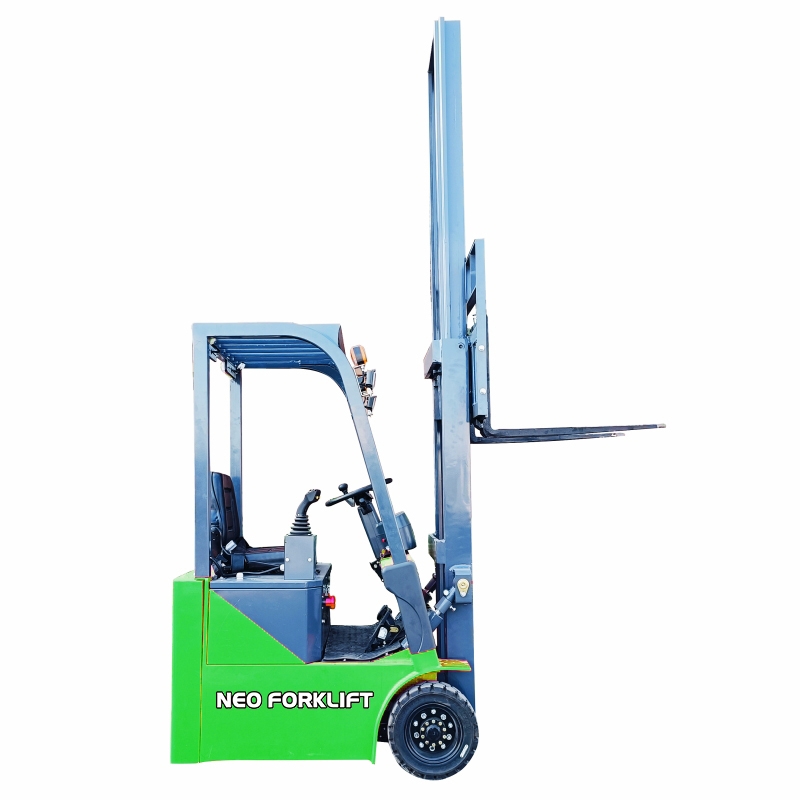
A compact three wheel electric forklift designed for space-conscious material handling.
The following comparison highlights the factors that matter most when selecting an electric forklift for warehouse or industrial use.
| Comparison Factor | Three Wheel Electric Forklift | Four Wheel Electric Forklift |
|---|---|---|
| Wheel configuration | Typically two front drive wheels and one rear steering wheel | Two front wheels and two rear wheels |
| Turning maneuverability | Generally smaller turning radius | Generally requires more turning space |
| Warehouse layout | Well suited to compact storage areas and narrow working routes | Suitable for wider aisles and more varied handling routes |
| Load capacity | Commonly used for light to medium-duty handling, depending on model | Available in a broad range of capacities, including heavier-duty models |
| Typical applications | Warehouses, compact storage areas, indoor operations | Warehousing, logistics, manufacturing, food and chemical industries |
| Main buying consideration | Turning space and maneuverability | Required capacity, operating conditions and versatility |
One important point: a four wheel forklift is not automatically the better choice for every heavy-duty application, and a three wheel forklift is not limited to very light loads. Buyers should compare the rated capacity and load chart of the specific model rather than relying on the wheel configuration alone.
The biggest reason to choose a three wheel electric forklift is maneuverability. In a warehouse where every meter of floor space matters, a smaller turning radius can make daily material handling easier and reduce the space needed for turning operations.
Better maneuverability in narrow aisles
Three wheel electric forklifts are commonly used in compact warehouses, retail distribution areas, and indoor storage facilities. Their steering arrangement allows operators to make tighter turns when moving pallets between closely spaced storage locations.
Compact body design
Some three wheel models have a shorter body and smaller overall dimensions than conventional counterbalance trucks. This can be useful when working around machinery, inside smaller warehouses, or in locations where access space is restricted.
Suitable for indoor material handling
Electric power makes these forklifts suitable for many indoor operations where exhaust emissions from internal combustion equipment are undesirable. They also avoid engine exhaust during normal electric operation.
Practical for frequent turning and repositioning
When operators repeatedly pick up, transport, and position pallets in a limited area, maneuverability can have a direct effect on workflow. A suitable three wheel model may help reduce unnecessary repositioning.
For example, NEO FORKLIFT's Very Short Mini 3 Wheel Electric Forklift is designed for compact working spaces. The NPML10 model has a rated load capacity of 1,000 kg, a maximum lifting height of 3,000 mm, and a 1.3-meter body. It comes with a lithium iron phosphate battery as standard.
NEO FORKLIFT NPML10: a compact three wheel electric forklift for restricted workspaces.
This type of forklift may be worth considering for warehouses with limited turning space, elevator access requirements, and floor-level material handling tasks. Actual suitability still depends on the available aisle width, floor conditions, load dimensions, and turning clearance.
A four wheel electric forklift is often the more suitable option when a warehouse needs a wider range of load capacities or handles different types of material throughout the working day.
A wider selection of load capacities
Four wheel electric counterbalance forklifts are available in different capacity classes. This makes it easier for buyers to match the truck to heavier pallets, larger goods, and higher-volume material handling requirements.
For instance, NEO FORKLIFT's four wheel electric counterbalance forklift series for storage covers a stated capacity range of 1.5 to 5.0 tons, with lifting heights of 3 to 6 meters across the product range. Exact specifications depend on the selected model.
More options for different working conditions
Four wheel models can be configured with different tire types, battery options, and attachments. For example, the NEO FORKLIFT storage series offers pneumatic and solid rubber tire options, as well as lead-acid and lithium battery configurations.
Suitable for mixed warehouse and industrial operations
Businesses that handle goods in warehouses, production areas, logistics centers, food facilities, or electronics plants may benefit from a four wheel model with specifications matched to their operating environment.
Consider the floor and load conditions
Wheel configuration alone does not determine stability. Floor condition, turning speed, load center, mast height, tire selection, and operator behavior all matter. A four wheel model should still be selected according to its rated capacity and the manufacturer's operating guidance.
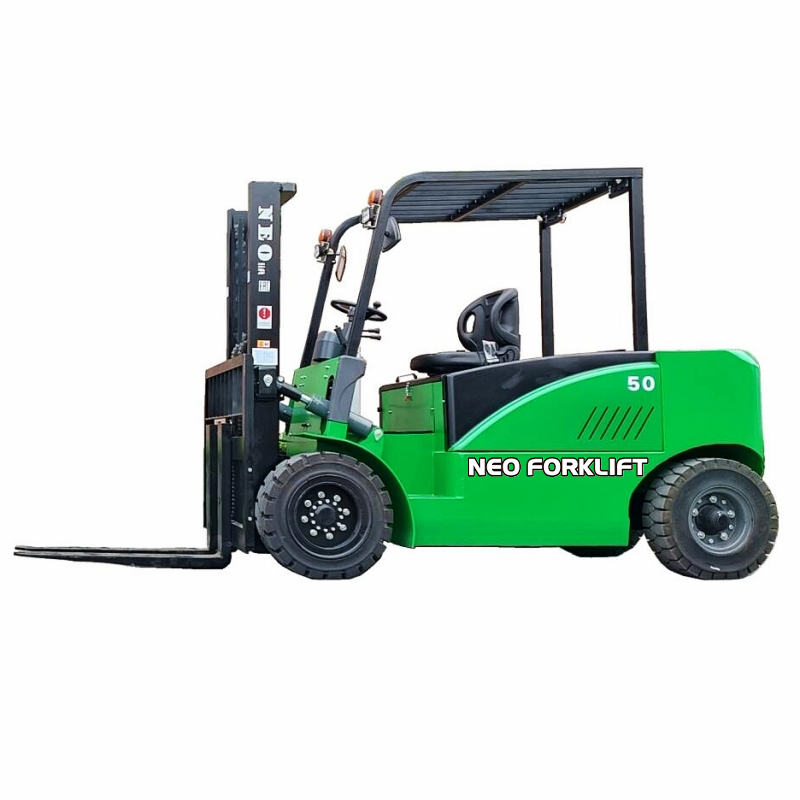
NEO FORKLIFT four wheel electric counterbalance forklift for warehouse and industrial material handling.
For operations that need a conventional four wheel configuration, the NEO FORKLIFT 4 Wheel Electric Counterbalance Forklift for Storage offers multiple capacity options and battery configurations for different warehouse requirements.
If your main concern is aisle width and turning space, a three wheel electric forklift is usually the first configuration to evaluate.
Its compact steering arrangement can make it easier to turn in restricted spaces, especially when the forklift needs to move between storage racks or work around other equipment. However, choosing a forklift based only on the nominal aisle width can lead to problems during actual operation.
Before purchasing, measure the following:
The right-angle stacking aisle requirement is particularly important. It is not always the same as the forklift's turning radius. The pallet dimensions, fork length, load orientation, and required operating clearance all influence the space needed to complete a stacking maneuver.
If your warehouse has very narrow aisles and high-density racking, it may also be worth comparing a counterbalance forklift with a specialized warehouse forklift solution such as a reach truck or VNA forklift, depending on the rack layout and lifting requirements.
For heavy material handling, the rated capacity of the specific forklift should be the starting point. Four wheel electric forklifts are commonly available in higher capacity configurations, but the actual lifting ability depends on the model, load center, mast, lifting height, and attachments.
A forklift rated at 2,000 kg does not necessarily lift 2,000 kg safely under every condition. If the load center is longer than the rated load center, or if an attachment changes the load geometry, the remaining lifting capacity may be reduced.
Buyers should check:
For example, NEO FORKLIFT's four wheel electric counterbalance range includes models with different rated capacities. The published product range lists capacities from 1.5 to 5.0 tons, but buyers should request the specification sheet and load chart for the exact model they intend to purchase.
Battery selection is another important part of the buying decision. Both three wheel and four wheel electric counterbalance forklifts can be available with different battery configurations, depending on the model.
Lithium battery electric forklifts
Lithium batteries are often selected by warehouses that need flexible charging schedules, frequent operation, and reduced battery maintenance. Opportunity charging may help keep equipment available during breaks, provided the battery and charging system are designed for this use.
Lead-acid battery electric forklifts
Lead-acid batteries remain a practical option for businesses with established charging areas and predictable operating shifts. Buyers should consider charging time, battery maintenance, ventilation requirements, and battery replacement arrangements.
NEO FORKLIFT offers lead-acid and lithium battery options across selected electric counterbalance forklift models. The available configuration should be confirmed for the specific model and capacity rather than assumed to be identical throughout the product range.
Before requesting a quotation, review your actual material handling tasks. The following questions can help narrow down the right configuration.
What is your narrowest working aisle?
If the forklift must turn frequently in restricted aisles, compare three wheel models first. Check the manufacturer's turning radius and right-angle stacking aisle dimensions against your warehouse measurements.
What is the heaviest load you need to lift?
Identify the maximum pallet weight and load center. If your operation regularly handles heavier goods, compare four wheel models with suitable rated capacities and load charts.
How high do you need to lift?
Racking height affects mast selection and residual capacity. A forklift that meets your capacity requirement at ground level may have a lower allowable capacity when lifting to a higher position.
What type of floor will the forklift operate on?
Consider whether the truck will work on smooth concrete, cold storage floors, loading areas, or other surfaces. Tire type and floor conditions should be evaluated together.
How many hours will the forklift operate each day?
For multi-shift operations, battery capacity, charging time, and charging opportunities are important. Choose a battery system that matches the working schedule rather than focusing only on the initial purchase price.
Do you need special attachments or customization?
If you handle paper rolls, long materials, unusual pallet sizes, or other non-standard loads, discuss the attachment and configuration requirements with the manufacturer before placing an order.
NEO FORKLIFT provides electric counterbalance forklifts in both three wheel and four wheel configurations. The product range includes compact models for space-conscious warehouse operations as well as four wheel models for a broader range of load capacities and industrial applications.
For buyers comparing the two configurations, several models are worth reviewing:
Very Short Mini 3 Wheel Electric Forklift – NPML10
This compact model has a rated capacity of 1,000 kg, a maximum lifting height of 3,000 mm, and a 1.3-meter body. It is equipped with a lithium iron phosphate battery as standard and is designed for smaller working spaces such as warehouses, elevators, and floor operations.
Front Dual-Drive 3 Wheel Electric Forklift – NPQ Series
The NPQ series is a three wheel electric counterbalance forklift designed for applications including cold storage. The published range covers 1.2 to 2.0 tons, with lifting heights of 3 to 6 meters. It features a full AC system and offers lead-acid battery as standard with lithium battery available as an option, subject to configuration.
View the Front Dual-Drive 3 Wheel Electric Forklift
Four Wheel Electric Counterbalance Forklift – NPS Series
The NPS storage series offers multiple capacity options, with the product range described as covering 1.5 to 5.0 tons and lifting heights of 3 to 6 meters. Battery and tire configurations can be selected according to the working environment and model specification.
NEO FORKLIFT has more than 20 years of experience in electric material handling equipment and provides different warehouse equipment solutions. If your operation has special requirements, you can also discuss custom forklift solutions with the team.
There is no single best electric forklift configuration for every warehouse. The better choice is the one that matches your operating space, load requirements, lifting height, and daily workflow.
Choose a three wheel electric forklift if your operation prioritizes:
Choose a four wheel electric forklift if your operation prioritizes:
Still unsure which configuration is right for your warehouse? Share your required load capacity, aisle width, lifting height, floor condition, and daily operating hours with NEO FORKLIFT. The team can help you compare suitable three wheel and four wheel electric forklift models based on your actual working conditions.
Is a three wheel electric forklift better than a four wheel forklift?
Not in every situation. A three wheel electric forklift is generally better for compact spaces and frequent turning, while a four wheel model may be more suitable when a wider capacity range and different operating configurations are required. The best option depends on the application and the specifications of the individual forklift.
Which electric forklift has a smaller turning radius?
Three wheel electric forklifts generally have a smaller turning radius than comparable four wheel models. However, the actual turning radius varies by model, wheelbase, steering design, and vehicle dimensions. Always check the manufacturer's technical specifications.
Are three wheel electric forklifts suitable for warehouses?
Yes. Three wheel electric forklifts are commonly used in warehouses, particularly where storage areas are compact and operators need to turn frequently. Buyers should confirm that the truck's rated capacity, aisle requirement, and lifting height meet the warehouse's needs.
Are four wheel electric forklifts more stable?
A four wheel configuration provides a different wheel support arrangement, but stability depends on more than the number of wheels. Load weight, load center, mast height, tire condition, floor surface, and driving behavior all affect forklift stability. Operators must follow the rated capacity and load chart.
What is the load capacity of NEO FORKLIFT electric counterbalance forklifts?
NEO FORKLIFT offers different models and capacity options. For example, the NPML10 mini three wheel electric forklift has a rated capacity of 1,000 kg. The NPS four wheel storage series includes multiple models, with the published range covering 1.5 to 5.0 tons. Exact specifications depend on the selected model.
Can I choose a lithium battery for a three wheel or four wheel electric forklift?
Yes, lithium battery configurations are available on selected NEO FORKLIFT electric counterbalance models. Battery availability depends on the model and configuration. Buyers should confirm battery voltage, capacity, charging requirements, and compatibility before ordering.
How do I know whether my warehouse needs a three wheel or four wheel forklift?
Start by measuring aisle width, checking the heaviest load and load center, identifying the required lifting height, and reviewing floor conditions. Then compare the turning radius, right-angle stacking aisle requirement, and rated capacity of the shortlisted models.
Can NEO FORKLIFT provide customized electric counterbalance forklifts?
NEO FORKLIFT provides customized material handling solutions according to customer requirements. Buyers can discuss operating conditions, load specifications, battery options, tires, and attachments with the team to identify a suitable configuration.
Add:No.609 Tahui Road , Shihudang Town, Songjiang District ,Shanghai, China


Friendly Links :
© 2026 Shanghai Zon-Cho Huge Science And Technology Co., Ltd. All Rights Reserved.
|Sitemap|Xml |Privacy Policy




