What Is an Electric Counterbalance Forklift and How Does It Work?
Nov 18, 2026An electric counterbalance forklift is a battery-powered material handling vehicle designed to lift, transport, and stack palletized goods without requiring front support legs or straddle arms. It uses a counterweight at the rear of the truck to balance the weight of the load carried on the forks. This design allows operators to handle different pallet sizes and work with a wide range of storage and loading applications.
Unlike reach trucks and pallet stackers, an electric counterbalance forklift carries the load directly in front of its front wheels. The rear counterweight helps maintain balance during lifting and transportation, while the electric drive system provides smooth movement with lower operating noise and no exhaust emissions during operation.
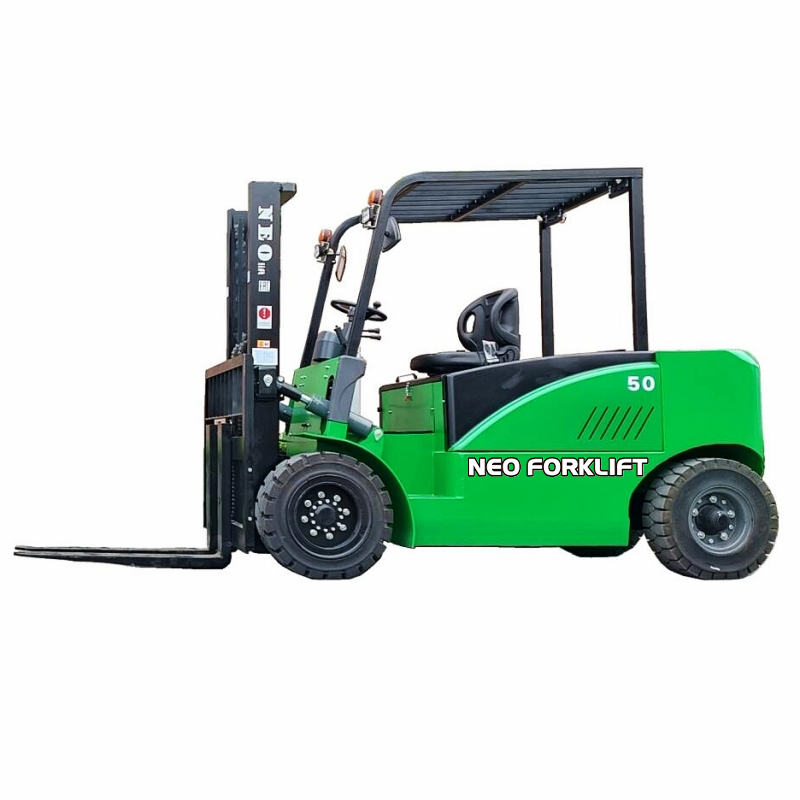
NEO FORKLIFT electric counterbalance forklift designed for industrial material handling.
NEO FORKLIFT offers both three-wheel and four-wheel electric counterbalance forklifts, with lead-acid and lithium battery configurations available across selected models. These trucks are designed for warehouses, manufacturing facilities, logistics centers, and other businesses that need reliable indoor and outdoor material handling equipment.
In this guide, we explain what an electric counterbalance forklift is, how its counterweight and electric drive system work, the differences between three-wheel and four-wheel models, and how to select the right forklift for your operation.
An electric counterbalance forklift is an industrial truck powered by a rechargeable battery. It uses electric motors for driving and hydraulic components for lifting and tilting loads.
Its most recognizable feature is the counterweight installed at the rear of the vehicle. When the forks lift a pallet, the load creates a forward tipping force. The counterweight generates an opposing moment that helps balance the truck.
Unlike reach trucks, which use an extending mast mechanism, a counterbalance forklift carries the load outside the front wheels. This makes it suitable for handling different pallet sizes, loading vehicles, unloading goods, and transporting materials between work areas.
The main components of an electric counterbalance forklift include:
NEO FORKLIFT provides different electric counterbalance forklift models for warehouses and industrial operations, including compact three-wheel trucks and heavier four-wheel configurations.
An electric counterbalance forklift works through the combined operation of its battery, electric motors, hydraulic lifting system, mast, and rear counterweight. Each component performs a specific function to move and lift loads while maintaining vehicle stability.
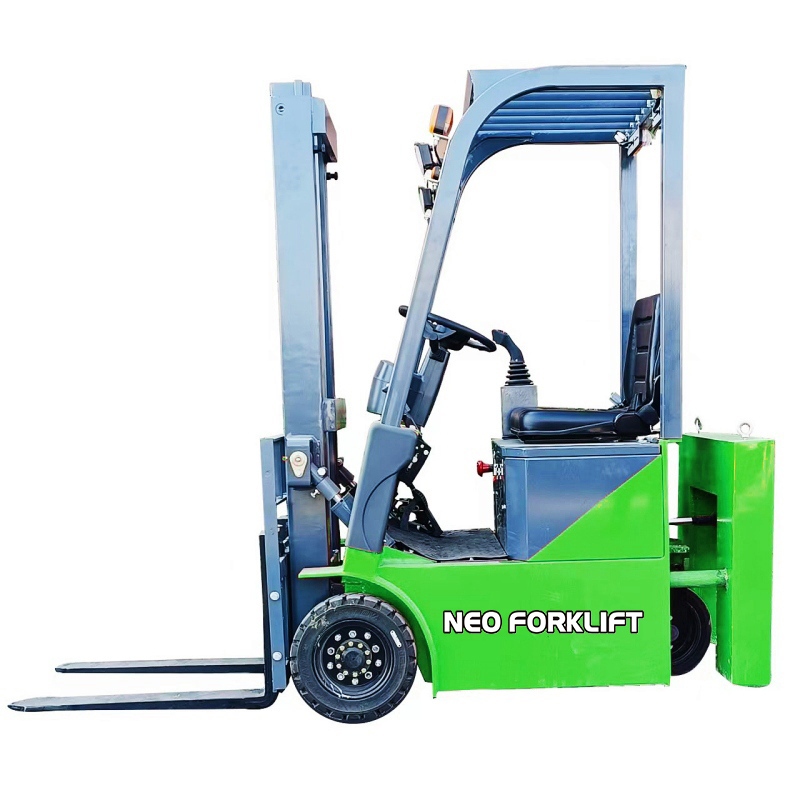
The counterbalance forklift design places the forks at the front and the counterweight at the rear.
Battery Supplies Electrical Power
The battery stores electrical energy and supplies power to the forklift's drive motor, hydraulic pump motor, controller, and other electrical components. Depending on the model, the forklift may use a lead-acid battery or a lithium battery.
Electric Motor Drives the Wheels
When the operator presses the accelerator, the controller regulates electrical power supplied to the drive motor. The motor generates torque to move the forklift forward or backward. AC drive systems are commonly used in modern electric forklifts because they provide responsive control and efficient operation.
Hydraulic System Lifts the Load
When the operator activates the lifting control, the hydraulic pump generates pressure to move hydraulic oil through the lifting circuit. This pressure operates the lift cylinders, causing the mast and forks to raise the load.
The operator can also control mast tilt to position the forks and load appropriately during handling. The hydraulic system provides the lifting force, while the electric motor supplies the energy required to operate the pump.
Counterweight Balances the Load
When a pallet is placed on the forks, its weight creates a forward tipping moment around the front axle. The counterweight at the rear produces an opposing moment to help maintain the forklift's balance.
This is the fundamental working principle of a counterbalance forklift. The load capacity is determined by the vehicle's rated design and depends on factors such as load center distance, lifting height, attachments, and load distribution.
Steering System Controls Direction
The steering system allows the operator to maneuver the forklift within the working area. Most counterbalance forklifts use rear-wheel steering, which helps the truck make relatively tight turns. Three-wheel models generally provide a smaller turning radius than comparable four-wheel models.
In short, the battery powers the electric drive and hydraulic systems, the mast lifts the cargo, and the rear counterweight helps balance the load during operation.
The counterweight is one of the most important structural components of an electric counterbalance forklift. Its purpose is to offset the forward tipping moment created by a load carried on the forks.
The principle can be understood through a simple lever system. The front axle acts as the fulcrum, while the load at the front and the counterweight at the rear create opposing moments.
The basic relationship can be expressed as:
Moment = Force × Distance
The load creates a forward moment based on its weight and horizontal distance from the front axle. The rear counterweight creates an opposing moment based on its weight and distance from the same reference point.
For example, when a forklift picks up a pallet, increasing the load weight or moving its center of gravity farther away from the fork face increases the forward tipping moment. The forklift must operate within its rated capacity to maintain the designed stability margin.
However, the counterweight does not make a forklift immune to tipping. Excessive loads, uneven floors, sharp turns, raised loads during travel, and incorrect attachments can all increase safety risks.
Operators should always follow the forklift's capacity plate and manufacturer instructions. Adding extra counterweight or attempting to compensate for overloading is not a safe solution.
Electric counterbalance forklifts are commonly available in three-wheel and four-wheel configurations. Both use a rear counterweight to balance front-mounted loads, but their wheel layouts create different handling characteristics.
Three-Wheel Electric Counterbalance Forklift
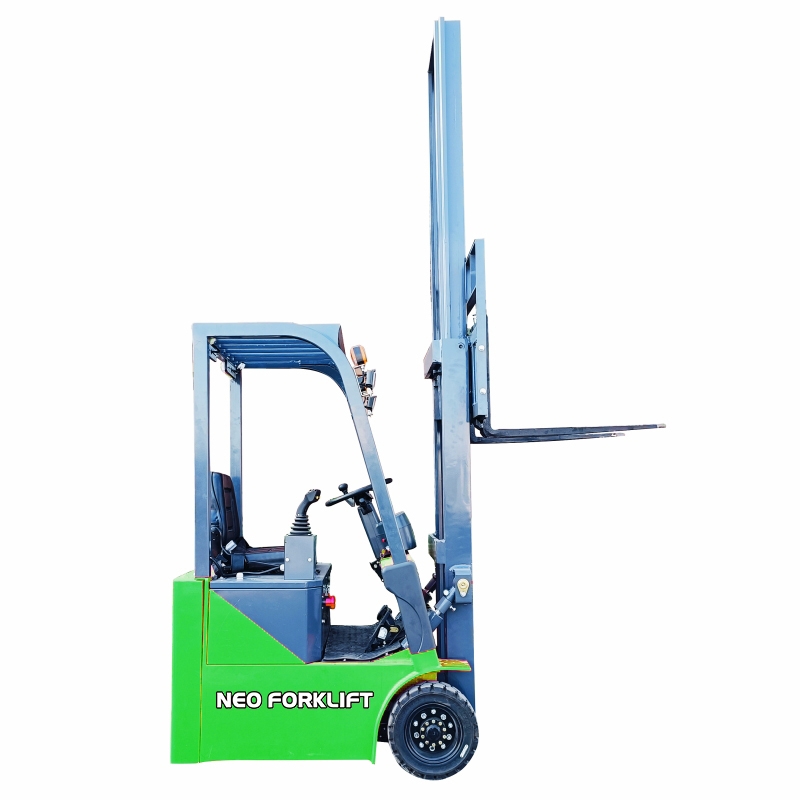
Three-wheel electric counterbalance forklift for operations requiring a compact turning radius.
A three-wheel electric counterbalance forklift generally uses two front wheels and one rear steering wheel. Its compact structure allows it to maneuver more easily in restricted working spaces.
Common applications include:
NEO FORKLIFT's very short mini three-wheel electric forklift offers a 1,000kg rated load capacity, a maximum lifting height of 3,000mm, and a compact 1.3-meter body length. It is designed for small spaces such as elevators, warehouses, and floor-level operations.
For businesses handling lighter loads in confined spaces, the NEO FORKLIFT Very Short Mini 3 Wheel Electric Forklift is worth considering.
Four-Wheel Electric Counterbalance Forklift
Four-wheel electric counterbalance forklift for heavier warehouse and industrial handling tasks.
A four-wheel electric counterbalance forklift typically has two front drive wheels and two rear steering wheels. Compared with a three-wheel model, its four-wheel configuration provides a different balance of stability, load capacity, and operating characteristics.
It is commonly selected for:
NEO FORKLIFT's four-wheel electric counterbalance forklift series offers rated capacities from 1.5 to 5.0 tons across the product range, with lifting heights of approximately 3–6 meters depending on the model and mast configuration.
Businesses requiring a heavier-duty electric forklift can review the 4 Wheel Electric Counterbalance Forklift for Storage for its battery options, lifting specifications, and available tire configurations.
Choosing between a three-wheel and four-wheel electric counterbalance forklift depends on the available working space, load requirements, floor conditions, and operating frequency.
| Comparison | Three-Wheel Model | Four-Wheel Model |
|---|---|---|
| Wheel Configuration | Two front wheels and one rear steering wheel | Two front wheels and two rear steering wheels |
| Turning Maneuverability | Generally tighter turning radius | Generally requires more turning space |
| Typical Load Range | Often used for lighter loads | Available in heavier-duty configurations |
| Working Space | Compact warehouses and restricted areas | Larger warehouses and industrial areas |
| Typical Application | Indoor material handling and frequent turning | Warehouse logistics and heavier handling |
| Main Selection Factor | Maneuverability and compact dimensions | Required capacity and operating conditions |
There is no universal winner. A three-wheel forklift may be more suitable for a compact warehouse with frequent turning, while a four-wheel model may be a better choice for businesses handling heavier pallets or working across larger areas.
Buyers should compare actual rated capacities, turning radii, aisle widths, and stability specifications rather than choosing based on wheel count alone.
Battery selection affects charging procedures, maintenance requirements, operating schedules, and the overall cost of ownership.
NEO FORKLIFT offers selected electric counterbalance forklift models with lead-acid and lithium battery options. The right choice depends on how frequently the truck operates and what charging facilities are available.
Lead-Acid Battery Forklifts
Lead-acid batteries are an established power solution for electric material handling equipment. They are often considered by businesses that operate on predictable shifts and have sufficient time for charging and battery maintenance.
Important considerations include:
Lithium Battery Forklifts
Lithium batteries are increasingly used in modern electric forklifts because they support convenient charging and can reduce routine battery maintenance.
Potential advantages include:
However, lithium battery performance depends on battery chemistry, battery management systems, charger compatibility, and operating temperature. Buyers should confirm these details with the manufacturer.
| Factor | Lead-Acid Battery | Lithium Battery |
|---|---|---|
| Charging | Usually requires longer planned charging periods | Supports opportunity charging when approved by the battery system |
| Maintenance | May require routine battery maintenance | Generally lower routine maintenance |
| Shift Operation | Requires careful charging and battery scheduling | Can offer greater flexibility for frequent-use operations |
| Initial Investment | Often lower | Often higher |
| Best Selection Basis | Budget and predictable operating schedules | Charging flexibility and intensive usage |
For businesses planning a fleet upgrade, battery selection should be evaluated together with daily operating hours, charging infrastructure, energy costs, and expected equipment life.
Electric counterbalance forklifts are widely used in industries that require regular pallet handling, loading, unloading, and material transportation. Their battery-powered operation makes them particularly suitable for indoor environments where exhaust emissions and operating noise need to be controlled.
Warehousing and Distribution Centers
Warehouses use electric counterbalance forklifts to move pallets between receiving areas, storage locations, staging zones, and loading docks. They can handle different pallet types without requiring the same straddle-leg arrangement used by some warehouse trucks.
Manufacturing Facilities
Factories use these forklifts to transport raw materials, components, and finished goods between production lines and storage areas. Electric drive systems are useful where controlled indoor material handling is important.
Food and Pharmaceutical Industries
Food processing and pharmaceutical facilities often have strict requirements for cleanliness and indoor air quality. Electric forklifts can support material movement in suitable indoor environments without producing exhaust emissions during operation.
Specific hygiene, washdown, and temperature requirements should be considered when selecting the truck configuration.
Electronics and Machinery Workshops
Electronics and machinery manufacturers need to move components, equipment, and finished products safely. A counterbalance forklift can handle palletized loads and support material movement between different production areas.
Loading and Unloading Areas
Counterbalance forklifts can pick up pallets from the front and transport them directly, making them useful for loading and unloading operations where suitable access and floor conditions are available.
For businesses handling heavier loads across industrial environments, NEO FORKLIFT also offers the Electric Counterbalance Forklift with Diesel Chassis, a lithium battery-powered four-wheel configuration with a 3.0–3.5 ton capacity range and lifting heights of 3–7 meters, depending on the configuration.
Electric counterbalance forklifts offer several practical advantages for modern material handling operations.
Zero Exhaust Emissions During Operation
Because they use battery power rather than an internal combustion engine, electric forklifts do not produce exhaust emissions during normal operation. This makes them suitable for many indoor warehouses and production facilities.
Lower Operating Noise
Electric drive systems generally operate more quietly than diesel or LPG-powered alternatives. This can improve the working environment in indoor facilities.
Flexible Load Handling
The counterbalance design allows the truck to handle different pallet sizes and load configurations without requiring front support legs. It is useful for a wide range of general material handling tasks.
Good Maneuverability
Three-wheel models offer compact dimensions and tight turning capabilities, while four-wheel configurations provide different capacity and stability options for larger operations.
Multiple Battery Choices
Depending on the model, businesses can choose between lead-acid and lithium battery configurations to match their operating schedule and maintenance preferences.
Suitable for Different Industries
From warehouses and logistics centers to food processing and machinery manufacturing, electric counterbalance forklifts can support a wide range of industrial applications.
Selecting an electric counterbalance forklift requires more than matching the rated capacity to the weight of a pallet. Buyers should evaluate the entire working environment and the actual load handling process.
Rated Load Capacity
Determine the maximum weight of the loads the forklift will handle. Select a model with an appropriate rated capacity and confirm that the capacity remains sufficient at the required lifting height and load center.
Lifting Height
Check the height of the warehouse racks, loading platforms, and storage locations. The mast configuration should provide sufficient lifting height while maintaining the required operating clearance.
Aisle Width and Turning Radius
Measure the available aisle width and turning areas. A compact three-wheel model may be appropriate for restricted spaces, while a four-wheel model may better match larger operating areas.
Battery Type and Operating Hours
Calculate daily working hours, shift arrangements, and charging opportunities. A lithium battery may suit intensive operations, while lead-acid batteries may be appropriate for more predictable schedules.
Floor Conditions and Tire Selection
Evaluate whether the forklift will operate on smooth warehouse floors, concrete yards, or mixed surfaces. Pneumatic and solid rubber tires have different characteristics, so the correct choice should match the working environment.
Attachments and Special Requirements
Some businesses need side shifters, special forks, clamps, or other attachments. These accessories can affect the load center and rated capacity, so the manufacturer should confirm compatibility and the resulting capacity rating.
After-Sales Service and Spare Parts
For long-term fleet operation, availability of technical support, spare parts, maintenance guidance, and warranty service should also be considered.
NEO FORKLIFT can provide different forklift configurations and customized solutions according to customer requirements. Buyers can contact the team through the NEO FORKLIFT product range to discuss suitable material handling equipment for their facilities.
Electric counterbalance forklifts and reach trucks are both battery-powered warehouse vehicles, but they are designed for different material handling requirements.
An electric counterbalance forklift carries the load in front of the front wheels and uses a rear counterweight to balance it. A reach truck uses an extending mast or fork mechanism to move the load into and out of racking positions.
| Comparison | Electric Counterbalance Forklift | Reach Truck |
|---|---|---|
| Load Position | In front of the front wheels | Extended into or retracted from the racking area |
| Main Design | Rear counterweight balances the load | Reach mechanism supports rack handling |
| Typical Application | General material handling and loading | High-density warehouse racking |
| Working Space | Requires suitable turning space | Designed for narrower warehouse aisles |
| Best Selection Factor | Versatile load handling | Storage density and rack access |
If your warehouse needs to handle pallets across different work areas, loading docks, and production zones, an electric counterbalance forklift may be the more versatile option. If your main priority is maximizing storage density in narrow aisles, a reach truck may be more appropriate.
NEO FORKLIFT is a material handling equipment brand operated by Shanghai Zon-Cho Huge Science and Technology Co., Ltd. The company was established in 2001 and provides electric forklifts, warehouse equipment, and customized material handling solutions.
Its electric counterbalance forklift range includes compact three-wheel models and four-wheel trucks for different load capacities and operating environments.
Product Options for Different Workloads
Customers can choose from different capacity ranges, lifting heights, wheel configurations, and battery options according to their applications.
Lead-Acid and Lithium Battery Configurations
Selected models support different battery solutions, allowing businesses to consider charging schedules, operating hours, and maintenance requirements.
Compact and Heavy-Duty Models
From compact three-wheel forklifts for confined spaces to higher-capacity four-wheel models, NEO FORKLIFT provides options for different warehouse and industrial operations.
Customized Equipment Solutions
Depending on the project, customers can discuss tire types, mast configurations, attachments, colors, and other equipment requirements with the NEO FORKLIFT team.
Technical and After-Sales Support
NEO FORKLIFT provides product selection assistance, technical consultation, and after-sales support for customers purchasing material handling equipment.
For businesses planning to upgrade their warehouse fleet or purchase new electric forklifts, the right equipment configuration should be based on actual load conditions, aisle dimensions, lifting requirements, and daily operating schedules.
What is an electric counterbalance forklift?
An electric counterbalance forklift is a battery-powered industrial truck that uses a rear counterweight to balance loads carried on front-mounted forks. It is commonly used in warehouses, factories, and logistics facilities for lifting, transporting, and stacking palletized goods.
How does an electric counterbalance forklift work?
The battery supplies power to the electric drive motor and hydraulic system. The drive motor moves the truck, the hydraulic system raises and lowers the forks, and the rear counterweight helps balance the load during lifting and transportation.
Why does a counterbalance forklift need a counterweight?
The counterweight creates an opposing moment to the forward tipping moment produced by the load on the forks. It helps maintain the forklift's designed stability when handling loads within its rated capacity.
What is the difference between a three-wheel and four-wheel electric counterbalance forklift?
A three-wheel model generally offers a smaller turning radius and better maneuverability in restricted spaces. A four-wheel model is available in a wider range of heavier-duty configurations and is often selected for larger warehouses and industrial applications.
What is the typical load capacity of an electric counterbalance forklift?
Capacity varies by model. NEO FORKLIFT offers compact three-wheel models such as the 1-ton NPML10, while its four-wheel electric counterbalance forklift series covers approximately 1.5–5.0 tons. Buyers should check the rated capacity of the specific model.
Are electric counterbalance forklifts suitable for indoor use?
Yes. Electric counterbalance forklifts produce no exhaust emissions during normal operation and generally operate more quietly than internal combustion forklifts. They are widely used in warehouses, manufacturing facilities, and other indoor material handling environments.
Which battery is better for an electric counterbalance forklift, lead-acid or lithium?
Lead-acid batteries may suit businesses with predictable operating schedules and planned charging periods. Lithium batteries can offer greater charging flexibility and lower routine maintenance. The right choice depends on operating hours, charging facilities, budget, and battery specifications.
Can an electric counterbalance forklift operate outdoors?
Yes, selected models can operate outdoors when equipped with suitable tires and configurations. Buyers should check ground conditions, weather exposure, traction requirements, and the manufacturer's operating recommendations.
How high can an electric counterbalance forklift lift?
Lifting height depends on the mast configuration and model. NEO FORKLIFT's product range includes models with lifting heights of approximately 3–6 meters and selected configurations reaching 7 meters. The exact specification should be confirmed for the chosen model.
What industries use electric counterbalance forklifts?
Common applications include warehousing, logistics, food processing, pharmaceuticals, electronics, machinery manufacturing, and general industrial material handling.
How do I choose the right electric counterbalance forklift?
Consider rated load capacity, load center, lifting height, aisle width, turning radius, floor conditions, battery type, operating hours, and attachment requirements. The selected forklift must meet the actual working conditions and manufacturer-rated capacity.
An electric counterbalance forklift uses a straightforward but effective engineering principle: the rear counterweight balances the load carried at the front, while the battery-powered drive and hydraulic systems provide efficient lifting and transportation.
Three-wheel models are suitable for businesses that prioritize maneuverability in compact spaces, while four-wheel models provide additional options for heavier loads and larger working environments. Battery type, lifting height, tire selection, and operating conditions should all be considered before purchasing.
NEO FORKLIFT offers a range of electric counterbalance forklifts designed for different warehouse and industrial requirements, including compact three-wheel models and four-wheel battery-powered trucks.
If you are looking for an electric counterbalance forklift manufacturer or planning to upgrade your material handling equipment, contact NEO FORKLIFT to discuss your load capacity, lifting height, battery requirements, and customized configuration.
Website: www.neoforklift.com
Add:No.609 Tahui Road , Shihudang Town, Songjiang District ,Shanghai, China


Friendly Links :
© 2026 Shanghai Zon-Cho Huge Science And Technology Co., Ltd. All Rights Reserved.
|Sitemap|Xml |Privacy Policy




