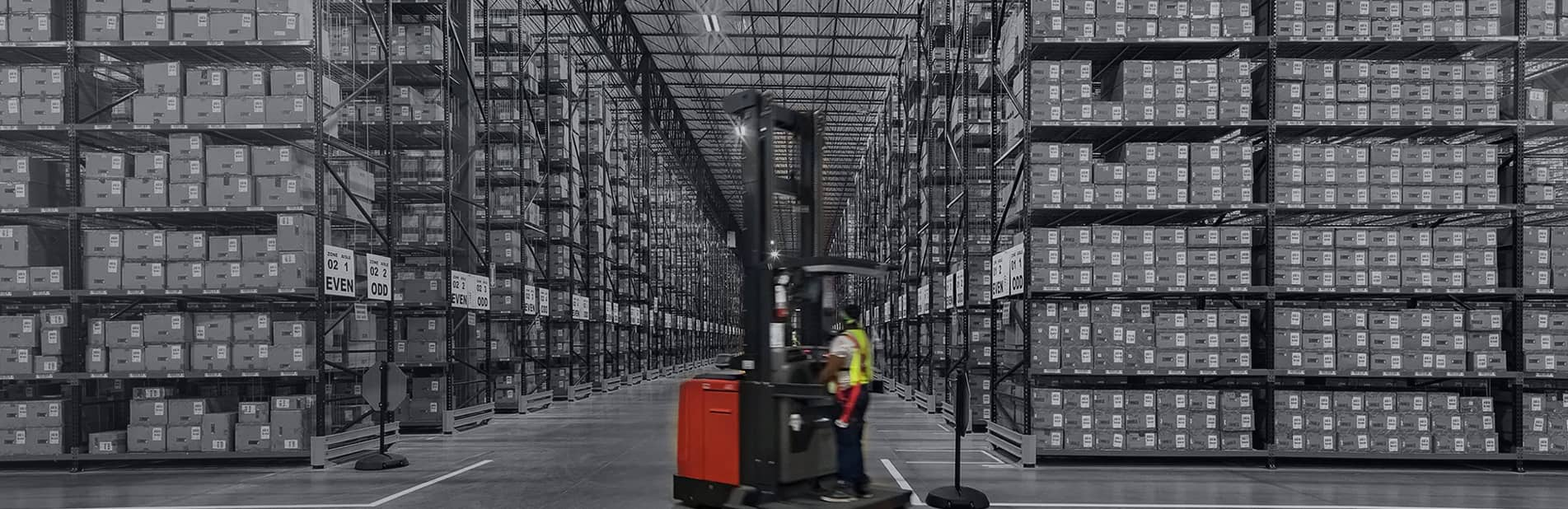
VNA Forklift Guide: How Very Narrow Aisle Forklifts Improve Warehouse Efficiency
Nov 11, 2026Warehouse space is becoming more valuable as manufacturers, distributors, and logistics companies handle more inventory within existing facilities. Expanding a warehouse is not always practical, so many operators are looking for ways to increase pallet storage capacity without increasing their building footprint.
A VNA forklift (Very Narrow Aisle forklift) is designed to solve this problem. By operating in specially designed narrow aisles and handling pallets at greater heights, VNA forklifts allow warehouses to make better use of both floor space and vertical storage areas. For operations with high inventory density and frequent pallet movements, this equipment can make a measurable difference in daily warehouse performance.
NEO FORKLIFT provides several VNA forklift configurations, including stand-on, seated, man-up three-way pallet stackers and electric articulated forklifts. With load capacities generally ranging from 1 to 2.5 tons and selected models reaching lifting heights of up to 14.2 meters, these solutions support different warehouse layouts and material handling requirements.
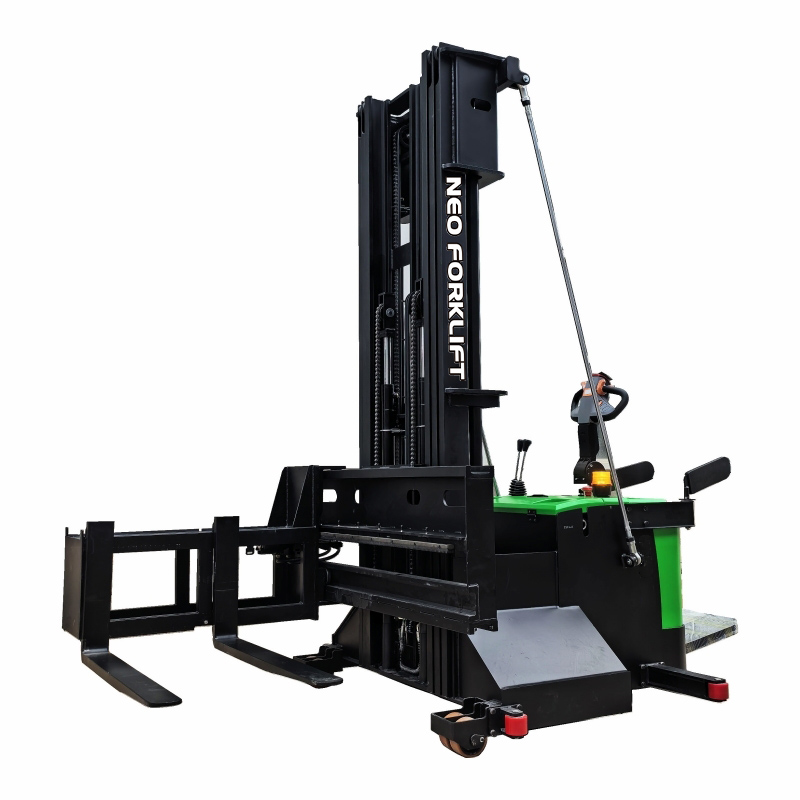
A VNA forklift is a specialized electric warehouse truck designed to store and retrieve palletized goods in very narrow aisles. VNA stands for Very Narrow Aisle, describing the compact working space in which these forklifts operate.
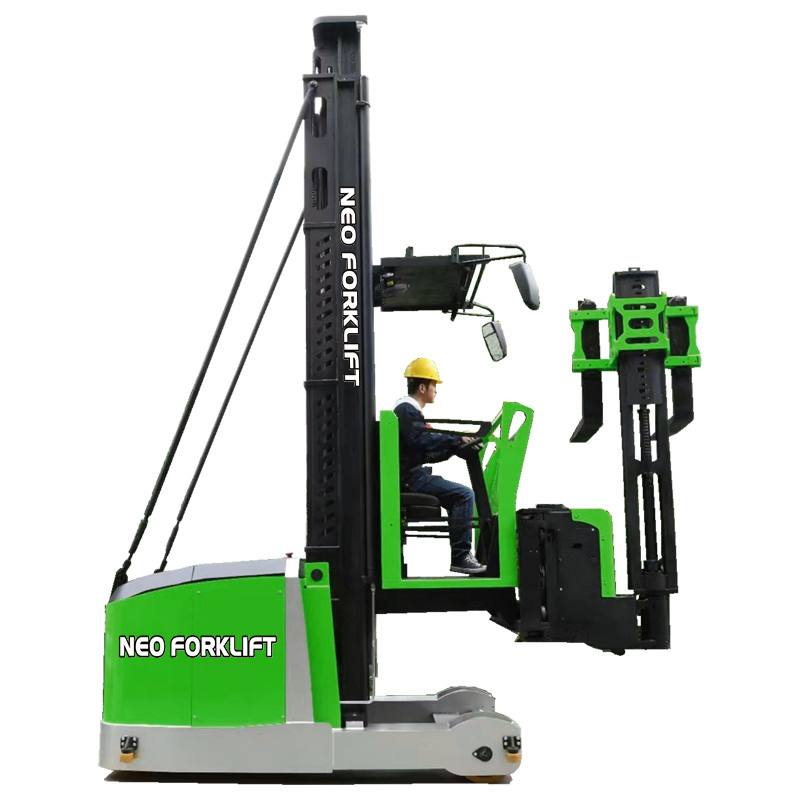
Unlike conventional counterbalance forklifts, many VNA trucks use a three-way fork mechanism. The forks can rotate 180 degrees and move sideways to pick up or place pallets on either side of the aisle. This allows the truck to handle loads without turning its entire body toward the storage rack.
Depending on the model and warehouse configuration, VNA forklifts can work in stacking aisles around 1.6 meters wide. The exact required aisle width must be confirmed using the truck's right-angle stacking dimensions, pallet size, load dimensions, and operating clearances.
In practical terms, a VNA forklift helps warehouse operators:
For businesses planning a high-density warehouse, a VNA forklift solution from NEO FORKLIFT provides several equipment configurations to consider according to aisle width, rack height, and handling requirements.
The main advantage of a VNA forklift is not simply that it can operate in a narrow aisle. Its real value comes from how it changes the relationship between storage space, pallet accessibility, and material handling operations.
In a conventional warehouse, wide forklift aisles take up a considerable amount of floor area. This space is necessary for turning and maneuvering, but it does not directly contribute to pallet storage.
VNA forklifts reduce the space required for stacking aisles. Warehouse planners can use the recovered floor area for additional pallet rack positions while maintaining access to stored goods.
The actual increase in storage capacity depends on the original warehouse layout, rack design, pallet dimensions, building columns, fire protection requirements, and aisle configuration. Rather than assuming a fixed percentage improvement, operators should compare the total number of usable pallet positions before and after redesigning the layout.
Floor space is only one part of warehouse capacity. The available building height is another important resource.
VNA forklifts are designed to handle pallets at elevated rack positions. Selected NEO FORKLIFT models offer lifting heights ranging from several meters to more than 10 meters, with the overall VNA product range reaching up to 14.2 meters depending on configuration.
Using higher storage racks can increase the number of pallet positions without expanding the warehouse footprint. However, buyers should always check residual load capacity at the required lifting height, mast deflection, load center, and floor conditions before selecting a truck.
Placing pallets on high racks requires controlled movement and accurate positioning. In a narrow aisle, unnecessary vehicle turning can increase operating difficulty and the risk of contacting rack structures.
A three-way VNA forklift addresses this challenge through its rotating and side-shifting fork assembly. Operators can retrieve or store pallets on either side of the aisle while the truck remains aligned with the aisle.
This working principle helps reduce unnecessary maneuvering and supports more consistent pallet handling, especially in warehouses with high rack systems and repetitive storage operations.
When storage locations are properly organized, VNA forklifts can support predictable put-away and retrieval routes. Operators spend less time dealing with unnecessary turning movements and can focus on moving pallets between designated storage locations.
For facilities handling frequent pallet movements, this can help improve workflow consistency. Actual throughput still depends on travel distance, lift height, operator experience, battery condition, picking methods, and warehouse management procedures.
Not every warehouse has the same rack height, aisle width, or operating schedule. Choosing the right VNA forklift therefore requires more than comparing lifting capacity. Operator position, working height, load frequency, and handling requirements also matter.
A stand-on VNA forklift is designed for operators who work from a standing platform. It combines the functionality of a three-way forklift with the compact design of an electric pallet stacker.
NEO FORKLIFT's stand-on three-way pallet stacker offers a rated load capacity of 1,000–1,500 kg and a lifting height of 3,000–6,000 mm. Its forks can move laterally, allowing pallet handling without turning the entire truck.
This configuration is suitable for warehouses that need compact equipment for repetitive stacking operations at moderate rack heights.
Typical applications: General warehousing, electronics, food distribution, hardware storage, and manufacturing facilities.
View NEO FORKLIFT Stand-On VNA Stacker
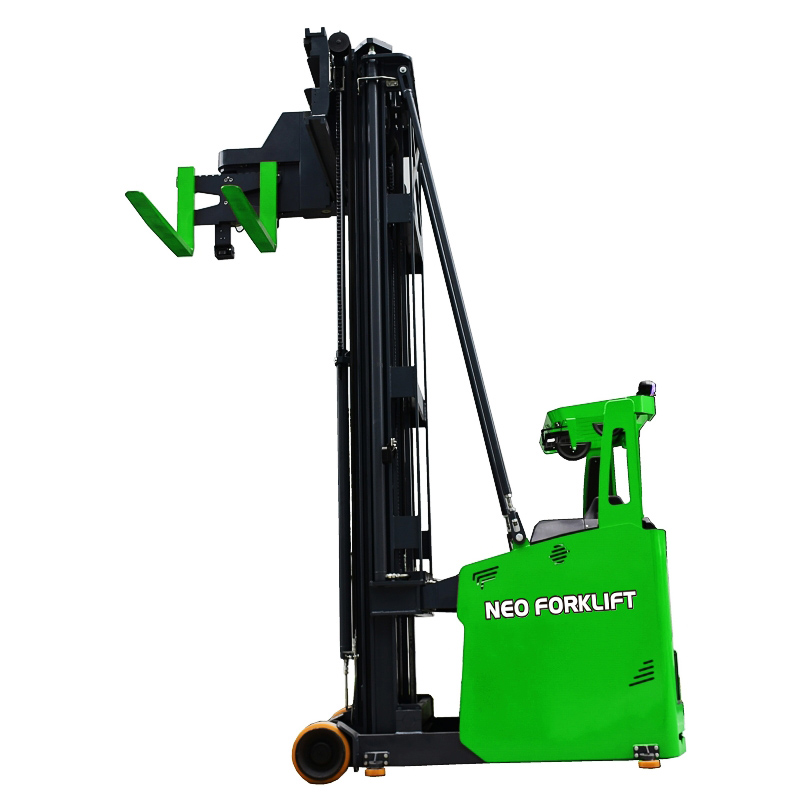
A seated VNA forklift allows the operator to work from a seated driving position. This configuration is worth considering for warehouses where operators perform frequent stacking and retrieval tasks throughout a shift.
The NEO FORKLIFT seated three-way pallet stacker has a rated capacity of 1,500 kg and lifting heights of approximately 4.5–10 meters. Its minimum stacking aisle width is specified at 1.6 meters under the applicable configuration. The forks can rotate 180 degrees and move sideways without requiring the vehicle body to turn.
This makes it a practical option for high-density warehouses that need to balance operator comfort, rack accessibility, and storage capacity.
Typical applications: Logistics centers, pharmaceutical warehouses, food storage, and low-temperature storage facilities.
View Seated Type Three-Way VNA Forklift
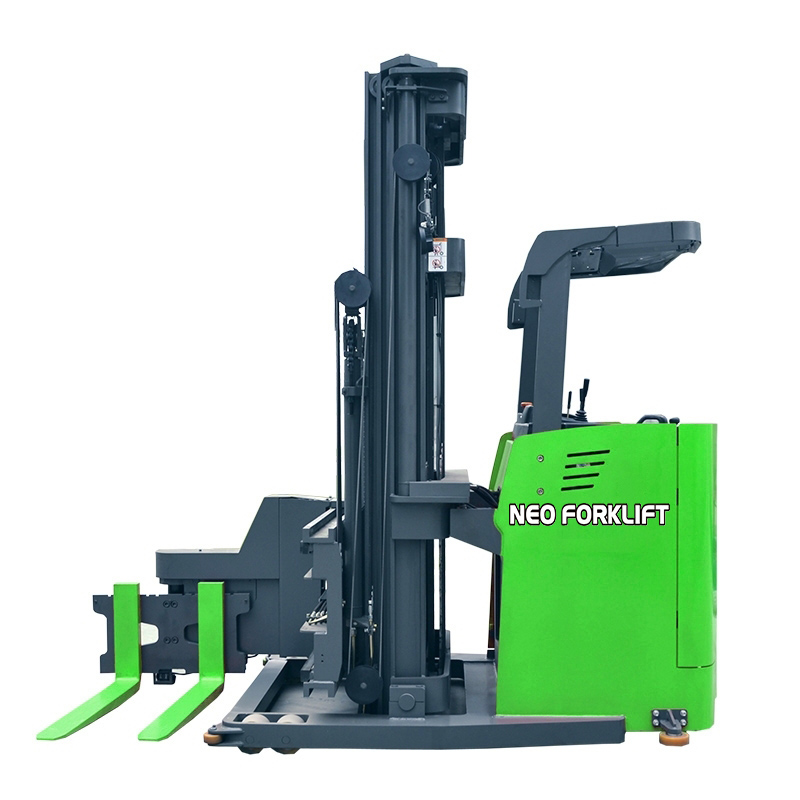
A man-up VNA forklift raises the operator together with the lifting platform, allowing the operator to work at the same elevated level as the pallet handling area.
This design is particularly useful when warehouse operations involve high-level order picking as well as pallet storage and retrieval. The elevated operator position provides a closer view of the load and rack location, supporting more precise handling.
NEO FORKLIFT's man-up VNA pallet stacker has a maximum rated capacity of 1,500 kg, with a main lifting height of up to 9,000 mm and an auxiliary lifting height of 1,500 mm.
Typical applications: High-bay warehouses, distribution centers, and facilities that combine pallet storage with elevated order picking.
View Man-Up VNA Turret Stacker
An electric articulated forklift uses an articulated steering design to maneuver in narrow warehouse aisles. Unlike a conventional three-way turret truck, it does not rely on the same fork rotation mechanism.
The NEO FORKLIFT NVJ series offers load capacities from 1.5 to 2.5 tons and a maximum lifting height of up to 12.5 meters. Its articulated design and electric drive system make it suitable for operations that require both narrow-aisle maneuverability and flexible pallet handling.
Typical applications: Logistics warehouses, food distribution, cold storage, and facilities handling medium to heavy palletized loads.
The following table summarizes the main specifications of selected NEO FORKLIFT VNA models. These figures provide an initial reference for equipment selection. Final specifications should always be confirmed against the individual model and configuration.
| VNA Forklift Type | Rated Capacity | Lifting Height | Main Application |
|---|---|---|---|
| Stand-On VNA | 1,000–1,500 kg | 3–6 m | Medium-height narrow aisle stacking |
| Seated VNA | 1,500 kg | 4.5–10 m | High-density pallet storage |
| Man-Up VNA | Up to 1,500 kg | Main lift up to 9 m | High-level storage and picking |
| Electric Articulated | 1,500–2,500 kg | Up to 12.5 m | Narrow aisle and medium-duty handling |
When comparing VNA forklift specifications, rated capacity alone is not enough. A truck rated for 1,500 kg at a specified load center may have a lower allowable capacity when lifting to maximum height or handling a load with a different center of gravity.
Buyers should request the manufacturer's load chart and confirm the required capacity at the actual working height.
VNA forklifts and reach trucks are both designed for warehouse operations where space utilization is important. However, they serve different aisle configurations and material handling requirements.
A reach truck generally offers greater flexibility for moving between storage aisles, staging areas, and loading zones. A VNA forklift is more specialized for warehouses with dedicated very narrow aisles and high-density rack systems.
| Comparison | VNA Forklift | Reach Truck |
|---|---|---|
| Aisle requirements | Very narrow dedicated aisles | Standard narrow aisles |
| Fork operation | Three-way rotating or side-shifting forks on turret models | Forward-reaching mast or fork carriage |
| Storage density | Well suited to high-density storage | Suitable for conventional narrow-aisle storage |
| Operating flexibility | Best in dedicated VNA aisles | More flexible between warehouse areas |
| Warehouse layout | Requires careful aisle and guidance planning | Generally easier to integrate into existing layouts |
| Best suited for | High-density, high-bay warehouses | General narrow-aisle warehouse operations |
For warehouses where maximum pallet density is the priority, VNA equipment is often worth evaluating first. If the operation requires frequent movement between different work areas or the existing building cannot accommodate a dedicated VNA layout, a reach truck may be the more practical option.
Explore the NEO FORKLIFT reach truck range to compare alternative narrow-aisle handling equipment.
VNA forklifts are particularly useful in industries where inventory density, storage organization, and frequent pallet movement are important operational requirements.
Logistics providers often manage inventory for multiple customers, with different product sizes and storage requirements. VNA forklifts help make better use of rack space while maintaining access to individual pallet locations.
Pharmaceutical warehouses need organized storage locations, accurate inventory control, and reliable handling procedures. VNA forklifts can support high-density pallet storage while helping operators maintain structured put-away and retrieval processes.
Cold storage facilities often face high building and operating costs. Maximizing available storage volume is therefore an important consideration. VNA forklifts can help reduce unnecessary aisle space and support organized storage in temperature-controlled environments.
Equipment intended for freezer applications should be configured with suitable batteries, hydraulic oils, seals, tires, and electrical components for the actual operating temperature.
Electronics manufacturers and industrial suppliers frequently store large quantities of palletized components, finished products, and production materials. A VNA storage system can help improve inventory organization while making efficient use of limited warehouse floor space.
Selecting the right VNA forklift requires an understanding of the warehouse environment, not just the advertised equipment specifications. Before requesting a quotation, warehouse managers should evaluate the following factors.
Warehouse layout and forklift selection should be planned together. A truck that meets the required lifting height may still be unsuitable if the aisle width, turning area, pallet dimensions, or floor conditions are not compatible.
For facilities with non-standard storage requirements, NEO FORKLIFT also provides custom forklift solutions to help evaluate equipment configurations for specific material handling applications.
Before investing in a VNA forklift, it is useful to compare the current warehouse layout with a proposed narrow-aisle arrangement. A simple assessment can help identify whether the investment is likely to deliver meaningful operational benefits.
Start by recording the current number of usable pallet positions. Then prepare a proposed layout that includes VNA aisle widths, rack dimensions, turning areas, staging zones, emergency access, and required clearances.
The potential change in storage capacity can be calculated using the following formula:
Storage Capacity Improvement (%)
[(New Pallet Positions - Existing Pallet Positions) ÷ Existing Pallet Positions] × 100
For example, if a warehouse increases its usable pallet positions from 1,000 to 1,200 after a layout redesign, the storage capacity improvement is 20%.
This is an illustrative calculation, not a guaranteed result of installing a VNA forklift. The actual outcome depends on the warehouse dimensions, rack arrangement, safety clearances, and equipment configuration.
It is also worth tracking operational indicators such as pallets moved per hour, average retrieval time, rack damage incidents, equipment utilization, and energy consumption. These measurements provide a more complete picture of warehouse efficiency than storage capacity alone.
Choosing a VNA forklift supplier involves more than finding a machine with the right rated capacity. Equipment compatibility, technical support, customization, and long-term service are also important considerations.
NEO FORKLIFT, operated by Shanghai Zon-Cho Huge Science and Technology Co., Ltd., has more than 20 years of experience in electric material handling equipment. Its product range includes VNA forklifts, electric reach trucks, pallet stackers, counterbalance forklifts, and other warehouse handling equipment.
For VNA applications, NEO FORKLIFT offers several configurations to accommodate different operating requirements:
Customers can discuss warehouse dimensions, load requirements, lifting heights, and operating conditions with the NEO FORKLIFT team before selecting a suitable configuration.
To discuss a suitable warehouse handling solution, visit the NEO FORKLIFT contact page and share your operating requirements.
VNA stands for Very Narrow Aisle. A VNA forklift is a specialized warehouse truck designed to store and retrieve pallets in very narrow aisles, helping warehouses increase storage density and use available floor space more efficiently.
Some VNA three-way pallet stackers from NEO FORKLIFT specify a minimum stacking aisle width of 1.6 meters. The actual requirement depends on the truck model, pallet dimensions, load size, rack design, and operating clearances. Always confirm the required aisle width using the manufacturer's specifications.
VNA forklift lifting heights vary by model. NEO FORKLIFT offers models with lifting heights of 3–6 meters, 4.5–10 meters, and other configurations. The wider product range includes selected equipment with maximum lifting heights of up to 14.2 meters.
NEO FORKLIFT's VNA forklift range generally covers rated capacities from 1,000 kg to 2,500 kg, depending on the model. Buyers should check the rated load chart at the required lifting height and load center before making a purchasing decision.
A VNA forklift is designed for dedicated very narrow aisles and may use a three-way rotating fork mechanism to handle pallets without turning the vehicle body. A reach truck uses a forward-reaching mast or fork carriage and generally operates in wider narrow aisles. VNA trucks are particularly suitable for high-density storage, while reach trucks offer greater flexibility for general warehouse operations.
Yes. VNA forklifts can be used in cold storage facilities where narrow aisles and high-density pallet storage help maximize available space. However, the forklift must be configured for the specified working temperature, including suitable battery, hydraulic, electrical, and material components.
Yes. High-level narrow-aisle operations require suitable floor flatness, levelness, and load-bearing capacity. Floor conditions are particularly important when lifting heavy pallets to significant heights. A warehouse floor assessment should be completed before installing a VNA system.
VNA forklifts can be a worthwhile investment for warehouses where storage density is a major priority and the existing building has sufficient height and suitable floor conditions. The decision should consider additional pallet positions, equipment costs, rack modifications, guidance systems, maintenance, and expected material handling volume.
Improving warehouse efficiency starts with understanding how space is used and where material handling operations can be improved. VNA forklifts provide a practical solution for businesses that need higher storage density, narrower aisles, and reliable pallet handling at elevated rack positions.
Whether your operation requires a stand-on VNA stacker, seated three-way pallet stacker, man-up turret forklift, or electric articulated forklift, selecting the right configuration is essential for long-term performance.
NEO FORKLIFT offers a range of warehouse handling equipment for different storage layouts and load requirements. Contact the team to discuss your warehouse dimensions, rack height, pallet weight, and expected handling volume.
Add:No.609 Tahui Road , Shihudang Town, Songjiang District ,Shanghai, China


Friendly Links :
© 2026 Shanghai Zon-Cho Huge Science And Technology Co., Ltd. All Rights Reserved.
|Sitemap|Xml |Privacy Policy




