Diesel Forklift vs Electric Forklift: How to Choose the Right Solution
Oct 19, 2026
No universally "best" forklift exists. The right choice depends on where and how you use it. Evaluate your application, load size, operating hours, budget, and emission rules. A structured Diesel Forklift VS Electric Forklift comparison then leads you to a confident purchase or rental decision.
Choose electric forklifts for indoor warehouses and cold storage. They produce zero emissions, run quietly, and lower maintenance costs.
Choose diesel forklifts for outdoor rough terrain and heavy loads. They deliver superior torque and fast refueling for demanding jobs.
Compare total ownership costs, not just purchase prices. Electric models often save thousands over time despite higher upfront costs.
Your operating environment decides the winner. Indoor warehouse work favors electric. Outdoor construction, rough terrain, and heavy loads demand diesel. Use this quick Diesel Forklift VS Electric Forklift breakdown to match the machine to your daily reality.
Electric forklifts excel indoors. They produce zero tailpipe emissions, so you protect indoor air quality without costly ventilation systems. They also run quietly, reducing noise fatigue for your team during long shifts. Compact frames and tight turning radius let you navigate narrow warehouse aisles and crowded floor spaces with ease.
Electric models contain fewer moving parts than internal-combustion trucks. Fewer parts mean less routine service and fewer engine-related maintenance interruptions. Electricity costs less than diesel fuel, so daily operating expenses drop. Choose electric for indoor facilities running one or two shifts. You avoid noise, fuel handling, and frequent maintenance stops.
Diesel forklifts rule outdoor environments. Open-air settings safely disperse exhaust fumes, so emissions never threaten your workers. Rough terrain, loose gravel, dirt, and steep slopes do not trouble these machines. Their larger frames and higher ground clearance deliver stability that electric models cannot replicate.
Diesel also provides superior power. Higher torque and faster acceleration allow you to move bigger, heavier loads and tow trailers. Typical lift capacity exceeds the 3,000–6,000-pound range common on electric trucks. Construction sites, shipping yards, farmland, and container-loading operations need this muscle. Diesel remains the reliable choice for outdoor work with oversized loads.
Electric forklifts draw power from large industrial batteries. You recharge these batteries overnight or during shift changes. The motor drives the lift and travel functions without any combustion. This design eliminates exhaust fumes and cuts noise dramatically.
Battery voltage determines your truck's power. Higher voltage delivers faster lift and travel speeds. Ampere-hour capacity controls runtime before you need a recharge. A forklift drawing 50 amps for 8 hours requires a 400 Ah battery. With a 48V battery, this equals 19,200 watt-hours.
|
Specification |
Typical Values |
|---|---|
|
Battery voltage |
24V, 36V, 48V, 72V, 80V |
|
Ampere-hour capacity |
100 Ah (walkie jack), 300 Ah (rider pallet truck), 600 Ah (lead-acid), 750 Ah (counterbalance) |
|
Counterbalance load capacity |
1,000–5,000 kg |
|
Pallet jack load capacity |
Up to 2,500 kg |
You will find electric forklifts across many industries. Warehousing and distribution centers use them for loading, stacking, and transporting goods indoors. Manufacturing facilities rely on them to move raw materials and finished products. Retail operations benefit from their maneuverability in crowded aisles. The food and beverage industry values their clean operation in processing plants and cold storage. Pharmaceutical facilities need their quiet, emission-free performance for sterile environments. Ports and shipping terminals also deploy electric models for container handling and pallet movement.
Diesel forklifts run on an internal combustion engine. The engine burns diesel fuel to generate power for lifting and travel. This design delivers high torque at low engine speeds. You get strong acceleration and reliable performance under heavy loads.
Engine displacement typically ranges from 2.0 to 4.5 liters for units with 5,000–15,000 lb capacity. A well-designed diesel engine delivers at least 80% of peak torque at 1,200 RPM. Torque density reaches at least 200 Nm per liter of displacement at that same engine speed. An 8,000 lb unit produces at least 300 Nm at 1,400 RPM.
|
Specification Category |
Typical Value / Requirement |
|---|---|
|
Engine displacement |
2.0–4.5 liters (for 5,000–15,000 lb capacity units) |
|
Low-RPM torque requirement |
80% of peak torque available at 1,200 RPM |
|
Minimum torque density |
At least 200 Nm per liter of displacement at 1,200 RPM |
|
Torque for demanding duty |
At least 300 Nm at 1,400 RPM (for an 8,000 lb unit) |
|
Rated load capacity |
8,000 lb at 500 mm load center |
|
Capacity derating |
8–10% decrease per 100 mm increase in load center beyond 500 mm |
Diesel or gas forklift types are popular in outdoor applications, while electric models are popular indoors.
You will find diesel forklifts across many demanding industries:
Construction sites: diesel forklifts lift construction materials and equipment, especially on rough terrain.
Lumberyards and logging/forestry: they move logs and other forestry products.
Agriculture: farms and agricultural facilities use them for handling hay bales, pallets of produce, and other heavy loads.
Large warehouses: they are commonly used where heavy loads need to be moved efficiently.
Ports and terminals: they load and unload cargo containers because of their high lifting capacity.
You need a clear picture of how these two machine types stack up against each other. This Diesel Forklift VS Electric Forklift comparison breaks down the critical differences across power delivery, operating costs, emissions, noise levels, capacity, and maintenance demands. Each factor carries different weight depending on your specific operation.
Power delivery separates these two forklift types at the most fundamental level. Diesel engines generate high torque at low RPM, which gives you strong acceleration and reliable performance under heavy loads. Electric motors deliver instant torque, but peak power output remains lower than diesel counterparts. You get smooth, consistent power for lighter indoor tasks.
Cost structures differ significantly between the two. Diesel forklifts carry a lower upfront purchase price for equivalent capacity. Electric models cost more initially because of the battery and charging infrastructure. That upfront gap narrows over time through lower energy costs and reduced maintenance expenses.
Emissions represent the sharpest divide. Electric forklifts produce zero point-of-use emissions, making them the safest indoor option. Diesel forklifts emit nitrogen oxides (NOx) at 400–1,200 ppm per hour of operation and particulate matter (PM2.5) at 0.2–0.5 g/kWh. These levels far exceed OSHA permissible exposure limits. Diesel emissions pose serious health risks including respiratory irritation, chronic lung damage, and lung cancer.
|
Pollutant |
Typical Emission Rate (Diesel Forklift) |
OSHA PEL (8-hr) |
Health Effect |
|---|---|---|---|
|
Nitrogen Oxides (NOx) |
400 – 1,200 ppm per hour of operation |
25 ppm |
Respiratory irritation, chronic lung damage |
|
Particulate Matter (PM2.5) |
0.2 – 0.5 g/kWh |
5 mg/m³ (respirable) |
Lung cancer (IARC Group 1 carcinogen) |
You must factor emission regulations into your decision. Indoor operations face strict air quality rules. Outdoor operations in open air disperse exhaust fumes safely. Your operating environment determines whether diesel emissions create a compliance problem.
Noise levels affect worker comfort and safety. Diesel forklifts run at 85–95 dB under load because of their internal combustion engines. That knocking sound creates fatigue during long shifts. Electric forklifts produce only 60–70 dB with lead-acid batteries. Lithium battery models can drop below 60 dB. The smooth, low-frequency hum of an electric motor suits noise-sensitive environments.
Indoor and outdoor suitability follows directly from emissions and design. Electric forklifts work best on smooth, level indoor surfaces. Their compact design and tight turning radius improve warehouse maneuverability. Zero direct emissions satisfy enclosed-space air-quality requirements. Diesel forklifts perform stronger outdoors on uneven, muddy, or gravel terrain. They handle steep grades and rough conditions with ease. Indoor use requires costly ventilation systems to manage exhaust.
Maximum load capacity has traditionally favored diesel. Gas-powered models can lift up to 8,000 lb or more and lift heavy loads faster. Electric models typically handle around 3,000–4,000 lb, enough for most warehouse work. Many current electric models now match diesel in the 2,000–5,000 kg warehouse range. The capacity gap has narrowed considerably.
|
Metric |
Diesel |
Electric |
|---|---|---|
|
Average decibel output |
Often 85–95 dB under load |
Typically 65–70 dB |
|
Indoor vs outdoor suitability |
Stronger outdoors on uneven, muddy, or gravel terrain; needs ventilation indoors |
Best on smooth, level indoor surfaces; zero direct emissions satisfy enclosed-space air-quality requirements |
|
Maximum load capacity |
Traditionally higher raw lifting capacity and speed in heavy-duty models |
Many current models match diesel in the 2,000–5,000 kg warehouse range; the gap has narrowed |
Maintenance requirements differ dramatically between diesel and electric forklifts. Electric forklifts cost less to maintain than diesel or LP forklifts, which is one of the reasons they outsell those alternatives. They still have wearable parts (tires, brakes, chains, forks, hoses) that need periodic inspection and replacement. Planned maintenance for electric forklifts works like a thorough safety check every 90 days. A factory-trained technician inspects safety features (chains, electrical system, lights), accessories and attachments, and confirms proper battery maintenance by operators. Electric forklift maintenance also includes checking the motor and cables (which can loosen from vibration and cause thousands of dollars in damage), lubricating moving parts, and documenting service for OSHA compliance and resale value. When you calculate downtime costs, planned maintenance proves very cost-effective because it avoids budget-busting repairs and allows scheduling service at convenient times.
Diesel forklifts demand more frequent attention. Engine oil and oil filter changes come every 500 hours. Hydraulic oil, engine oil, transmission oil, and filters need replacement every 1,000 hours. Belt replacement adds another recurring task. The maintenance cycle for diesel runs up to 500 working hours. Electric forklifts stretch that cycle to 1,000+ working hours, which is 2–3 times longer than diesel. Major service for electric models (hydraulic oil, gear oil, filter change) occurs every 2,000–3,000 hours. Diesel major service happens every 1,000 hours plus engine oil, transmission oil, filters, and belts.
|
Maintenance Aspect |
Electric Forklift |
Diesel Forklift |
|---|---|---|
|
Typical maintenance cycle |
1,000+ working hours |
Up to 500 working hours |
|
Maintenance cycle comparison |
2–3 times longer than diesel |
Baseline |
|
Major service (hydraulic oil, gear oil, filter change) |
Every 2,000–3,000 hours |
Every 1,000 hours (plus engine oil, transmission oil, filters, belt) |
|
Routine maintenance content |
Lubrication of joints (gantry bearings, steering axles), inspection and cleaning |
Engine oil and oil filter every 500 hours; hydraulic oil, engine oil, transmission oil and filters every 1,000 hours; belt replacement |
|
Downtime impact |
Downtime greatly shortened due to longer intervals and shorter service time |
Higher downtime due to more frequent and longer maintenance |
Downtime hits your bottom line hard. Diesel forklifts spend more time in the shop because of frequent and longer maintenance. Electric forklifts shorten downtime through longer intervals and shorter service time. You keep more machines running and fewer on the sidelines.
You face two main battery choices for electric forklifts: lead-acid and lithium-ion. Each option changes how you charge, maintain, and budget for your fleet.
|
Feature |
Lead-Acid |
Lithium-Ion (LFP) |
|---|---|---|
|
Charging Time |
8 hours charge + 8 hours cool-down |
1–2 hours, no cool-down |
|
Cycle Life |
1,000–1,500 cycles |
3,000+ cycles |
|
Daily Maintenance |
Watering, cleaning, equalizing |
None; sealed cells |
Lead-acid batteries demand daily attention. You water every cell, clean corrosive residue, and perform weekly equalization charges. The 8+8 problem makes a lead-acid battery unavailable for 16 hours after use. Multi-shift operations must buy two or three batteries per forklift. These batteries also release flammable hydrogen gas during charging, which requires a dedicated ventilated room by law.
Lithium-ion batteries eliminate these burdens. They recharge three times faster, need no cool-down, and support opportunity charging during breaks. You reclaim valuable warehouse space because no battery room is needed. Lithium-ion packs last 5–7 years, which is two to three times longer than lead-acid. The purchase price runs three to four times higher, but the battery typically pays for itself within three to five years through reduced downtime, lower energy bills, and longer lifespan.
Electric forklifts shine in indoor environments. They produce zero tailpipe emissions, run quietly, and require less routine maintenance than diesel models. Cold storage facilities prefer them for clean, air-sensitive operations. With cold-rated components, they handle deep-freeze work effectively.
Performance limitations appear in heavy-duty outdoor applications. Battery runtime drops in cold temperatures, and charging becomes more complicated. Recharging can interrupt continuous operations. This is where the Diesel Forklift VS Electric Forklift debate becomes critical for your operation. Electric models generally cost more upfront but deliver better long-term ROI in indoor and light-duty use. Heavy-duty outdoor tasks often demand diesel power instead.
Diesel forklifts refuel in minutes. You pull up to a fuel tank, fill the tank, and return to work. This quick turnaround keeps your operation moving without long pauses. Minimal infrastructure supports this process. You need fuel storage and safe fueling procedures, nothing more.
Electric models demand far more time. A full charge takes eight hours, plus cool-down time. Battery swaps help, but they require extra batteries and swap systems. For continuous 24/7 cycles, diesel minimizes downtime compared to battery charging constraints. This advantage matters when every minute of uptime counts.
Diesel refuels in minutes, while electric models require charging or battery swaps.
|
Metric |
Electric Forklift |
LP Forklift |
|---|---|---|
|
Runtime per fill/charge |
1 shift (6–8 hrs) |
1 shift (LP tank swap = 5 min) |
|
Refuel/recharge time |
8 hours (charge + cool) |
5 minutes (tank swap) |
Diesel forklifts deliver strong torque for heavy loads and outdoor tasks. They handle rough terrain, extreme temperatures, and intense duty cycles with ease. Quick refueling suits operations without charging facilities. These strengths make diesel a reliable choice for construction sites, lumberyards, and ports.
Diesel also carries real drawbacks. Exhaust emissions run high, so indoor use requires strong ventilation and compliance with OSHA CO exposure limits. Noise levels reach 85–90 dB, similar to a lawn mower. This noise harms operator comfort and makes communication difficult. Maintenance and operating costs run high, with fuel consumption at 1.5–2 gallons per hour. The Diesel Forklift VS Electric Forklift comparison often favors electric for indoor, regulated facilities. Diesel remains a poor fit for enclosed spaces because of ventilation and air-quality costs.
Your decision comes down to five variables: operating environment, load size, shift length, energy access, and long-term budget. These variables form the core of the Diesel Forklift VS Electric Forklift comparison. Use the table below to judge your site against the strengths of each machine.
|
Evaluation Criterion |
Electric Forklift |
Diesel Forklift |
|---|---|---|
|
Primary operating environment |
Indoor warehouses, cold storage, enclosed spaces |
Outdoor yards, rough terrain, open sites |
|
Emissions & noise |
Zero tailpipe emissions; low noise |
Exhaust emissions (needs ventilation); high noise |
|
Upfront investment |
Higher (battery + charging setup) |
Lower initial capital cost |
|
Operating/fuel cost |
Lower electricity cost per hour |
Subject to diesel price fluctuations; high fuel use |
|
Maintenance |
Fewer moving parts; no engine oil/plugs/filters |
Regular engine servicing required |
|
Refueling/recharging |
Plug-in or opportunity charging during breaks |
Fast refueling at on-site tanks/stations |
The following scenarios translate these criteria into practical guidance for the three most common operating setups.
Electric forklifts fit warehouses, distribution centers, and cold storage facilities. They produce zero tailpipe emissions, so you protect indoor air quality without installing ventilation systems. Their low noise levels reduce operator fatigue during long shifts. They also execute stop-start pallet movement efficiently, which matches typical warehouse duty cycles.
Electric remains the stronger starting point when your operation matches these conditions:
Work happens mainly indoors
Local exhaust emissions must be eliminated
Stop-start pallet handling dominates
Charging windows or opportunity charging are available
Lower noise and heat improve the workplace
Electric often yields lower lifetime costs for indoor operations despite the higher battery investment. You avoid diesel fuel storage on site and cut daily energy expenses. A single-shift warehouse with planned break charging runs the entire day without a battery swap.
Diesel forklifts handle the punishment of construction sites, lumberyards, and shipping yards. They pull heavy loads across gravel, mud, and steep grades. The internal combustion engine delivers high torque at low engine speeds, giving you the muscle to move pallets of brick, steel, and timber. Fast refueling keeps the machine running around the clock. Sites without charging infrastructure make diesel the practical choice.
Diesel remains relevant when work stays outdoors on prepared yard surfaces, when utilization is sustained and charging windows are difficult, when rapid refueling is essential for throughput, when the site cannot support the required electrical infrastructure, or when the needed capacity is not available in a suitable electric model. On-site diesel tanks simplify operations. The machine also tolerates extreme temperatures without the battery degradation electric models face in the same conditions.
Ask these practical questions before committing to a model. Does each unit retain enough capacity at the required lift height? Can it travel safely on the actual surface and gradients? Can the energy system support the peak shift with reserve? What happens if a charger, fuel delivery, or truck becomes unavailable? The answers reveal which machine avoids costly downtime.
Load capacity often decides the winner. Diesel forklifts typically handle 5,000–30,000 lbs. Electric counterbalance models cover 3,000–8,000 lbs. Routine lifts above 8,000 lbs demand diesel's headroom. The higher torque also moves those loads faster across long distances.
Diesel forklifts are typically designed for heavy-duty outdoor operations and often have higher lifting capacities. Electric forklifts, on the other hand, dominate indoor warehouses due to their clean operation and lower maintenance requirements.
That general rule has exceptions. Modern electric forklifts can lift similar loads as many diesel forklifts, especially in the 3–8 ton capacity range used in warehouses. A 5,000 lb electric model may outperform a smaller diesel truck when you factor in lower energy costs and longer maintenance intervals. Match capacity to your actual load profile, not just the maximum number on the spec sheet.
You pay more for an electric forklift at purchase. A 1.5–2.5 tonne electric model costs USD 18,000–40,000. A comparable diesel unit runs USD 15,000–30,000. For 3–5 tonne capacity, electric prices reach USD 35,000–70,000+. Diesel models cost USD 25,000–50,000. That upfront gap often reaches 15%–25%.
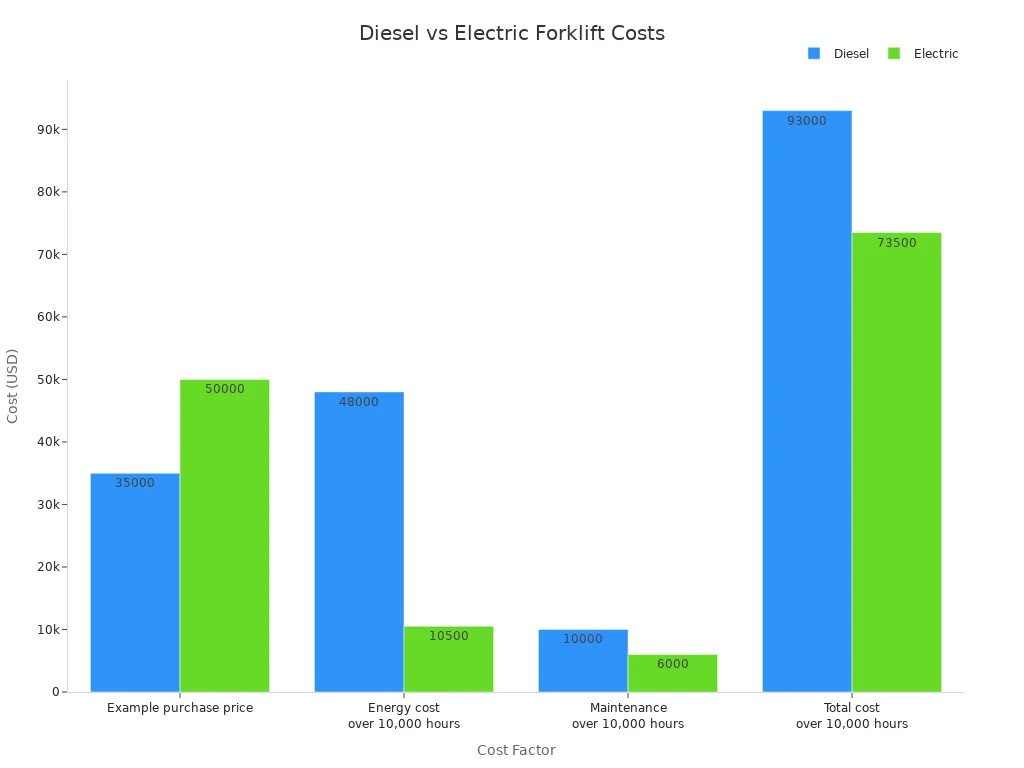
Long-term savings flip the equation. Consider a diesel forklift at USD 35,000 and an electric model at USD 50,000. Over 10,000 operating hours, diesel energy costs hit USD 48,000. Electric energy costs total only USD 10,500. Diesel maintenance reaches USD 10,000. Electric maintenance runs USD 6,000. Battery depreciation adds USD 7,000 for electric. Total diesel cost: USD 93,000. Total electric cost: USD 73,500. The electric forklift saves USD 19,500 despite the higher sticker price.
Energy costs separate these machines dramatically. Diesel fuel costs USD 2.80–3.50 per hour. Electric charging costs only USD 0.30–0.50 per hour. An average electric forklift draws about 4 kW to recharge for each operating hour. At roughly USD 0.10 per kWh, electricity costs about USD 0.40 per hour. Diesel runs roughly 10 times higher.
Maintenance costs per operating hour also favor electric. Diesel averages about USD 2.00 per hour. Electric averages about USD 1.25 per hour. For a forklift used 1,500–2,000+ hours per year, the higher electric purchase price pays back in 18–24 months. Lower energy and maintenance costs then accumulate over the rest of the ownership period. This Diesel Forklift VS Electric Forklift cost analysis shows electric delivering stronger lifetime value for most indoor operations.
You must follow federal rules when you operate diesel forklifts. OSHA enforces several standards that apply directly to your indoor warehouse operations.
|
Agency |
Standard |
Application to Indoor Diesel Forklifts |
|---|---|---|
|
OSHA |
29 CFR 1910.178 |
Powered industrial truck standard covers forklift operation, including diesel-powered units in warehouses. |
|
OSHA |
29 CFR 1910.1000 |
Air contaminants standard limits employee exposure to diesel exhaust components in general industry workplaces. |
|
OSHA |
29 CFR 1910.1200 |
Hazard communication standard requires information and training on diesel exhaust component hazards. |
The EPA also sets federal off-road diesel engine emission limits through Tier 4 standards. These rules require about a 90% reduction in particulate matter and nitrogen oxides compared with earlier tiers. Manufacturers must use advanced technologies such as diesel particulate filters, selective catalytic reduction, and diesel exhaust fluid to meet the limits.
Diesel forklift indoor use depends on adequate ventilation to remove exhaust fumes and maintain safe air quality. You face real hazards when cold weather forces doors and windows closed. Follow these safety practices:
Do not run diesel engines for extended periods in confined areas such as truck trailers.
Shut off the engine when you remain inside a small confined area.
Do not operate a combustion engine in a warehouse without adequate ventilation.
Use extra caution in cold weather and small rooms where gases may accumulate.
Install CO monitors to detect carbon monoxide levels.
Train employees to recognize the warning signs of excessive carbon monoxide exposure.
Ventilation methods include general ventilation using fans and exhaust systems, plus local exhaust ventilation that captures fumes at the source. Larger, well-ventilated areas with high ceilings generally provide better conditions. This Diesel Forklift VS Electric Forklift consideration matters most in poorly ventilated spaces. Consider switching to battery-powered forklifts if much work happens in confined areas.
Lithium-ion technology continues to reshape the Diesel Forklift VS Electric Forklift landscape. These batteries weigh about 30% less than lead-acid counterparts. You gain greater payload capacity and improved maneuverability in tight warehouse spaces. Modern lithium-ion batteries withstand over 2,000 charging cycles, which is three to five times more than lead-acid options. Charging takes as little as one hour.
|
Innovation |
Key Features |
Expected Benefits |
|---|---|---|
|
High-Energy Density Cells |
Advanced cell chemistry |
Longer run times |
|
Rapid Charging Technology |
Reduced downtime |
Increased efficiency |
|
Battery Management Systems |
Real-time monitoring |
Enhanced safety |
|
Thermal Management Solutions |
Battery cooling |
Overheating prevention |
|
Modular Battery Design |
Flexible configurations |
Scalability |
The global lithium-ion forklift battery market will reach approximately $3.5 billion by 2026, growing over 18% annually. Smart battery solutions enable up to a 20% productivity increase through reduced operational disruptions.
Hydrogen fuel cells represent another promising trend. These systems refuel in minutes and deliver consistent power throughout the entire shift. Battery-electric forklifts lose lift speed as charge declines. Hydrogen fuel cells maintain full performance until refueling.
|
Attribute |
Hydrogen Fuel-Cell |
Battery-Electric |
|---|---|---|
|
Refueling Time |
Minutes |
Hours |
|
Power Delivery |
Consistent |
Declines with charge |
|
Cold Storage |
Operates at -22°F |
More affected by cold |
The fuel-cell market reached roughly $6 billion in 2025 and will grow to $16.6 billion by 2030. High hydrogen production costs and limited refueling infrastructure remain key barriers. High-utilization, multi-shift operations benefit most from this technology.
You now hold the core criteria for your decision: application, environment, load, hours, and budget. The Diesel Forklift VS Electric Forklift choice has no single answer. The right solution matches your specific operation. Consult a supplier for a site evaluation or a side-by-side demo before you buy or rent.
You can, but you need strong ventilation and CO monitors. Diesel exhaust poses health risks in enclosed spaces. Electric models suit indoor work far better.
Lead-acid batteries last 1,000–1,500 cycles. Lithium-ion packs reach 3,000+ cycles. You get 5–7 years from lithium-ion with proper care.
Electric forklifts cost less. They have fewer moving parts and no engine oil changes. You service them every 1,000+ hours instead of 500.
Add:No.609 Tahui Road , Shihudang Town, Songjiang District ,Shanghai, China


Friendly Links :
© 2026 Shanghai Zon-Cho Huge Science And Technology Co., Ltd. All Rights Reserved.
|Sitemap|Xml |Privacy Policy




