
VNA Forklift Buying Guide: How to Maximize Warehouse Storage Space
Oct 27, 2026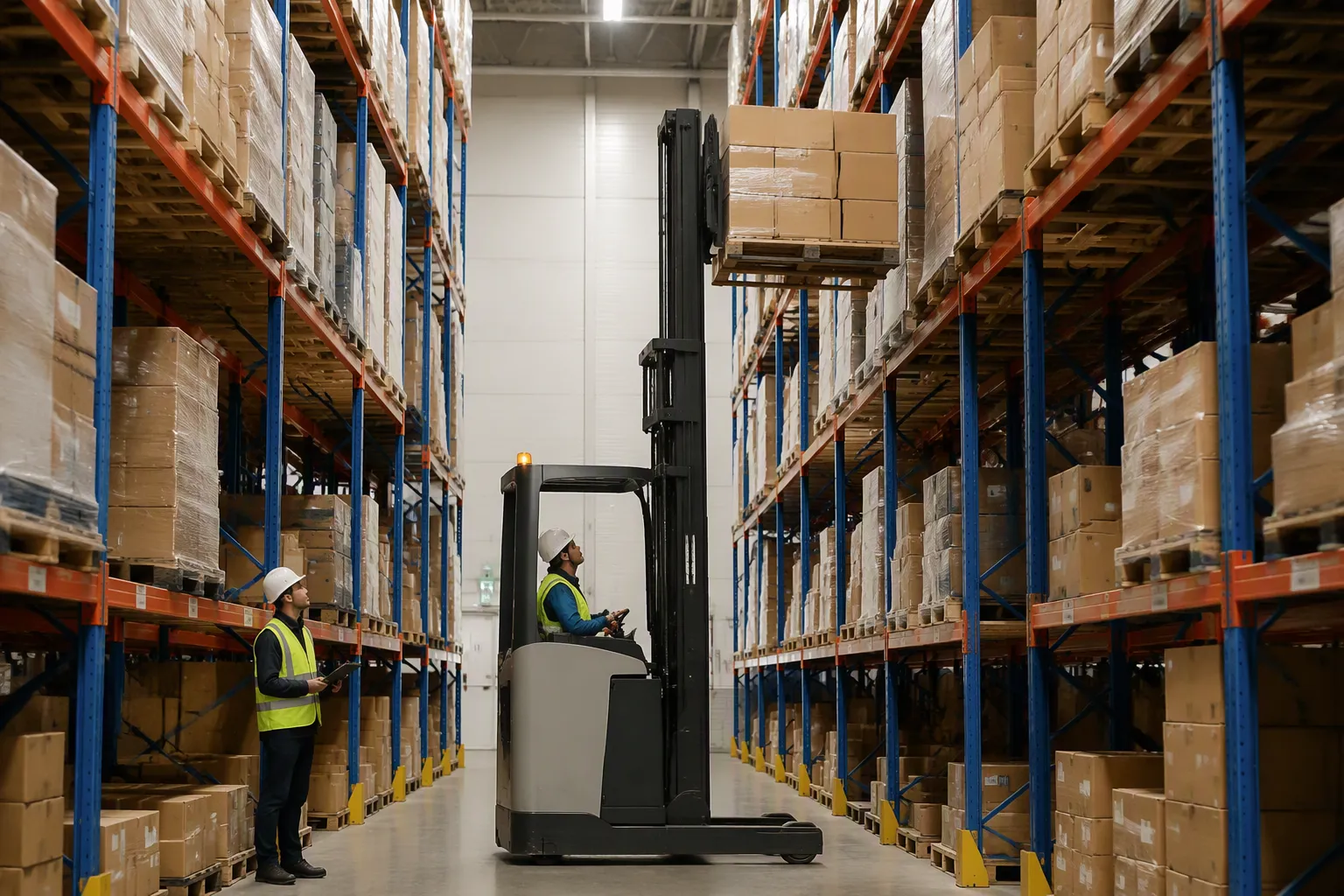
A vna forklift cuts your aisle width to roughly 5–6 feet. This design frees valuable warehouse space for more racking and pallet positions. According to Abel Womack, very narrow aisle systems shrink aisles from 12–14 feet down to 6–7 feet. That change delivers a 30–50% gain in storage capacity. Pair ultra-narrow aisles with high-lift masts, and you build upward instead of outward. You avoid new construction. Your VNA Forklift For Warehouse layout often yields increased storage capacity of 20–50% within the same four walls. For any warehouse, vna forklifts turn wasted aisle space into productive storage.
A vna forklift is material handling equipment engineered for aisles much narrower than standard forklifts require. This machine operates in spaces as tight as 1.5 meters. A very narrow aisle forklift can boost your warehouse storage capacity by up to 40%. The defining feature is a rotating mast or turret head. This turret truck moves 180 degrees. You pick and place pallets on either side of the aisle without turning the vehicle. You find vna equipment in logistics centers, cold storage facilities, retail distribution hubs, and e-commerce warehouses.
Manufacturers build several vna forklift truck configurations for different tasks. The turret truck is the most common type. These turret trucks handle full pallet loads at high lift heights. Man-up order pickers let operators rise with the platform for piece picking. Some vna trucks combine both functions. Each type relies on wire guidance, rail guidance, and precise operator controls. You see these machines in high-volume distribution centers, automated warehouses, and large-scale retail fulfillment facilities.
Traditional aisles measure around 10.5 feet or wider. A very narrow aisle measures only 5 to 7 feet. Conventional counterbalance forklifts cannot operate safely in such confined spaces. A very narrow aisle forklift truck solves this problem. The vna design trades travel speed for storage density. You gain more pallet positions per square foot. Standard trucks offer flexibility across your whole facility. Very narrow aisle forklift trucks excel in one dedicated zone. Your operation picks the right tool for each area.

The most direct way a vna forklift for warehouse storage frees up space is by shrinking your aisles. Standard counterbalance forklifts need aisles 10 to 13 feet wide. A very narrow aisle forklift operates in aisles just 5 to 6 feet wide. That difference sounds small on paper. In practice, it transforms your entire floor plan.
Consider what happens when you cut aisle width by half. You reclaim that square footage for racking. You add pallet positions in the same building footprint. You avoid the cost of new construction entirely.
The numbers back this up. A same-footprint comparison shows the impact clearly:
|
Metric |
Standard Aisle |
Very Narrow Aisle (VNA) |
Improvement |
|---|---|---|---|
|
Storage density vs. conventional layouts |
Baseline |
Up to 50% greater |
Up to 50% increase |
|
Aisle width (reach truck) |
Wider |
8–10 ft |
Reduced footprint |
|
Aisle width (turret/swing-reach) |
Wider |
5–6 ft |
Reduced footprint |
|
Pallet positions (4-level, same footprint) |
192 |
240 |
25% increase (48 more positions) |
|
Aisle width modeled |
2.7 m (~9 ft) |
1.8 m (~6 ft) |
~33% narrower aisles |
Here is how that 25% gain plays out step by step:
Start with a same-footprint, four-level layout using 2.7 m (~9 ft) aisles: 192 pallet positions.
Narrow the aisles to 1.8 m (~6 ft) to create a VNA layout.
Result: 240 pallet positions in the identical footprint.
Net measurable improvement: 25% increase (48 additional pallet positions).
The gains grow even larger at scale. In a same-space, 5-level-high comparison of selective rack with standard 12 ft aisles versus selective rack with very narrow aisles (typically 6 ft to 6 ft-6 in), the VNA layout gains 1,000 more pallet positions than the standard-aisle layout, while still preserving first-in, first-out storage and retrieval.
Very Narrow Aisle or VNA are typically turret trucks or swing reach trucks. Normally these are guided by wire (embedded in concrete) or angle and used in aisles as narrow as 66". General rule of thumb for aisle width is 12" - 18" wider than the truck's width.
Aisle width requirements vary by truck type. Electric counterbalance forklifts need 10–13 feet. Internal combustion forklifts need 12–14 feet. Reach trucks need 8–10 feet. Order pickers need 7–9 feet. Turret trucks, the core of most vna solutions, need only 5–7 feet. Swing reach forklifts work in aisles just 5 to 6 feet wide. Their masts swivel 90 degrees to retrieve pallets from racking. The forklift body never turns. This design eliminates the turning radius that eats up floor space in conventional layouts.
Narrow aisles solve half the puzzle. The other half is height. A vna forklift truck with a high-lift mast lets you build racking upward instead of outward. You capture unused vertical space above your current racks. You multiply pallet positions without adding a single square foot of floor.
Standard forklifts typically lift loads about 15–20 feet. Narrow aisle forklifts often reach 30–40 feet. That extra 15–20 feet of vertical reach changes your warehouse storage density dramatically. You stack more levels of racking in the same footprint. You turn a four-level rack system into a five- or six-level system.
The Electric Reach Truck illustrates this capability well. It extends its forks to place pallets in back-to-back configurations. It handles loads up to 4,500 lbs. It lifts up to almost 30 feet. This makes it suitable for high-bay racking systems and heavy-duty storage applications.
If your picking style matches, the VNA is the ultimate for space efficiency and productivity. It's an especially good way to use tall racks because the operator can raise with the forks for perfect visibility.
Man-up turret trucks take this further. The operator rises with the forks. This provides perfect visibility at every lift height. You place and retrieve pallets accurately at 40 feet. You maintain productivity at heights that would slow down a standard forklift operator.
The combination of ultra-narrow aisles and high-lift masts creates a compounding effect. You gain floor space from narrower aisles. You gain vertical space from taller masts. Together, these two factors drive the 20–50% storage capacity gains that define successful vna forklift for warehouse projects.
Not every racking system works with a vna forklift. You need to match your rack configuration to the truck's capabilities. The wrong pairing wastes money and creates operational problems.
Here is how the main racking options compare:
|
System |
Typical Aisle Width |
Truck Type |
Density |
Flexibility |
|---|---|---|---|---|
|
Standard Selective |
~10-12 ft |
Sit-down forklift |
Lowest |
Highest |
|
Narrow Aisle (NAR) |
~8.5-9.5 ft |
Reach truck |
Mid-range |
Mid-range |
|
VNA |
~5-6.5 ft (60"-78") |
Turret/wire-guided truck |
Highest |
Lowest |
VNA anchors at the far end of this spectrum. It delivers maximum density. It demands dedicated turret trucks and, often, wire or rail guidance.
A common misconception about vna storage systems deserves clarification. VNA is not a high-density storage system like drive-in or push-back racking. It is fundamentally single-deep selective racking. This distinction matters for your operation:
Every pallet is directly accessible, with no digging through blocked positions.
First-in, first-out (FIFO) inventory rotation is preserved.
100% pallet selectivity remains intact, just in a tighter footprint.
Double-deep racking cannot be used in VNA layouts, because turret trucks physically cannot reach a second pallet position stacked behind the first.
This means your vna racking system gives you the best of both worlds. You get the space efficiency of very narrow aisle storage systems. You also keep the selectivity and inventory rotation of standard selective rack. You do not sacrifice accessibility for density.
The equipment that makes this possible falls into two categories. Trilateral trucks use a rotating fork head that reaches both rack faces plus the front of the aisle. Bilateral trucks use telescopic forks housed in a cradle and can operate in even narrower aisles than trilateral trucks. Both types rely on guidance systems. Mechanical (rail) guidance uses a physical rail anchored to the floor with guide rollers on the truck. Wire guidance uses a powered wire embedded in the floor that creates a magnetic field detected by truck sensors.
Your choice between these options depends on your specific very narrow aisle (VNA) application. Consider your aisle dimensions, your rack heights, and your throughput requirements. The right configuration turns your warehouse into a model of warehouse space utilization. The wrong one creates bottlenecks and safety risks.
For most operations, the path to better warehouse density runs through careful planning. You measure your space. You select the right truck. You configure your racking to match. The result is a warehouse that stores more pallets in less space, with no compromise on safety or accessibility.
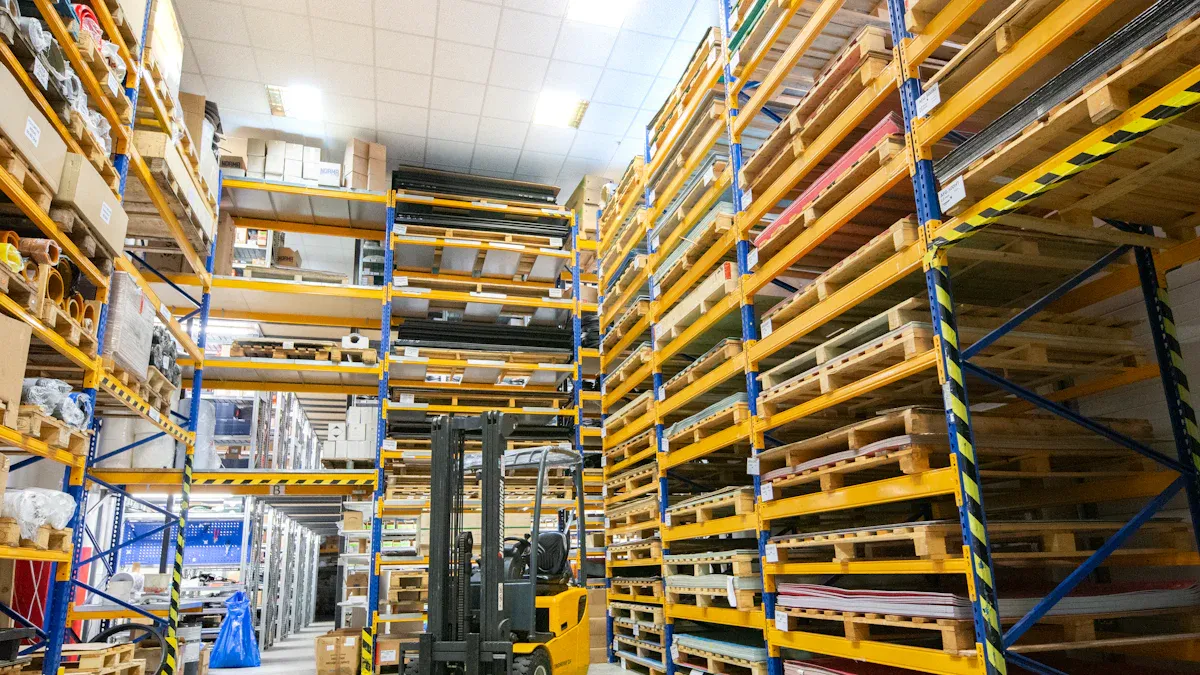
The first metric you compare is the aisle width. A standard counterbalance forklift needs 12.5 to 13 feet. A very narrow aisle forklift operates in just 5 to 7 feet. That difference of 6.5 feet per aisle translates directly into more racking rows. Your vna forklift turns that reclaimed space into added pallet positions. Your storage density climbs without any building expansion. This is the core value proposition for any warehouse weighing a vna investment.
Standard reach trucks lift 30 to 40 feet. Turret trucks match that range, but their forks rotate 180 degrees. You place pallets on either side of the aisle without moving the truck. This turret design preserves load capacity at full lift height. You handle full pallets at heights that standard equipment cannot manage reliably. A turret truck also keeps the operator riding with the forks. That position gives perfect visibility at 40 feet. The table below compares the two truck families:
|
Operational Aspect |
VNA Turret Truck |
|
|---|---|---|
|
Aisle width requirement |
8–10 feet |
5–7 feet |
|
Lift height |
30–40 feet |
30–40 feet |
|
Fork mechanism |
Carriage extends forward |
Forks rotate on turret |
|
Guidance requirements |
Smooth floors only |
Wire or rail guidance |
The trade-off appears in throughput. Standard forklifts travel faster across long distances. Turret trucks move slower, but they never turn around at aisle ends. Their rotating forks eliminate entire maneuvers. Every pallet placement becomes a short, direct motion. Many vna systems use wire or rail guidance. This keeps the truck centered, so the operator focuses on lifting instead of steering.
Turret trucks also shine in high-density operations. Each cycle takes consistent time. Operators build muscle memory quickly. The very narrow aisle layout reduces travel distance between picks. You move fewer total feet per pallet.
The result: standard equipment wins on open-floor speed, but vna forklifts win on pallets moved per hour in tight racking.
VNA systems demand a higher upfront investment. A single turret truck costs significantly more than a standard reach truck. You also need wire guidance installation in every aisle. That installation requires saw-cutting the concrete floor and embedding wire. Some facilities need floor grinding or re-leveling before installation. These costs add up quickly. One warehouse manager reported spending $15,000 per aisle on guidance installation alone.
You face operational trade-offs as well. Standard forklifts offer flexibility across your facility. They handle loading docks, staging areas, and racking alike. Turret trucks excel in one dedicated zone. They lack the versatility for multi-purpose use. You may need a mixed fleet. That approach adds equipment costs but maintains operational flexibility.
Maintenance expenses also differ. Turret trucks contain complex rotating mechanisms and guidance sensors. These components require specialized technicians trained by the manufacturer. Standard reach truck maintenance remains simpler and less expensive. The advanced mechanics inside these machines drive up service costs. You pay a premium for the advanced technology.
Training costs exceed standard forklift certification. Operators must learn wire guidance systems, narrow-aisle protocols, and precise positioning techniques. The learning curve stretches beyond basic truck operation. You should budget for extended onboarding time.
However, the financial equation favors vna in the right context. The storage capacity gains translate directly to revenue potential. You avoid building expansion costs. You reduce land and property tax expenses. In high-volume operations, the payback period often ranges from one to three years. You measure the return not just in pallet positions, but in avoided construction costs.
The decision hinges on your specific needs. Evaluate your throughput requirements, existing floor conditions, and long-term storage goals. Calculate the full cost of ownership, not just the purchase price. That analysis determines whether the density gains justify the investment.
Floor quality determines whether your vna systems succeed or fail. VNA trucks lack suspension. Any bump or gradient shift amplifies up the mast. You must grind down uneven areas and level the surface before installation. Your floor also needs to resist deterioration from repetitive heavy truck impact.
Warehouse floors use FM tolerance levels. FM1 represents the highest precision. FM3 permits greater deviation. High-bay automated warehouses typically require FM1 or FM2. Very narrow aisle forklifts need exceptionally flat floors to keep the mast vertical and the load stable. Even minor floor deviations cause tilting. As aisle width decreases, floor flatness requirements become stricter to avoid rack collisions. Plan FM tolerance and aisle width together.
|
Industrial Use Case |
Target FF / FL |
|---|---|
|
Standard Warehouse |
35 / 25 |
|
Narrow Aisle / High Rack Storage |
50+ / 35+ |
|
Robotic or AGV Areas |
60+ / 40+ |
|
Clean Rooms / Precision Labs |
65+ / 45+ |
You must determine the optimal aisle width and calculate maximum usable ceiling height before redesigning your layout. Standard conventional racking usually suffices for a vna racking system. You do not need exotic structural steel. However, you build racks much higher to exploit turret trucks. Assess your facility ceiling height. You may need to adjust overhead lighting to accommodate higher racking and lift heights.
In-aisle movement requires active guidance in very narrow aisle environments. You choose between mechanical rails and electromagnetic wire guidance. Mechanical rails use a steel rail with side guidance rollers. Wire guidance relies on a buried wire emitting a low-frequency magnetic field. Onboard sensors track that field. Turret trucks also need sufficient staging space next to the VNA zone. Dedicated pick-and-drop stations transfer goods between dense storage and standard horizontal transport. Safety measures include a Personal Protection System for automatic slowdown at aisle ends. RFID tags or magnets track position. Zone-dependent interlocks limit speed, lift height, or fork movement in high-risk areas.
Electric power drives nearly every vna truck on the market today. Your charging strategy shapes your uptime, your floor plan, and your electrical budget. Match the right approach to your shift pattern before you commit.
|
Charging strategy |
Battery type |
Charge window |
Charger specs |
Best-fit facility |
|---|---|---|---|---|
|
Conventional |
Lead-acid |
8 hr charge / 8 hr cool / 8 hr operation |
208–240V single-phase, 30–60A per charger |
Single-shift operations; requires dedicated battery room and spare battery sets |
|
Opportunity |
Lithium-ion |
15–45 min windows during breaks, lunch, shift changes |
24V or 48V chargers, 25–80A |
Multi-shift facilities; aisle-end charging stations can eliminate battery room and recover up to 2,000 sq ft |
|
Fast charging |
Lithium-ion |
Restores 80% capacity in under 2 hr |
80–100A+; dedicated 480V three-phase circuit per charger bank; load management software |
Two-to-three shift operations with short downtime windows |
Opportunity charging suits most vna systems in high-throughput buildings. You plug in during breaks and skip the battery room entirely. Plan your electrical load with care:
A 48V/600Ah lithium-ion battery on a mid-size counterbalance machine draws roughly 8–10 kWh per operating shift.
A 20-truck lithium fleet on two shifts should plan for 320–400 kWh of daily electrical throughput (including a 20% demand buffer).
Budget $15,000–$40,000 for electrical infrastructure upgrades when converting a 15–25 truck fleet from lead-acid to lithium-ion with opportunity charging.
A licensed electrical engineer must validate panel capacity and conduit routing before installation.
Turret trucks and other vna equipment benefit most from lithium-ion power. These machines run long shifts in dense racking, and every minute of charging downtime costs you pallet moves.
Modern narrow aisle forklifts are engineered for aisle widths around 5.5 feet, with high-efficiency lithium-ion battery systems and fast-charging capability reducing downtime and improving shift continuity in high-density logistics environments. Autonomous VNA trucks and robotic stackers further integrate these lithium-ion systems to support faster material flow in complex warehouse layouts.
Turret trucks also pair well with fast charging when your operation runs two or three shifts. You restore most capacity during a single lunch break. That schedule keeps your fleet productive without spare batteries.
You gain more pallet positions per square foot when you switch to vna operations. The numbers speak for themselves. A very narrow aisle layout packs racking into space that standard forklifts waste on turning room.
Narrow aisle warehouses offer a unique advantage in maximizing storage density by significantly increasing the amount of racking within a given footprint. Businesses can store more inventory without requiring additional square footage by optimizing vertical space with taller racks.
Your operation captures several gains at once:
Increased storage density with full pallet selectivity: VNA racking maximizes the use of space while keeping every pallet directly accessible, unlike drive-in or push-back systems.
Supports FIFO inventory control: Because every pallet is directly accessible, companies can follow first-in, first-out inventory control without disruption.
Higher productivity: Turret trucks can operate quickly and efficiently in narrow aisles.
Better space utilization: Vertical capacity is fully optimized in tall warehouses.
Improved safety: Guided forklift systems reduce the likelihood of collisions with racks.
Long-term cost savings: Companies avoid costly building expansions or relocations.
You avoid new construction when your existing warehouse holds more inventory. That single benefit often justifies the entire vna investment. You skip land purchases, permit fees, and construction timelines. Your increased storage capacity comes from better space utilization, not from a bigger building.
VNA systems also scale with your business. You can add racking levels, integrate new technology, or reconfigure layouts for different products. Modular components make expansion easy. You future-proof your operation without major disruption.
You spend less on labor when turret trucks move more pallets per hour. Guided travel reduces operator fatigue and speeds up each cycle. Energy costs drop because electric vna solutions use power efficiently. Insurance premiums often fall as guided systems reduce rack damage and collisions. These savings compound over time. Your vna delivers value far beyond the initial purchase price.
You need concrete numbers before you invest in a vna system. Most operations recover their investment within two to three years. That timeline makes very narrow aisle one of the fastest-paying material handling upgrades you can make.
The math starts with your current storage costs. A typical project pays back in 24 to 36 months. Single-shift electric operations often see payback in 18 to 24 months. Multi-shift operations accelerate that timeline even further, especially when you pair lithium-ion batteries with fast charging.
Your return comes from three sources. First, additional storage value. Most warehouses gain 40 to 60% storage density after conversion. Consider a 50,000-square-foot facility. That warehouse held 2,000 pallets before the change. The new layout holds 3,200 pallets in the same footprint. That 60% increase translates directly into revenue potential.
Second, labor productivity gains. Turret trucks move more pallets per hour than standard equipment. They eliminate turning maneuvers entirely. Operators complete more cycles in less time. Those hours become savings on your payroll.
Third, avoided expansion costs. You skip new construction, land purchases, and permit fees. Your existing building holds the extra inventory.
The five-year total cost of ownership reduction for electric material handling reaches 43%. A ten-unit fleet saves roughly $545,000 over that period. Those figures include maintenance, energy, and labor.
You should measure ROI with a simple formula. Add your additional storage value, labor productivity gains, and avoided expansion costs. Divide that total by your system investment. Strong vna investments exceed a 25% annual return. That number beats the 15% baseline you would accept from a typical capital project.
Turret trucks deliver the strongest returns in high-density operations. They maximize value per operational hour by increasing throughput density. Your payback depends on your facility, your racking, and your shift schedule. Calculate your numbers before you buy.
Selecting the right vna forklift requires careful planning. You cannot rely on guesswork or vendor brochures alone. Every warehouse has unique dimensions, load profiles, and racking layouts. The right truck for one facility may fail in another. Follow these three steps to match equipment to your exact operation.
Accurate measurements form the foundation of every successful vna forklift purchase. You must survey your facility before you talk to any supplier. A professional site survey captures several critical data points. These include aisle widths, lift capacities, pallet racking height, operating environment, and other warehouse-specific factors. Each measurement shapes your equipment choice.
Start with your tightest pinch points. Walk your warehouse and identify every narrow passage, doorway, and column. Measure these areas first. A single bottleneck can eliminate an otherwise perfect truck candidate.
Aisle width tops the priority list. A very narrow aisle forklift typically operates in aisles between 5 and 6 feet wide. Standard counterbalance forklifts need 10 to 13 feet. This difference drives your entire storage density calculation. The table below shows typical minimum aisle widths by truck type:
|
Forklift Type |
Typical Minimum Aisle Width |
|---|---|
|
Powered Pallet Jack |
~2.4 meters |
|
Counterbalance Forklift |
3.5–4.0 meters |
|
Very Narrow Aisle (VNA) Forklift |
1.8–2.2 meters |
|
Reach Truck |
2.7–3.5 meters |
|
AGV (Automated Guided Vehicle) |
1.8–2.5 meters |
You also need to account for safety clearance. Aisles should have 30–50 cm of space on both sides. This prevents collisions or pinching during forklift operations. If two forklifts must pass in the same aisle, add the combined width of both machines plus 50–100 cm for safety clearance. High-level racking requires extra stability clearance. Forklift sway at height demands more room than ground-level operation.
Load dimensions affect aisle width significantly. Pallet width and overall load size (such as 1000 mm, 1200 mm, or larger) change your space requirements. Rack layout also matters. Single-deep, double-deep, or high-level rack arrangements influence forklift operating space. During the design phase, use CAD software or 3D simulations to verify your aisle design.
Height measurements matter just as much. You must calculate the maximum height of your top rack level. The support rail must sit at least 7.9 inches below the maximum lifting height. This ensures pallet skids clear the beam when the mast is fully extended. The retracted mast height determines the required height of doors, lower passageways, and ceilings. Maintain a minimum clearance of 19.7 inches between the retracted mast and the ceiling or overhead beams. Always leave a margin of 19.7 inches above the maximum lifting height.
Racking clearances follow specific rules. External side frames must extend at least 19 inches above the top load level. Internal ones must extend at least 3.9 inches above. If you use upper transverse beams in aisles, keep the vertical clearance between them and the load or mast at least 5.9 inches.
Load capacity requires equal attention. Identify the load center of your typical pallet. Standard pallets usually have a 24-inch load center from the fork face. If you handle oversized crates or long materials, account for reduced effective capacity as the load center moves forward. Match tonnage to inventory needs. An oversized unit (such as 8,000 lb versus 5,000 lb) requires more aisle space to turn. It also wastes storage potential if you only move lighter loads.
Floor flatness demands tighter tolerances than standard forklifts require. Minimal side clearance and elevated operation amplify every bump. A professional floor flatness survey is recommended before installing a vna system. Floor flatness must meet the equipment manufacturer's specifications before deployment. You should also verify compatibility with guide rail or wire-guidance systems.
Follow this measurement sequence to determine your required aisle width:
Measure the tightest pinch points in your warehouse layout before selecting equipment.
Calculate the Minimum Turn Radius (MTR) of the candidate forklift.
Add the MTR to the length of your load.
Include at least 12 inches of clearance for safe maneuvering to determine required aisle width.
For VNA environments with approximately 6-foot aisles, use wire-guided or rail-guided systems. These keep the machine centered and prevent rack damage.
Your racking system dictates which vna forklift truck fits your operation. The wrong pairing creates bottlenecks, safety hazards, and wasted investment. Start by identifying your racking type. Then match it to the right equipment.
Double-deep racking and single-deep racking require completely different approaches. The table below shows the match:
|
Racking Type |
Matched Forklift / Equipment |
Aisle Width |
Selectivity |
|---|---|---|---|
|
Double-deep pallet racking |
Dedicated double reach truck or forklift with telescopic attachment (pantograph) |
Wider than VNA; may require ~10 ft aisle due to extra reach length |
LIFO / FILO; second pallet not directly accessible |
|
Single-deep / selective racking in VNA setup |
Narrow aisle reach trucks, turret trucks, man-up turret trucks, or swing-mast trucks (with guidance systems) |
Compressed to ~5.5–8 ft (1.7–2.4 m) |
100% direct selectivity; FIFO/FEFO compatible |
Double-deep racking stores two pallets back-to-back. The second pallet is not directly accessible. This creates LIFO or FILO inventory flow. A dedicated double reach truck or a forklift with a telescopic pantograph attachment handles this layout. These machines need wider aisles, often around 10 feet, because of the extra reach length.
Single-deep selective racking in a VNA setup delivers 100% direct selectivity. Every pallet is accessible without moving another load. This supports FIFO and FEFO inventory control. A turret truck or swing-mast truck with guidance systems fits this layout. Aisles compress to roughly 5.5 to 8 feet.
A turret truck uses a rotating fork head. The operator picks and places pallets on either side of the aisle without turning the vehicle. Man-up turret trucks lift the operator with the forks. This provides perfect visibility at every height. Swing-mast trucks use a mast that rotates 90 degrees to service both rack faces.
Your vna racking system must match the truck's reach mechanism. Trilateral trucks reach both rack faces plus the front of the aisle. Bilateral trucks use telescopic forks and operate in even narrower aisles. Confirm your rack configuration before you commit to a truck type.
Consider your throughput requirements as well. Turret trucks excel in high-density, high-volume operations. They move more pallets per hour in tight racking than standard equipment. If your operation mixes pallet handling with piece picking, a combination truck may serve you better.
Guidance systems keep your vna forklift centered in the aisle. They prevent rack damage and enable the ultra-narrow operation that defines VNA storage. You have three main options: wire guidance, rail guidance, and magnetic guidance. Each offers distinct advantages.
Wire guidance uses a powered wire embedded in the floor. The wire emits a low-frequency magnetic field. Onboard sensors detect that field and steer the truck automatically. Installation requires saw-cutting the concrete floor and embedding the wire. This approach offers flexibility because the wire path can curve and branch. You can reconfigure aisles later with moderate effort.
Rail guidance uses a physical steel rail anchored to the floor. Guide rollers on the truck follow the rail. This mechanical system provides the most precise tracking. It also delivers the tightest aisle tolerances. Rail guidance suits operations with fixed layouts and maximum density requirements. The trade-off is inflexibility. Moving a rail means cutting and re-anchoring steel.
Magnetic guidance relies on magnets or RFID tags placed along the aisle. Sensors on the truck read these markers for position tracking. This system costs less to install than wire or rail. It also allows easier layout changes. However, magnetic guidance offers less continuous steering control than wire or rail systems.
Your choice depends on several factors. Consider your aisle dimensions, rack heights, and throughput requirements. Think about your long-term layout plans. A facility that may reconfigure racking in two years should weigh flexibility heavily. A facility with a permanent layout can prioritize precision.
Modern vna solutions often combine guidance types. Zone-dependent interlocks limit speed, lift height, or fork movement in high-risk areas. A Personal Protection System provides automatic slowdown at aisle ends. RFID tags or magnets track position throughout the aisle. These safety layers protect your operators and your racking.
Dedicated pick-and-drop stations transfer goods between dense storage and standard horizontal transport. You need sufficient staging space next to the VNA zone. Plan this area during your layout design. Poor staging creates bottlenecks that erase your density gains.
Test the guidance system before you buy. Request a demonstration in a facility similar to yours. Verify that the system handles your floor conditions, your load weights, and your throughput targets. A guidance system that works in a showroom may struggle in a real warehouse with uneven floors and heavy traffic.
Rated capacity on a spec sheet tells you only part of the story. You must evaluate how much load your vna forklift carries at its maximum lift height. This step separates a smart purchase from an expensive mistake.
Every forklift has a capacity chart. That chart shows how load weight changes with lift height and load center. A truck rated at 3,000 pounds at ground level may handle only 2,000 pounds at 30 feet. The mast flexes. The hydraulic system works harder. The carriage geometry shifts the load center forward. These factors reduce effective capacity as you go higher.
You need to match capacity to your heaviest pallet at your highest rack level. Start by identifying your worst-case load. Find the heaviest pallet in your inventory. Measure its weight, its dimensions, and its load center. Then check the capacity chart at the lift height where that pallet goes. If the chart shows less capacity than your load weighs, you need a different truck.
Load center matters more than most buyers realize. A standard pallet has a 24-inch load center from the fork face. Oversized crates, long materials, and irregular loads push that center forward. Every inch forward reduces effective capacity. A truck that handles 2,500 pounds at a 24-inch load center may handle only 1,800 pounds at a 36-inch load center. You must account for this shift before you buy.
High-lift masts also affect stability. A turret truck with a 40-foot mast carries more sway at full extension than a truck with a 20-foot mast. The rotating fork head adds another variable. When the forks rotate 180 degrees, the load moves away from the truck's center of gravity. The capacity chart accounts for this motion. You must read the chart for the rotated position, not just the forward position.
Here is a practical sequence for evaluating capacity at full lift height:
Identify your heaviest pallet and its load center.
Determine the rack level where that pallet will sit.
Find the capacity rating at that lift height on the truck's chart.
Confirm the rating covers the rotated fork position if you use a turret truck.
Add a safety margin of at least 10 percent for dynamic loads and mast flex.
You should also test the truck under real conditions. Ask your supplier for a demonstration with your heaviest load at your highest rack level. Watch how the mast behaves. Check for sway, hydraulic drift, and fork deflection. A truck that feels stable at 20 feet may feel unstable at 35 feet. You need to see the machine work at your actual heights before you commit.
Attachments change capacity too. A sideshifter, a fork positioner, or a telescopic pantograph adds weight to the carriage. That added weight reduces the load you can lift. You must subtract the attachment weight from the rated capacity. A 300-pound attachment on a 2,500-pound truck leaves you with 2,200 pounds of usable capacity. Factor this into your calculations.
Turret trucks and swing-mast trucks have unique capacity profiles. The rotating mechanism adds mass to the mast. This mass reduces capacity at height compared to a standard reach truck with the same lift height. You pay for the rotation capability with a capacity penalty. Make sure the trade-off works for your load profile.
You should also consider the floor condition at full lift height. A truck lifting 2,500 pounds to 35 feet exerts significant pressure on the floor. The outriggers or stabilizers carry that load. If your floor has weak spots or uneven sections, the truck may not operate safely at full height. You need a floor survey before you finalize your capacity evaluation.
Document everything. Record the capacity at each lift height for each truck you consider. Compare those numbers side by side. A truck with a lower purchase price may cost more in the long run if it cannot handle your loads at your required heights. Capacity at full lift height is not a minor specification. It is a core performance requirement that determines whether your vna forklift meets your operational needs.
The truck you buy matters. The supplier you buy it from matters just as much. A vna forklift is a long-term asset. You need a partner who supports that asset for its entire lifecycle. Procurement teams should evaluate suppliers on several criteria before they sign a purchase order.
The table below shows the key comparison criteria for vna forklift suppliers:
|
Comparison Criterion |
What Procurement Teams Should Evaluate |
Why It Matters |
|---|---|---|
|
Replacement parts availability |
Confirm that commonly required parts are readily available for the specific VNA model before purchase; be cautious with older or uncommon units |
Hard-to-source parts can leave equipment idle for weeks, eroding the value of a low purchase price |
|
Maintenance and service support |
Ask what post-sale support the dealer provides, including routine maintenance and access to qualified technicians |
Ensures uptime and reduces downtime when unexpected failures occur |
|
Warranty and service coverage |
Clarify exactly what the warranty covers, its duration, and any conditions that could void coverage |
Warranty terms vary by equipment, age, condition, and seller, so coverage must be verified rather than assumed |
|
Dealer competence and long-term partnership |
Work with a dealer that understands the equipment and can assist with both parts and service over the ownership lifecycle |
Long-term support lowers total cost of ownership and keeps the forklift operating safely |
Parts availability tops the list for a reason. A turret truck contains complex rotating mechanisms, guidance sensors, and specialized hydraulic components. These parts are not universal. You cannot source them from a generic auto parts store. You need a supplier who stocks them or can get them quickly. Ask about lead times for common failure points. Ask about the cost of a replacement turret head. Ask about the availability of guidance system components. A supplier who cannot answer these questions clearly is a risk.
Service support determines your uptime. A vna forklift that sits idle costs you money every hour. You need a dealer with trained technicians who can diagnose and repair your equipment. Ask how many technicians the dealer employs. Ask how many are certified on your specific truck model. Ask about response times for emergency calls. A dealer with a two-day response time may not meet your operational needs.
Warranty coverage requires careful reading. Some warranties cover parts only. Some cover labor only. Some cover both. Some exclude wear items like forks, tires, and batteries. Some void coverage if you perform your own maintenance. You must understand exactly what your warranty covers before you buy. Ask for the warranty terms in writing. Compare them across suppliers.
Suppliers are increasingly differentiated by their ability to engineer warehouse performance, not merely sell lift trucks. Leading VNA providers must demonstrate density, safety, uptime, software compatibility, and service support. Lift height alone is insufficient. The strongest competitive advantage lies in the engineered warehouse system around the truck. That system includes racks, floors, guidance, batteries, safety scanners, navigation, automation software, and service support.
Buyers now expect vna trucks to support high-bay accuracy, operator safety, energy efficiency, predictable throughput, warehouse navigation, fleet connectivity, and in advanced sites, autonomous pallet handling. Procurement teams should therefore compare suppliers on their ability to deliver an integrated operating result. That result means more inventory handled more accurately, in less space, with fewer trade-offs. You should not compare suppliers on truck specifications alone.
Consider these factors when you evaluate a potential supplier:
Does the supplier offer a site survey before the sale?
Does the supplier provide operator training as part of the package?
Does the supplier have a local parts warehouse or service center?
Does the supplier offer fleet management software or telematics?
Does the supplier support integration with your existing racking and guidance systems?
Does the supplier provide references from similar operations?
A supplier who answers yes to most of these questions is likely a strong partner. A supplier who answers no to several is a risk. You should weigh these factors alongside the purchase price. A lower price from a weak supplier often costs more over the life of the equipment.
You should also consider the supplier's ability to support future growth. Your operation may expand. You may add more turret trucks. You may add new racking or new guidance systems. A supplier who understands your long-term goals can help you plan that growth. A supplier who only wants to sell you one truck may not.
Request a facility assessment and a demonstration from at least two qualified suppliers. Compare their recommendations side by side. Ask each supplier to explain why their proposed solution fits your operation. A supplier who asks detailed questions about your loads, your racking, and your throughput is more likely to deliver a solution that works. A supplier who quotes a price without asking questions is less likely to meet your needs.
The right supplier becomes a partner in your operation. They help you maintain uptime. They help you control costs. They help you adapt to changing business needs. That partnership is worth more than a small discount on the purchase price. Choose your supplier with the same care you apply to choosing your truck.
OSHA requires all narrow aisle forklift operators to complete full training and certification before they touch the equipment. This is a legal obligation, not a suggestion. Without proper certification, operators make errors that jeopardize health and safety, and employers face costly OSHA fines. Your training program must cover safe navigation in tight spaces, proper maintenance, and operational precautions such as maintaining at least 12 inches of clearance for turn radius.
VNA equipment demands more advanced skills than standard forklifts. You drive these machines in aisles only 1.8–2.4 meters wide, so precise maneuvering becomes critical. Operators must also learn to use cameras, sensors, and guidance systems effectively. The table below summarizes the key requirement areas.
|
Requirement Area |
Specific VNA Safety & Training Requirement |
|---|---|
|
Operator Training |
OSHA mandates equipment-specific training and evaluation for each powered industrial truck type. VNA equipment requires additional training on guide systems, elevated picking, and narrow-clearance maneuvering. |
|
Floor Conditions |
VNA equipment demands tighter floor flatness tolerances than standard forklifts due to minimal side clearance and elevated operation. A professional floor flatness survey is recommended before installation. |
|
Aisle Width |
VNA forklifts operate in aisles typically 5–6 feet wide, compared to 10–13 feet for standard counterbalance forklifts, enabling higher storage density. |
You must enforce strict aisle discipline in every VNA zone. Only trained operators enter these aisles. Pedestrians never walk through active VNA systems. Install physical barriers, warning lights, and floor markings at every aisle entrance. A Personal Protection System automatically slows the turret truck at aisle ends. Zone-dependent interlocks limit speed and lift height in high-risk areas. These controls protect your team and your racking.
Daily inspections keep your turret trucks safe and productive. Check hydraulic systems, guidance sensors, forks, and tires before each shift. Document every finding. Load integrity deserves equal attention. Confirm that pallets are undamaged, properly stacked, and within the rated capacity at full lift height. A turret truck lifting a compromised load at 35 feet creates serious risk. Schedule preventive maintenance with certified technicians. Their work protects your warehouse investment and keeps uptime high.
You cannot treat a vna conversion as a simple equipment swap. Floor flatness determines whether your investment pays off. VNA equipment needs very level floors, typically within 1/8 inch over 10 feet. Many buyers skip this check and face costly surprises later.
Watch for these common floor tolerance mistakes:
Treating VNA conversion as a simple equipment swap without evaluating floor flatness.
Allowing sloped or irregular floors to go unchecked. In existing warehouses, sloped floors can make the conversion cost outweigh the storage-density benefit.
Failing to survey the floor against the manufacturer's specific VNA tolerance before installing narrow-aisle racking.
A full feasibility study protects your budget. Your turret truck operates with only a few inches of clearance. Tight tolerances leave no room for error.
Buyers often focus on lift height and forget the load itself. Your pallet dimensions, load center, and attachment weight all reduce effective capacity. A turret truck rated at 2,500 pounds may handle far less with a sideshifter or a forward-shifted load. Measure your heaviest pallet at its actual load center. Confirm the capacity chart covers that exact configuration. Skipping this step leads to unsafe lifts at height.
Operators need more than basic certification to run turret trucks safely. They must master guidance systems, narrow-aisle protocols, and precise positioning. This learning curve stretches beyond standard forklift training. Budget for extended onboarding. Rushed training creates rack damage, downtime, and safety incidents. Give your team time to build muscle memory before you push full throughput.
VNA forklifts turn unused aisle space into productive storage. You can boost storage capacity by double digits without new construction. Success depends on matching your very narrow aisle forklift to your floor, racking, and load profile. Select a vna forklift with a high-lift mast. A turret truck must clear your tallest rack level. Turret trucks perform best with wire guidance. Prioritize suppliers who offer site surveys, operator training, and reliable local service. Request a turret truck demo to validate projected gains. Ask a qualified supplier for a facility assessment. Your warehouse maximizes every square foot.
A vna aisle typically measures 5 to 6 feet wide. Turret trucks and swing-reach trucks operate in these tight spaces. You gain significant storage density compared to standard 12-foot aisles. Always verify your specific truck model's minimum aisle requirement before finalizing your layout.
You need floor tolerances within 1/8 inch over 10 feet for most vna installations. Uneven floors cause mast tilt and rack collisions. Commission a professional floor survey before you buy. Grinding or leveling may add cost, but skipping this step creates safety hazards.
Wire guidance offers flexibility for future layout changes. Rail guidance delivers the tightest tolerances for fixed layouts. Magnetic guidance costs less but provides less steering control. Your choice depends on aisle dimensions, rack heights, and long-term reconfiguration plans. Test any system under real warehouse conditions first.
A turret truck loses capacity as lift height increases. A truck rated at 3,000 pounds at ground level may handle only 2,000 pounds at 30 feet. Check the capacity chart at your highest rack level. Account for attachment weight and load center shifts.
Add:No.609 Tahui Road , Shihudang Town, Songjiang District ,Shanghai, China


Friendly Links :
© 2026 Shanghai Zon-Cho Huge Science And Technology Co., Ltd. All Rights Reserved.
|Sitemap|Xml |Privacy Policy




