
Reach Truck vs VNA Forklift: Which Warehouse Solution Fits Your Needs?
Oct 28, 2026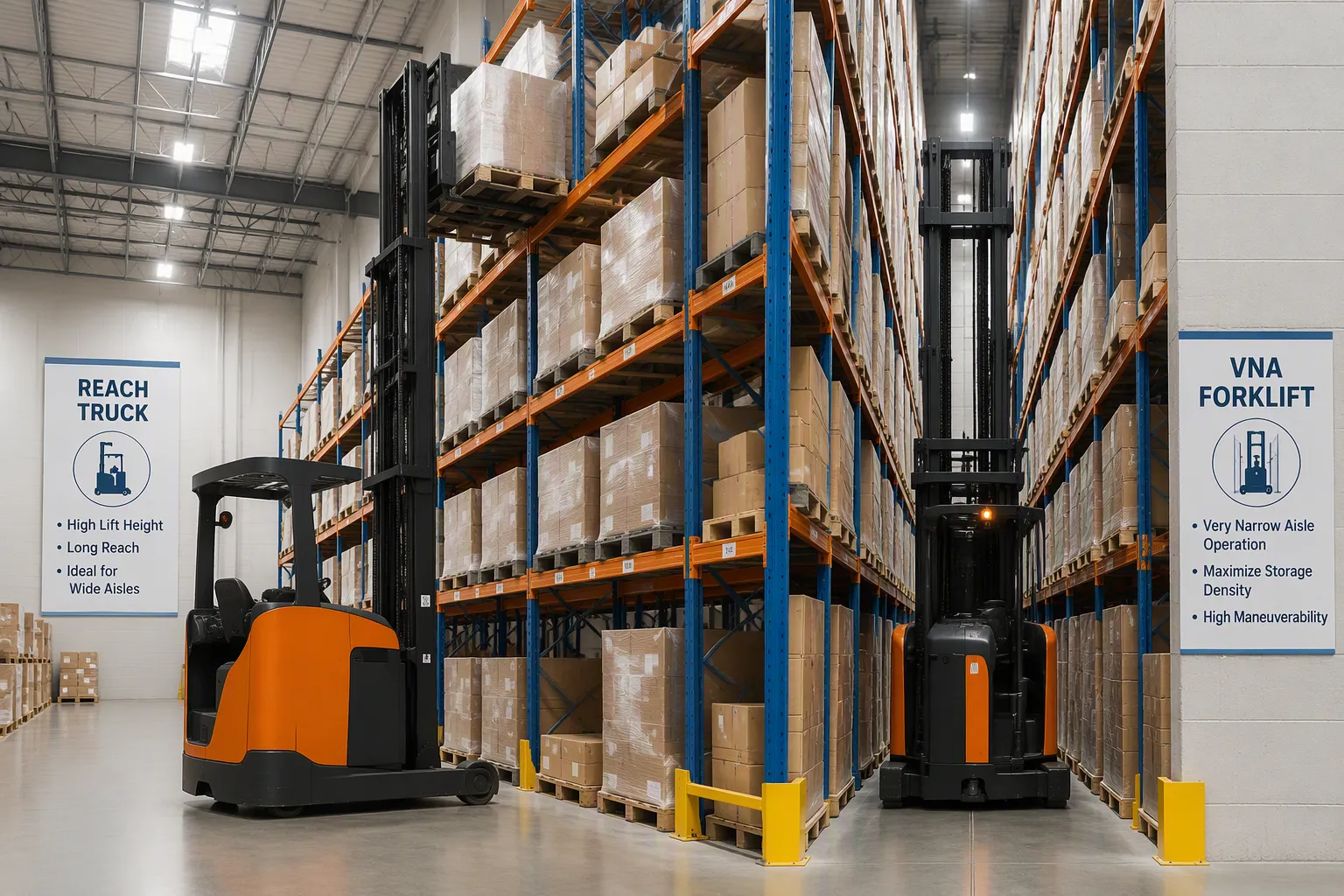
Your choice in the reach truck vs vna forklift debate shapes storage capacity, operating cost, and scalability. VNA forklifts excel in extremely narrow aisles of 4.5–6 ft and boost storage density. Reach trucks handle standard narrow aisles of 8–10 ft. A very narrow aisle layout needs a vna truck with guidance; reach trucks do not. Warehouse managers weigh aisle width, lift height, throughput, infrastructure, and budget. VNA forklifts and VNA trucks serve warehouse layouts well. Both forklifts work hard. Pick the vna forklift for high-density storage or the reach truck for flexibility.
You can settle most reach truck vs vna forklift decisions with a short list of criteria. The table below shows how experts frame the trade-offs.
|
Decision Factor |
VNA Forklift |
Reach Truck |
|---|---|---|
|
Space use (floor and height) |
Favored — high-density, narrow-aisle storage |
Less favored — needs wider aisles |
|
Layout flexibility |
Lower — fixed guidance, dedicated aisles |
Higher — free-moving, mixed storage |
|
Budget (initial and long-term) |
Higher purchase and maintenance cost |
Lower purchase and maintenance cost |
|
Growth plans |
Suited to high-density expansion |
Suited to adaptable, mixed-use growth |
|
Operator training |
Requires specialist certification |
Standard reach truck certification |
|
Floor quality |
Requires precision-leveled flooring |
Works with conventional layouts |
Choose vna forklifts when floor space is expensive and every pallet position counts. A vna truck runs in aisles as narrow as 54 inches and adds 25% to 50% more pallet positions than a reach truck layout. That storage density pays off in cold storage, pharmaceutical, electronics, and e-commerce sites. In dedicated aisle operations, vna trucks reach 25 to 35 loads per hour. Battery life on these forklifts suits continuous shifts. Warehouse managers who plan high-density storage expansion should shortlist vna forklifts first.
Pick a reach truck when your building cannot justify a very narrow aisle system. Reach trucks need no wire or rail guidance, and they work on standard FM2 floors. One machine moves freely between racking, staging, and dock areas. These forklifts also cost less to buy and maintain. Choose reach trucks when clear height stays below 14 meters, throughput is moderate, or you need redeployment across sites. A reach truck also handles mixed tasks and narrow aisles of 9 to 10 feet with ease. Weigh load capacity and total cost before you commit to either fleet.
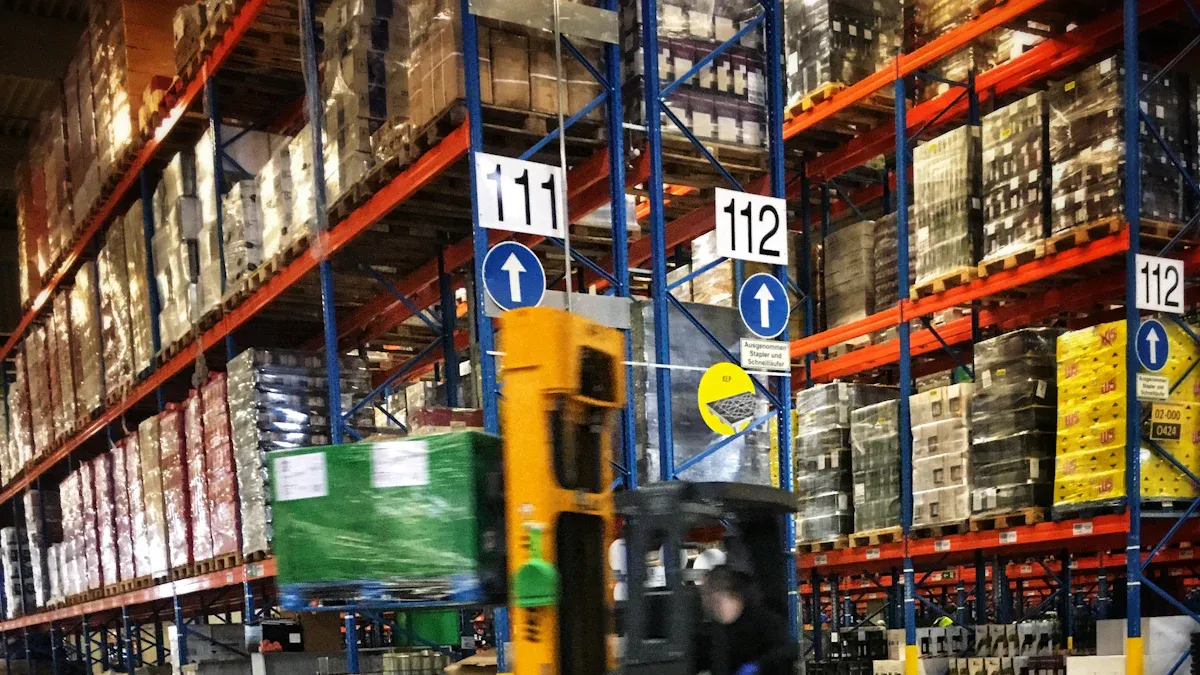
A reach truck is a narrow-aisle, right-angle stacking machine. It stores and retrieves palletized loads inside racking. You will find these forklifts in medium to large warehouse and distribution centers.
Several design features set reach trucks apart from standard counterbalance forklifts:
The pantograph pushes the forks forward into the rack bay and pulls them back, so the truck never enters the rack.
Baselegs with load wheels stabilize the machine and replace the rear counterweight.
The battery sits slightly in front of the operator and acts as a counterweight.
The operator stands perpendicular to the forks for a clear view of the load.
Drive tires sit under the operator compartment, which produces a very tight turning radius.
These forklifts run on electric power only. A short chassis lets them work in aisles as narrow as 8 feet. A standard forklift needs 12 to 14 feet for the same job. You control travel, lift, tilt, extend, and sideshift with a joystick and a deadman pedal. The mast and pantograph work together to raise loads and reach into racking. Other forklifts cannot match this footprint.
Reach trucks suit high-bay put-away and retrieval in structured racking. You see them in warehouse and distribution operations, food and beverage distribution, cold storage, and manufacturing. These reach trucks handle bulk storage and the transport of palletized loads. They rank among the most versatile narrow aisle forklifts on the floor. Check load capacity and cost against your rack heights before you buy.
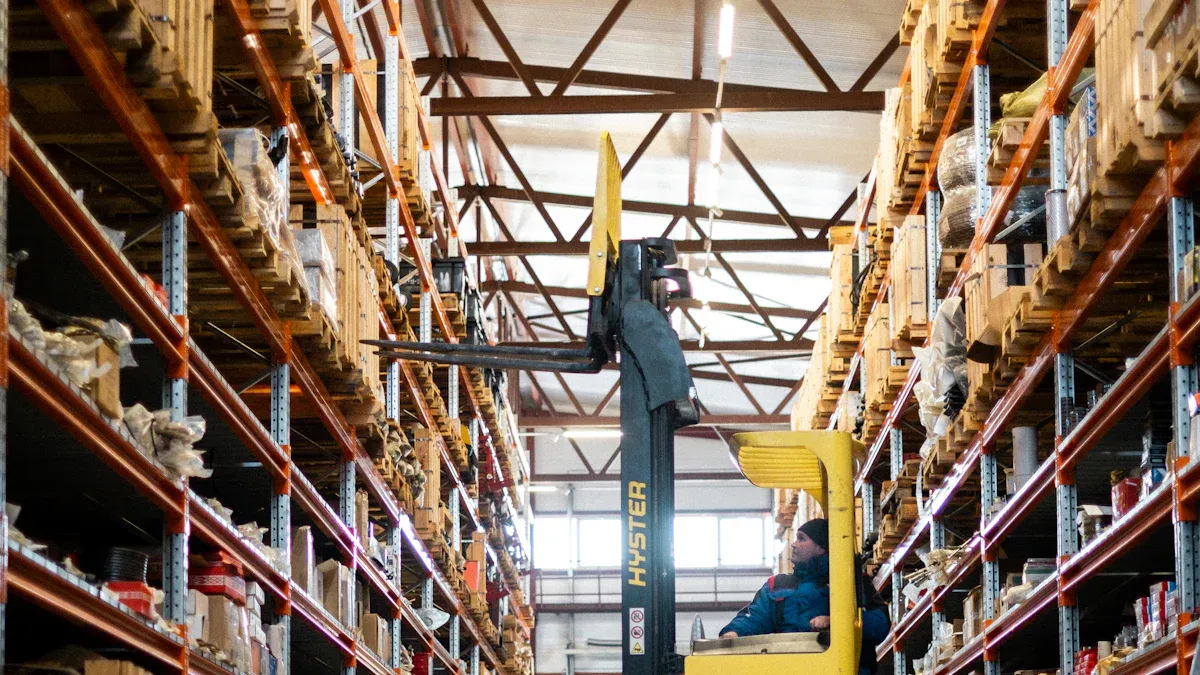
A VNA forklift is a specialist machine built for very narrow aisle storage. These trucks lift pallets to high racking inside aisles that standard equipment cannot enter. You will find them in warehouses where floor space is scarce and every cubic foot matters.
The table below summarizes the core design features and operating mechanisms of these machines.
|
Category |
Feature / Mechanism |
Description |
|---|---|---|
|
Design |
Ultra-narrow aisle capability |
Operates in aisles as narrow as 1.6–2.0 m, enabling high-density storage |
|
Design |
Three-way fork head / rotary structure |
Allows loading and unloading without rotating the vehicle body |
|
Design |
High lift height & precise positioning |
Supports high-rack storage with accurate pallet placement |
|
Design |
Reinforced frame & stable mast |
Handles varying load weights safely and reduces tipping risk |
|
Design |
Ergonomic cabin |
Adjustable seating, intuitive controls, clear pallet visibility to reduce fatigue |
|
Design |
Energy-efficient components |
Optimized electric drives and regenerative braking reduce energy use |
|
Operation |
Intelligent navigation / sensor-assisted guidance |
Real-time monitoring of mast, pallet position, and aisle alignment for precise placement |
|
Operation |
Collision avoidance system |
Detects obstacles, vehicles, and personnel; alerts operators to prevent impacts |
|
Operation |
Speed monitoring |
Automatically adjusts speed in narrow aisles to maintain stability |
|
Operation |
Anti-skid tires |
Improve traction and control on warehouse floors |
|
Operation |
Emergency stop |
Immediately halts the truck to protect personnel and equipment |
A VNA truck moves and lifts at the same time, so a pallet travels diagonally at height at high speed. Modern vna trucks reach up to 30 pallets per hour at a 7 m shelf height. Guidance systems keep the machine centered. Wire guidance uses a floor-embedded wire and a sensor on the truck. Rail guidance uses physical rails at the racking base. Wire guidance costs less and is easier to reconfigure. Rail guidance suits very high racking. Turret trucks rotate forks to pick loads from either side without turning the vehicle. Swing reach trucks extend and pivot forks to access loads at various angles. You must keep loads evenly distributed and within load capacity to prevent tipping and mechanical strain.
You see vna forklifts across many industries:
Food and cold chain operations
Hardware and automotive parts
Textiles, elevators, curtain walls, and cables
Warehousing sites with limited space that need efficient inbound and outbound flow
Cold storage models and AGV models meet special operational needs. These forklifts maximize storage density in extremely narrow aisles. A vna forklift also reduces long-term cost per pallet position. Choose vna forklifts when your layout demands maximum density and your team can commit to guided aisle operations.
You now understand what each machine does. This section puts them side by side on the numbers that drive your decision. Aisle width, lift height, load capacity, and guidance infrastructure separate these two solutions more than any other factors.
Aisle width is the first number you should measure. It sets your storage density and your choice of equipment. A reach truck needs 8 to 10 feet of aisle space. A vna forklift works in aisles under 6 feet. That difference of 2 to 4 feet per aisle compounds across a whole building. Every foot you remove from an aisle becomes a pallet position.
The minimum aisle width for a vna truck sits near 54 inches. At that width, you gain 25% to 50% more pallet positions than a reach truck layout. This gain explains why vna forklifts dominate high-density storage sites. Cold storage, pharmaceutical, and e-commerce operations pay for floor space by the square foot. They recover that cost through space efficiency.
Space utilisation is not only about floor area. Vertical space matters just as much. A vna truck travels and lifts at the same time. It places pallets diagonally at height without turning the chassis. This motion pattern lets you build taller racking in tighter footprints. The result is a storage density that a reach truck cannot match in the same building.
Reach trucks still hold their ground in mixed layouts. They steer normally and move between racking, staging, and dock areas. You lose some density, but you gain freedom of movement. Measure your aisle widths before you choose. The answer usually falls out of that single measurement.
Lift height and load capacity decide which loads you can store and how high you can stack them. The table below compares the two machine types on these core specs.
|
Forklift Type |
Load Capacity |
Aisle Width |
Application |
|---|---|---|---|
|
Reach truck |
3,000–5,500 lb |
8–10 ft |
High-bay indoor racking |
|
VNA/Turret truck |
2,000–4,000 lb |
Under 6 ft |
Ultra-high-density storage |
Reach trucks carry more weight per pallet. Their baselegs and rear counterweight support heavier loads. VNA forklifts trade some load capacity for reach and height. You must match the load capacity to your heaviest pallet before you commit.
Height is where vna forklifts pull ahead. Modern turret trucks can reach lift heights of 40 to 55 feet (12–16.5 meters), depending on the model, making them ideal for high-bay warehouses and dense vertical storage. That reach lets you use every foot of clear height in your building.
Reach trucks are suited for facilities with racking that runs 30 feet or higher, making them a primary workhorse for high-bay storage.
The lifting capacity gap runs in both directions. Consider these points as you weigh the two options:
Turret trucks have a higher lifting capacity than reach trucks.
Reach trucks cannot stack as high or work in aisles as narrow as turret trucks.
Turret trucks allow maximum space utilization and lift heights but require higher investment and specialized infrastructure.
Reach trucks are more affordable and flexible but have lower lift heights and capacity than turret trucks.
Your clear height sets the ceiling on this decision. A building under 30 feet rarely justifies a vna forklift. A building above 40 feet rarely justifies anything else. Check your racking plan and your heaviest pallet. Those two numbers point you to the right machine.
Guidance is the hidden cost of a very narrow aisle system. A reach truck steers normally. It needs no wire, no rail, and no reflectors. A vna truck needs a guidance system to stay centered in aisles under 6 feet. You have three main options, and each one carries a different price and a different level of flexibility.
|
Guidance System |
How It Works |
Relative Cost |
Flexibility / Reconfiguration |
Maintenance & Operational Notes |
|---|---|---|---|---|
|
Rail guidance |
Floor-mounted physical rails |
Cheapest option |
Difficult to reconfigure aisles |
Affected by floor debris; rails need cleaning |
|
Wire guidance |
Embedded floor wires carrying a signal |
Mid-range |
More flexible than rails, but requires cutting into the floor to install or modify |
Signal integrity checks required |
|
Laser guidance |
Reflectors mounted on racking or walls |
Most expensive |
Most flexible and easiest to reconfigure |
Can be disrupted by dust or obstructions in the laser path; reflector alignment verification needed |
Installed guidance cost runs $8,000 to $20,000 per aisle for rail, wire, or laser. That figure covers only the guidance itself. A full vna project carries several cost buckets. Plan for the truck, energy (battery and charger), guidance (wire, rail, sensors, transmitter, commissioning), floor work (survey, grinding, repair, wire installation), rack (relocation, protection, alignment), controls (positioning, navigation, fleet software), safety, implementation (freight, installation, testing, training), and transition (temporary storage, rental equipment).
A used turret truck alone does not create a vna warehouse. A machine that costs around $20,000 may still need roughly $40,000 of floor work plus new guidance, rack relocation, and battery or charger replacement. Budget the whole project, not just the truck.
Each guidance type demands its own preparation. Wire guidance requires floor cutting and installation, wire and signal-generation equipment, truck guidance hardware, commissioning, aisle mapping, and ongoing maintenance when floors are repaired or altered. Rail guidance uses physical guide rails instead of embedded wire. Those rails occupy space near the floor and interact directly with rack design. Compare wire and rail on installed cost, floor modifications, rack geometry, wheel and guide equipment, future layout changes, maintenance, and pedestrian access.
Reach trucks avoid this entire category. They steer normally in 8 to 10 foot aisles and usually need no guidance infrastructure. That freedom keeps your warehouse layout flexible. You can move racking, add a dock door, or reconfigure a zone without cutting the floor. VNA trucks reward you with density, but they lock your layout into a fixed pattern. Weigh that trade-off against your growth plans before you sign the order.
Purchase price is where the reach truck vs vna forklift gap looks widest. The table below shows typical price bands for both machine types.
|
Forklift Type |
New Price Range |
Used Price Range |
Capacity |
Power Type |
|---|---|---|---|---|
|
Reach Truck |
$40,000–$70,000 |
$15,000–$35,000 |
3,000–5,000 lbs |
Battery |
|
Turret Truck (VNA) |
$80,000–$130,000 |
$30,000–$60,000 |
2,500–3,500 lbs |
Battery |
These figures tell only part of the story. In 2026, reach trucks can broadly range from around $6,000 for basic China-sourced equipment to $60,000 or more for high-performance or premium-brand configurations. Used machines can fall anywhere from a few thousand dollars to above $30,000 depending on specification and condition. A vna forklift sits in a higher bracket because of its turret head, guidance hardware, and precision mast. You pay for that engineering up front, and you recover it through storage density over the life of the fleet.
The purchase decision also involves how you pay. Buying outright, financing, and leasing each shift the cost profile across five years. The table below compares three common paths for a typical machine.
|
Cost Category |
Buy (Financed) |
Lease (60-Mo FMV) |
Lease (Full-Service) |
|---|---|---|---|
|
Equipment/Payments |
$53,400 |
$48,000 |
$66,000 |
|
Maintenance & Repairs |
$12,000–$18,000 |
$12,000–$18,000 |
Included |
|
Battery Replacement |
$6,000–$12,000 |
$0 (return at end) |
$0 (return at end) |
|
Tires (over 5 years) |
$1,500–$3,000 |
$1,500–$3,000 |
$1,500–$3,000 |
|
Residual Value |
($8,000–$14,000) |
$0 |
$0 |
|
5-Year Net Cost |
$55,000–$72,000 |
$61,500–$69,000 |
$67,500–$69,000 |
A full-service lease bundles maintenance into one predictable payment. That structure suits vna trucks, where specialist repairs can catch you off guard. A financed purchase leaves you with residual value at the end. That residual matters more for reach trucks, which hold resale value well in the secondary market.
Purchase price is not the number that should drive your decision. Total cost of ownership is. You calculate it across the whole fleet and the whole shift pattern.
All-in forklift TCO per hour = (annualized capital + energy + maintenance + repairs + tires + battery/charger reserve + downtime/rental + other fleet costs) ÷ annual operating or productive hours
This formula forces you to count the costs that hide outside the invoice. Energy, tires, battery reserve, and downtime all land in the total. Downtime deserves special attention. A vna truck that stops in a guided aisle can block an entire aisle system. A reach truck that stops usually leaves room to maneuver around it. Factor rental replacement and lost throughput into your model.
You can also strip the analysis down to a single aisle or a single shift.
Cost per operating hour = (Purchase price + energy + maintenance + downtime − resale value) ÷ productive operating hours
Run this calculation for each candidate machine against your real shift hours. A vna forklift with a high purchase price can still win on cost per pallet position. A reach truck with a lower sticker price can lose that race once you count the extra aisles it needs. The vna trucks in a dense layout move more pallets through less floor space, and that efficiency compounds every year.
Infrastructure belongs in the same ledger. Guidance systems, floor preparation, and rack relocation add $8,000 to $20,000 per aisle before a single vna truck enters the building. Reach trucks skip that line item almost entirely. You must weigh those setup costs against the pallet positions you gain. A warehouse with cheap floor space rarely justifies the vna premium. A warehouse with expensive floor space often does.
Maintenance patterns differ as well. Reach trucks use widely available parts and standard service schedules. Vna forklifts carry turret heads, sensors, and guidance components that demand specialist technicians. Budget higher annual maintenance for vna forklifts and plan service windows around production. A well-run fleet of forklifts keeps both machine types productive, but the vna fleet needs tighter discipline.
Energy costs stay roughly comparable across both types. Both run on electric power, and both use regenerative braking on modern models. Battery capacity and charger strategy affect the bill more than the machine category does. Size the battery to your shift length and your charging window. A vna truck that runs continuous shifts needs a larger reserve than a reach truck on light duty.
Finally, weigh the cost against your growth plan. A reach truck fleet scales by adding machines and aisles. A vna system scales by adding guided aisles and turret units. The second path costs more per step, but each step buys far more storage density. Match the spending curve to your projected pallet count. That match keeps your cost per pallet position falling as you grow.
You must train operators on seven core areas before they run either machine:
Equipment familiarity and controls — components, features, and how the turret head positions loads.
Pre-operational inspection and equipment readiness — shift-start checks and when to pull a truck from service.
Load handling, stability, and capacity limits — center of gravity, fork positioning, and rated load capacity.
Safe narrow-aisle travel and positioning — alignment in tight aisles and guided travel systems.
Hazard recognition and safe operating procedures — rack damage, unstable loads, and traffic hazards.
Emergency procedures and incident reporting.
Written and practical evaluation on your actual equipment and aisles.
On-site group forklift training combines classroom instruction with hands-on evaluation in the real warehouse environment; operators needing training on new equipment or a certification refresher course can schedule on-site group training with experts.
VNA forklifts demand specialist certification. Reach trucks follow standard certification. These forklifts need site-specific evaluation.
Plan service around real wear, not a fleet-wide guess.
|
Interval |
What it covers |
Purpose |
|---|---|---|
|
Daily / pre-shift |
Operator check — forks, mast, reach, brakes, horn, leaks, tires, battery charge |
Catches unsafe conditions before the shift |
|
~250 hours |
Reach mechanism, mast rollers and chains, hydraulic level and leaks, lubrication |
High-cycle wear points |
|
~500 hours |
Load and drive wheels, bearings, brakes, steering, battery and connectors |
Handling and stopping components |
|
~1000 hours |
Full hydraulic service, mast strip and measure, chain stretch, carriage rebuild items |
Deeper wear and adjustment |
|
Annual |
Structural mast and frame, overhead guard, full battery capacity test, certification |
Compliance and structural integrity |
Set intervals by these signals:
Operating hours: the hour meter is the truest wear signal.
Calendar time: seals, fluids, and batteries age on low-hour units.
Workload and duty cycle: constant full-height picks compress intervals.
Site conditions: dust, cold storage, and uneven floors accelerate wear.
Trigger rule: whichever comes first — hours or calendar — triggers the service.
Check mast rollers, lift chains, mast guides, load wheels, drive wheel, and hydraulic lift at each service. Chunked load wheels make the truck bang over floor joints and throw off fork positioning at height.
VNA forklifts carry turret heads, sensors, and guidance components. These VNA forklifts need specialist technicians. A vna truck that stops in a guided aisle can block the whole aisle system. Both forklifts run on electric power. Modern forklifts use regenerative braking. Keep these forklifts on a strict service schedule.
Floor flatness decides whether a very narrow aisle system works.
|
Equipment |
Floor Flatness (FF) |
Floor Levelness (FL) |
Notes |
|---|---|---|---|
|
Reach trucks / turret trucks |
FF 40–50 |
FL 30–40 |
Tolerances tighten as lift height increases |
|
VNA equipment |
FF 50–75 (some systems higher) |
FL 50 |
Most makers specify a defined traffic area standard on wheel paths |
VNA trucks require a tighter floor flatness and levelness tolerance than standard forklift aisles because the truck operates with only a few inches of clearance. Have your floor surveyed against the specific standard required by your VNA equipment manufacturer before installing narrow aisle racking.
VNA racking runs about 5.5 to 6 ft wide, versus about 12 ft for standard selective layouts. Rail-guided systems need guide rails and anchoring built to the truck maker's spec. Taller heavy-duty upright frames support the extra storage levels. Anchors and shims hold every frame plumb. Add back guard panels or safety netting at height, load capacity labels on every bay, and clear aisle signage. Measure flatness as F-numbers under ASTM E1155, with concrete tolerances set through ACI 117.
VNA forklifts need this tighter floor. VNA aisles leave only inches of clearance. A vna truck with a high lifting capacity still fails on a wavy floor. A reach truck tolerates a conventional floor. Both forklifts share the same racking rules. VNA trucks add guide rails. Compare the cost of floor grinding against the density you gain. A vna forklift repays that floor work with reliable throughput. Many warehouse teams survey the floor before they order vna trucks. VNA forklifts and reach trucks both need clear aisle signage.
Stability starts with the load plate. You must match load capacity to your heaviest pallet and verify the effective rating for your mast and attachments. VNA forklifts carry loads at height with only inches of clearance. Keep every load centered and within the rated limit. A shifted load at 40 feet can tip a vna truck. Reach trucks tolerate more margin, yet the same rules apply. Check your racking for damage before each shift. Damaged beams change how a load sits and raise the risk of a collapse.
Modern forklifts ship with safety technology that protects your team. The table below lists the systems you will see on vna forklifts and reach trucks.
|
Safety system |
Function |
|---|---|
|
Proximity sensors |
Automatically reduce travel speed near pedestrians, equipment, or location-specific zones (e.g., crossings, pedestrian areas) |
|
Dynamic alerts |
Trigger warnings when a pedestrian or obstacle is detected in the path, or when a speed/condition rule is met, to aid operator awareness |
|
Pedestrian awareness camera |
Identifies pedestrians up to 16 ft within a 110° field of view; provides audible/visual alerts and optional gradual automatic slowing |
|
LiDAR object detection |
Detects obstacles in the travel path, including those without proximity tags, to inform performance controls |
|
Proximity/tag detection |
Uses local or real-time location tags to detect trucks, pedestrians, and beacons to inform performance controls |
Cameras, sensors, and alarms are commonly fitted to modern vna trucks to improve operator visibility and warn of hazards. Advanced options include automatic braking systems and collision detection, which help operators react quickly to unexpected obstacles. A vna forklift in a guided aisle benefits most from these systems. The cost of one avoided impact pays for the upgrade many times over.
Compliance depends on where you operate. The table below maps the main frameworks to your obligations.
|
Framework |
Primary scope |
Where relevant |
Buyer takeaway |
|---|---|---|---|
|
OSHA 29 CFR 1910.178 |
Workplace operation and employer duties |
United States |
Focus on safe use, operator competence, maintenance, hazardous locations, worksite conditions |
|
ANSI/ITSDF B56.1 |
Industry consensus standard for powered industrial trucks |
U.S. / North American industry practice |
Important technical reference; confirm current requirements with manufacturer and authorities |
|
ISO 3691 series |
International safety requirements and verification for industrial trucks |
Global design and cross-border sourcing |
Technical basis only; does not replace national laws or local workplace rules |
|
CE marking / EU machinery requirements |
Product conformity before placing machinery on EEA market |
European Economic Area |
Not interchangeable with OSHA compliance; requires conformity documentation |
|
National/local regulations |
Product, labor, traffic, emissions, electrical, inspection duties |
Country/region-specific |
May add language, documentation, emissions, inspection, battery, or operator-authorization rules |
You must train, evaluate, and certify operators for the specific truck type and workplace. Re-evaluate at least every three years and refresh training after incidents, reassignment, or worksite changes. Get prior written manufacturer approval for any modification that affects capacity or safe operation. Document pre-shift checks and pull unsafe trucks from service until repaired. Conduct a formal site classification before you select electric equipment for hazardous locations. Battery charging areas need ventilation, fire prevention, and electrical protection. Match capacity, mast, tires, and attachments to your actual aisles, racks, and docks. Rated capacity alone is insufficient. Attachments and narrow-aisle operation change the effective load center and residual capacity, so verify the capacity plate and approved configuration before delivery. Start from the application, not the product category. Maximum load weight, lift height, aisle width, floor conditions, and required attachments decide whether a reach truck, a vna truck, or another machine fits your warehouse.
A reach truck earns its place through space efficiency and precise handling. The forward reach mechanism places pallets without repositioning the chassis. The load rides between the wheels for stability. Operators get good visibility and ergonomic controls that reduce fatigue over long shifts. These forklifts cut aisle width and lift loads up to about 12 meters, so you fit more racking into the same footprint.
|
Category |
Advantage |
Limitation |
|---|---|---|
|
Space utilization |
Narrow aisles and high lift maximize vertical storage |
Aisle width and rack height need careful comparison against vna trucks |
|
Handling |
Precise pallet placement without repositioning |
Best for full-pallet work, not fast item-level picking |
|
Safety/ergonomics |
Good visibility and ergonomic controls |
Uneven floors raise stability risks at full lift height |
|
Weight capacity |
— |
Typically limited to roughly 1,000–2,500 kg |
|
Surface/terrain |
— |
Mostly indoor use; poor on uneven floors or outdoors |
|
Cost |
— |
Higher initial investment than standard forklifts |
Reach trucks stay indoors. Mixed indoor-outdoor workflows, trailer loading, and dock operations need counterbalanced units. Loads above roughly 6,000 lbs exceed reach truck design limits. Check floor tolerance with specialists before you commit.
A vna forklift delivers maximum storage density. Narrow aisles allow the most rack rows, and storage grows vertically instead of outward. You avoid building expansion, relocation, and off-site rental costs. Shorter travel distances speed up put-away and picking. Traffic flow stays controlled, and visibility in travel paths improves.
The limits deserve equal attention. In a 1.6 m aisle, a few centimeters of lateral deviation can cause racking collisions or tip-over. Confined aisles strain operators over long shifts, and fatigue-related errors drive accidents. Cautious navigation slows throughput at peak demand. Wire-guided vna trucks need costly floor modifications and lock your layout in place. Skilled operators are hard to recruit. These forklifts also demand extra training and certification. Match lifting capacity and load capacity to your heaviest pallet, and weigh the full cost against the density you gain.
You have the specs, the costs, and the safety rules in front of you. Now you need a repeatable way to turn those numbers into a decision. This framework walks you through three questions in order: what your building allows, what your operation demands, and what your budget and growth plan can support. Answer them honestly, and the right machine usually becomes obvious.
Start with the building, not the equipment catalog. Aisle width compatibility is the single hardest constraint to change later. Measure your aisles and compare them against the minimum each machine class needs.
|
Forklift class |
Typical minimum aisle width |
Design basis |
|---|---|---|
|
Standard counterbalance |
~12 ft or more |
Rear counterweight and mast turning geometry need room to carry a load through a turn |
|
Reach truck |
~8–10 ft |
Extending fork mechanism reaches toward the load instead of pivoting the whole truck |
|
VNA (turret / swing-mast) |
~5–6 ft |
Trades outside-the-rack maneuverability for higher storage density |
Run through these steps before you shortlist anything:
Measure the facility's actual current aisle width directly, rather than estimating from memory or outdated blueprints.
Confirm whether a racking redesign is planned that would change that aisle width in the near future.
Quantify how much of daily operation occurs at height versus ground-level movement.
Establish a realistic operator training timeline if narrow-aisle or VNA equipment is being considered.
Then weigh the three factors that shape every layout decision:
Warehouse layout and space constraints — determine whether the operation primarily needs vertical storage space (favoring reach trucks) or the ability to navigate extremely narrow aisles (favoring vna forklifts).
Load characteristics — weigh the weight and dimensions of regularly handled loads, along with the racking systems already in place.
Operational requirements — evaluate required speed, precision, and maneuverability against day-to-day operational needs.
A building with 10-foot aisles and a 28-foot clear height points you toward reach trucks. A building with 6-foot aisles and a 45-foot clear height points you toward vna forklifts. Measure first, then match. Warehouse managers who skip the measurement step often buy the wrong machine and pay for it in retrofits.
Every layout decision trades one benefit for another. More density means less freedom to move. More freedom means more floor space per pallet. The table below lays out the trade-offs side by side.
|
Factor |
Flexibility Side (Reach Trucks / Standard Aisles) |
Storage-Density Side (VNA / Turret Trucks) |
|---|---|---|
|
Aisle width |
Wider aisles allow easier maneuvering and multi-task use |
Aisles under ~6 ft enable up to ~50% more product in the same footprint |
|
Equipment cost |
Standard forklifts are cheaper upfront |
Specialized turret/VNA trucks carry higher purchase and maintenance costs |
|
Training |
Basic operator training suffices |
Enhanced training needed for precision maneuvering in restricted spaces and strict safety protocols |
|
Energy & infrastructure |
Lower power draw, fewer facility modifications |
Higher energy consumption and possible floor/shelving upgrades |
|
Space utilization |
Less vertical/horizontal optimization |
Height and depth customizable to maximize vertical and horizontal space |
|
Operational access |
Flexible across varied tasks and aisle widths |
Direct access to every pallet, better stock rotation, but little margin for error |
Work through this checklist to score each option against your real operation:
Measure actual aisle widths before choosing equipment — model must match aisle requirement.
Consider rack dimensions and lift height, since high-density storage depends on vertical reach.
Evaluate rated capacity together with load center; capacity drops as lift height and load center increase.
Check overall width, turning radius, and mast configuration for maneuverability in tight spaces.
Factor in battery capacity and charging infrastructure for electric narrow-aisle units.
Weigh operator visibility, safety technology, and ergonomic controls.
Account for operator training and serviceability/parts availability.
Calculate total ownership cost, not just purchase price.
Match forklift type to workflow: reach trucks for tall racks with depth access; turret/VNA trucks for aisles under ~6 ft and high throughput; articulated forklifts for mixed narrow/standard aisle flexibility.
The flexibility question often comes down to how your team works. A site that moves pallets between racking, staging, and the dock all shift needs a machine that travels freely. A site that runs steady put-away and retrieval in fixed aisles can trade that freedom for storage density. VNA trucks reward discipline with space efficiency. Reach trucks reward variety with adaptability. Pick the pattern that matches your daily reality.
The breaking point for moving to a VNA system typically occurs when a company wants to generate more profitability from its existing square footage instead of investing capital in a new building. VNA is positioned as a cost-effective alternative to physical warehouse extension or renting external storage, delivering higher storage capacity and lower operating cost per square meter, though pallets in VNA applications tend to have somewhat longer shelf life and slower turnover than a standard reach truck setup.
You also face a fleet-shape decision. One flexible machine and several specialized machines each carry their own economics.
|
Decision Factor |
One Versatile Forklift |
Multiple Specialized Machines |
|---|---|---|
|
Initial cost |
Lower purchase and setup cost |
Higher upfront investment |
|
Flexibility |
Strong for mixed daily tasks |
Strong for repeated specialized tasks |
|
Best fit |
Small warehouses with standard pallets |
High-volume or narrow-aisle operations |
|
Management complexity |
Simpler maintenance and training |
Requires stronger scheduling and upkeep |
Expansion ambitions belong on the same shortlist as aisle width, rack height, and load types. Treat them as a core input, not an afterthought.
VNA is a good fit when you have tall clear height, many SKUs needing direct access, steady throughput spread across aisles, and a sprinklered building with budget for trucks and floor work.
VNA is a poor fit when you have low ceilings or an uneven slab, only standard forklifts with no fleet-change plan, or sharp inbound/outbound peaks and a few fast-moving high-volume SKUs (drive-in or pushback often fits better).
Cost consideration: turret trucks can cost roughly three times as much as counterbalance or reach trucks, and total VNA cost also includes rack, guidance (rail/wire), floor work, engineering/permits, and fire protection.
Growth consideration: VNA can delay a building expansion or a move by extracting more storage from existing square footage.
Run the numbers against your five-year pallet forecast. A vna forklift fleet that adds 30% more positions may let you defer a building lease for years. A reach truck fleet that redeploys across sites may serve a growing network better than a fixed guided system. The right answer depends on whether your growth comes from more volume in one building or more buildings in one network. Match the spending curve to that pattern, and your cost per pallet position keeps falling as you scale.
Two errors sink more equipment decisions than any other. You overlook the infrastructure bill, or you size the machine to the load instead of the workload. Both mistakes cost far more than the truck itself.
The sticker price rarely tells the full story. VNA forklifts demand floor work, guidance, and power upgrades that never appear on the quote. Review the hidden line items before you budget.
|
Overlooked Infrastructure Cost |
Why It Is Commonly Overlooked / Impact |
|---|---|
|
Floor flatness and leveling |
VNA floors must be exceptionally flat and level to keep loads stable; concrete grinding, laser-leveling, and possible structural reinforcement add substantial cost beyond the forklift price. |
|
Specialized operator training |
Turret and reach truck operation demands higher skill; ongoing certification and training are costlier and more time-consuming, and fatigue raises accident and repair risk. |
|
Power supply and reinforced flooring |
Infrastructure preparation requires specific power capacity and often reinforced flooring, which are frequently omitted from initial budgets. |
Precision racking installation, guidance systems, lighting upgrades, and laser floor assessment also add expense. Warehouse managers who skip these items face budget overruns mid-project.
A truck that lifts your load may still fail your duty cycle. Match the machine to real operating conditions, not rated load capacity alone.
|
Recommendation |
How It Prevents Mismatching Equipment to Throughput |
|---|---|
|
Match truck to duty cycle, not just load |
A truck that lifts the load may still fail under high-volume cycles; if lift cycles per hour or continuous-shift use exceed the spec, performance degrades and maintenance intervals shorten. |
|
Specify aisle width and truck class together |
Reach trucks work in roughly 8–10 ft aisles; VNA equipment needs tighter aisles plus rail or wire guidance and compliant floors. Mismatched aisles cause slow navigation, rack-end damage, and lost throughput. |
|
Base specs on real operating conditions |
Evaluate actual travel paths, traffic flow, and storage configuration rather than rated capacity alone. |
|
Treat storage and equipment as one system |
Rack configuration, aisle widths, and truck class must be designed together; a mismatch anywhere shows up as daily friction or downtime. |
A vna truck cannot substitute for reach trucks in a standard layout. A reach truck cannot match vna forklifts in a guided aisle. Treat the warehouse as one system, and the right forklifts follow.
The reach truck vs vna forklift answer is clear. Choose vna forklifts for maximum storage density in very narrow aisles. Choose reach trucks for flexibility and lower cost in standard aisles. Weigh aisle width, lift height, infrastructure, budget, and growth plans together. Aisle dimensions, loads, power, and workflow all matter. Match the vna truck to your layout and throughput, not to trends. These forklifts reward planning. A vna forklift pays off in high-density storage. Your warehouse gains flexibility with a reach truck. Compare cost per position in each vna layout. Modern vna trucks and forklifts serve both paths. Vna forklifts and standard forklifts each fit a distinct warehouse. The vna decision follows your data. Both forklifts fit real demand.
A vna forklift needs aisles of roughly 54 inches to 6 feet. You must pair that width with wire, rail, or laser guidance. Measure your aisles first. A layout below that threshold rules out vna forklifts entirely.
No. Reach trucks need 8 to 10 feet of aisle space. They steer freely and need no guidance system. Squeezing one into a 6-foot aisle creates rack damage and slow travel. Keep reach trucks in standard narrow aisles.
Yes. VNA forklifts demand specialist certification beyond standard training. Operators must master guided travel, turret controls, and precise load placement at height. Reach trucks follow standard certification. Both forklifts need site-specific evaluation on your actual aisles.
Pick vna forklifts when floor space is expensive and clear height exceeds 40 feet. A vna system adds 25% to 50% more pallet positions. Choose reach trucks for
Add:No.609 Tahui Road , Shihudang Town, Songjiang District ,Shanghai, China


Friendly Links :
© 2026 Shanghai Zon-Cho Huge Science And Technology Co., Ltd. All Rights Reserved.
|Sitemap|Xml |Privacy Policy




