Lithium Battery Forklifts vs Lead Acid Forklifts: Which One Is Better for Your Business?
Oct 14, 2026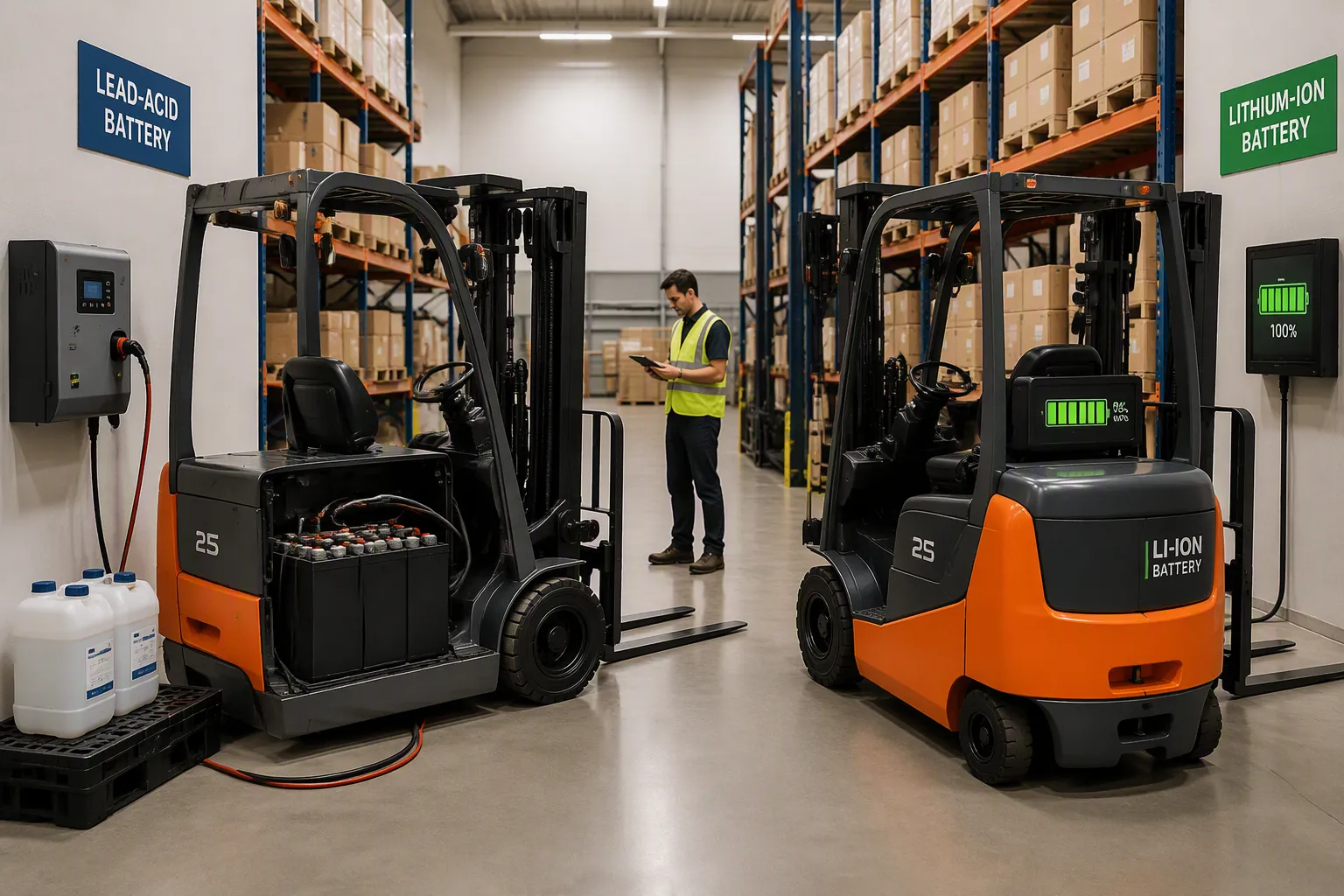
You should choose a lithium-ion battery for multi-shift, high-productivity operations. These batteries support opportunity charging during breaks and need almost no maintenance. A Lithium Battery Forklift Truck fully charges in about one hour, while lead-acid batteries require eight hours of charging plus eight hours of cooling. Lead-acid remains more economical for single-shift, low-intensity work with limited upfront budgets. Your workflow, budget, facility space, and growth plans determine the best option.
Lithium-ion batteries charge in 1-2 hours and allow opportunity charging during breaks, which keeps multi-shift operations running without downtime.
Lithium-ion batteries need almost no maintenance and last 8-10 years, saving you money on labor and replacements over time.
Lead-acid batteries cost less upfront and work well for single-shift operations with limited budgets and available charging space.
Charging speed separates these two battery types more than any other factor. Lead-acid forklift batteries require roughly 8 to 16 hours for a full charge. Lithium-ion batteries reach 100% in only 1 to 2 hours. You also avoid the cooling period with lithium power.
Lead-acid batteries require full charge cycles, which can take up to 8–12 hours, increasing downtime and reducing operational efficiency.
The table below shows the difference clearly.
|
Battery Type |
Charging Time |
Additional Notes |
|---|---|---|
|
Lead-Acid |
8–10 hours |
Plus 6–8 hours cooling |
|
Lithium-Ion |
1–2 hours |
No cooling needed |
Opportunity charging changes how you schedule your fleet. A Lithium Battery Forklift Truck accepts quick top-offs during operator breaks, shift changes, or lunch periods. You plug it in for 15 to 30 minutes, and the battery gains enough charge to finish the shift. Lead-acid batteries cannot handle this pattern. They need a complete cycle from full to empty, or the plates degrade.
Multi-shift operations expose the real cost of slow charging. Lead-acid batteries force you to keep two or three batteries per truck. Each swap takes 15 to 20 minutes and requires extra labor. Your trucks sit idle during the 16-hour charge and cool cycle. Lithium power eliminates this problem. One battery supports continuous operation across all three shifts. You gain more uptime, fewer changeouts, and lower labor costs.
Voltage stability determines how your forklift performs under load. Lead-acid batteries show significant voltage sag as they discharge. Once they fall below about 50% state of charge, lift capacity drops, travel speed slows, and hydraulic response weakens. A Lithium Battery Forklift Truck maintains a flat, stable voltage curve until almost fully depleted. You get consistent lift speed and cycle time whether the battery sits at 90% or 20% charge.
|
Aspect |
Lead-Acid Behavior |
Lithium-Ion Behavior |
|---|---|---|
|
Voltage pattern during discharge |
Noticeable voltage sag; output declines progressively |
Maintains a flat, stable voltage curve |
|
Performance under heavy load |
Below ~50% state of charge, lift capacity drops |
Consistent lift speed and response even at 20% charge |
|
Discharge rate capability |
Limited to 0.2–0.5C continuous |
Handles 1–5C continuous discharge |
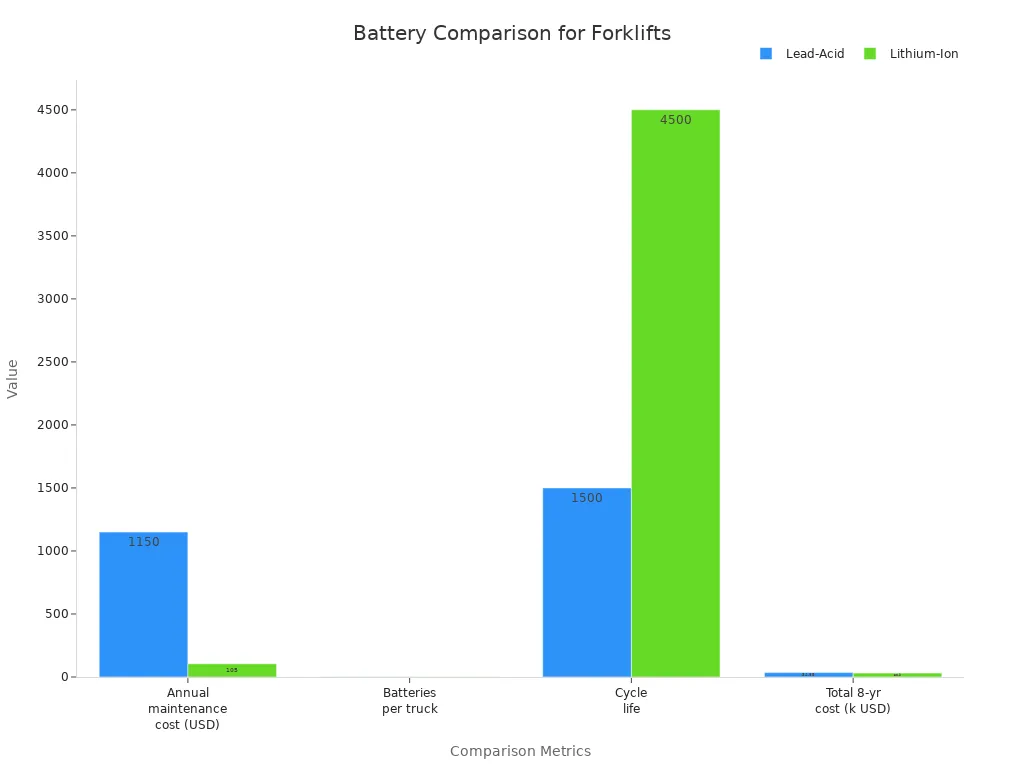
Cycle life separates these two technologies over time. Lead-acid batteries deliver roughly 1,200 to 1,500 charge cycles under typical warehouse usage. Lithium-ion batteries provide 2,000 to 3,000 cycles or more. You replace lead-acid batteries more often and absorb that cost repeatedly. Lithium power gives you a longer service life from a single investment.
|
Battery Type |
Cycle Life (Typical Warehouse Usage) |
|---|---|
|
Lead-Acid |
1,200–1,500 charge cycles |
|
Lithium-Ion |
2,000–3,000 charge cycles |
Lead-acid batteries lose capacity gradually. You notice slower acceleration and reduced runtime as the battery approaches the end of its life. Lithium-ion batteries hold their voltage curve and power output much longer. Your operators experience uniform performance throughout the battery's service life. This consistency protects your productivity targets across every shift.
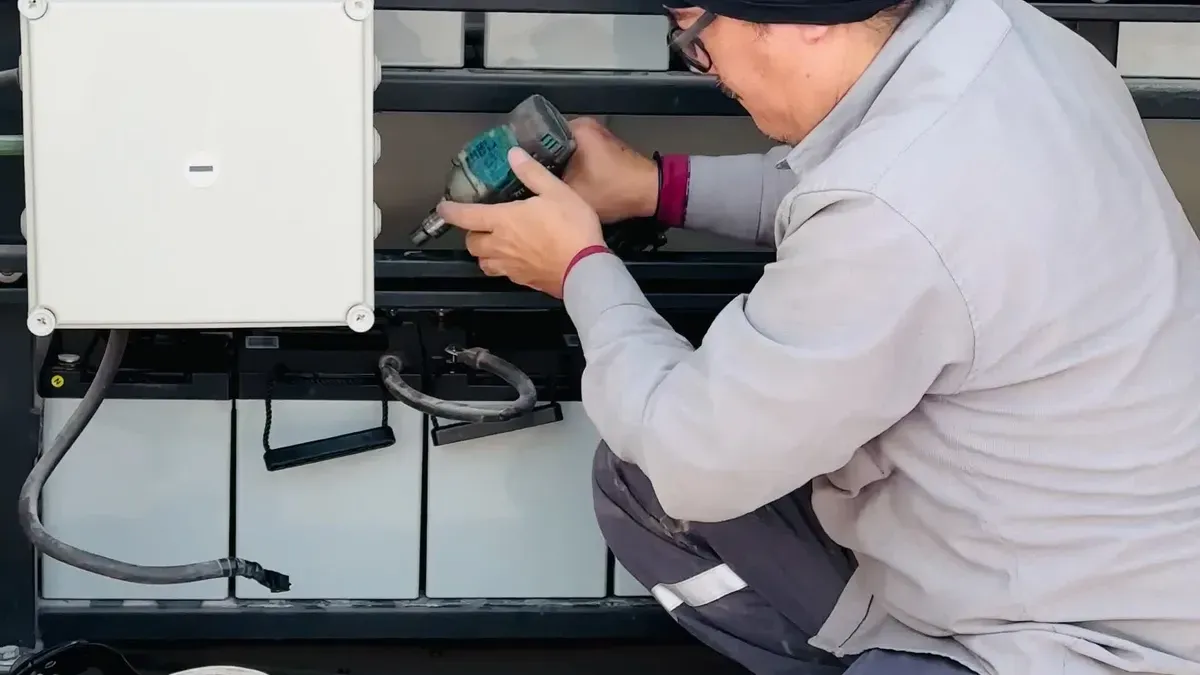
Lead-acid batteries demand attention every single day. Before each shift, you must inspect the battery case for cracks, bulging, or wet spots. You check terminal connections for corrosion and tightness. You verify that vent caps sit in place and remain undamaged. You confirm the charge level stays above 20% state of charge. You also examine cables for fraying, cracking, or loose fittings. This pre-shift inspection takes a few minutes per shift. Beyond daily checks, you water the battery every 5 to 10 charge cycles with distilled water. You clean the terminals monthly with a diluted baking soda solution.
A Lithium Battery Forklift Truck removes nearly all of these tasks. Lithium-ion cells are fully sealed. You never water them. You never clean acid corrosion. You never perform equalization charging. You never manage ventilation for toxic fumes. The battery stays inside the forklift and charges in one to two hours with no cool-down period. Battery swapping disappears entirely. One battery powers your truck across all three shifts.
With lithium-ion batteries there is no more watering, cleaning, equalizing or other repetitive tasks. All of that maintenance time, equipment and expense can be completely eliminated.
Maintenance tasks consume labor hours that add up quickly. Lead-acid batteries cost roughly $625 per unit each year for watering and cleaning alone. Lithium-ion batteries cost $0 in annual maintenance. You save $500 to $1,000 per battery per year after switching. A large distribution center reported saving over $100,000 annually in combined maintenance and energy costs.
|
Battery Type |
Annual Maintenance Cost per Unit |
|---|---|
|
Lead-Acid |
$625 (for watering and cleaning) |
|
Lithium-Ion |
$0 |
Lead-acid batteries create three main hazards in your warehouse: chemical exposure, explosion risk, and physical injury. The sulfuric acid inside these batteries causes respiratory irritation, eye damage, skin burns, and tooth enamel erosion when spills or leaks occur. Charging also releases hydrogen gas, which becomes explosive at concentrations between 4% and 74% in air.
Hydrogen is produced from the electrochemical process that occurs when lead-acid batteries are charged. Hydrogen has an explosive range of approximately 4%–74% in air and can initiate an explosion even when the oxygen content of the air is as low as 5%.
Battery handling also injures workers through weight strain and acid burns. A review of MSHA data from 2008 to 2012 found 128 incidents tied to lead-acid battery maintenance and repair.
|
Injury Category |
Reported Cases |
|---|---|
|
Crushing/cutting hand injuries |
40 |
|
Arc flash/acid burn injuries |
38 |
|
Back/shoulder/muscle strains |
37 |
|
Others (NEC), including nausea from hydrogen exposure |
Not specified |
A Lithium Battery Forklift Truck eliminates these specific hazards. Lithium-ion cells are sealed, so they produce no hydrogen gas and leak no acid. You face no explosion risk from charging fumes and no chemical burns from battery fluid. These batteries also weigh less, which reduces strain during any necessary handling.
You should verify third-party certifications before you buy. UL 2271 covers lithium-ion battery packs for electric forklifts and includes simulated abuse testing. UN38.3 certifies safe transport by air, sea, or land. IEC 62619 addresses overcharge protection and thermal control for industrial batteries. These certifications confirm that your battery meets recognized safety standards.
You notice a sharp contrast at the point of sale. A lithium-ion battery costs 2 to 4 times more than a lead-acid battery of comparable capacity. This initial price gap often steers budget-conscious buyers toward lead-acid. However, the per-truck investment changes when you plan for multiple shifts. Lead-acid requires 2 to 3 batteries per truck to support continuous operation. You also need dedicated charging stations, ventilation systems, and a battery room. A Lithium Battery Forklift Truck needs only one battery per truck. You eliminate the extra batteries, the charging infrastructure, and the floor space for a battery room. The total upfront capital narrows significantly when you calculate the full system requirements.
Operating expenses reveal the hidden cost of lead-acid batteries. You spend money on distilled water, cleaning supplies, and ventilation systems every week. You assign labor hours for watering cells, cleaning terminals, and performing equalization charges. You lose production time during the 8-hour charge and 8-hour cool-down cycle. Battery swapping adds 15 to 20 minutes per change, and you may swap 2 to 3 times per day per truck. Energy efficiency also affects your electric bill. Lead-acid operates at 70 to 80 percent efficiency. Lithium-ion exceeds 90 percent. You waste 10 to 30 percent of every kilowatt-hour with lead-acid. The table below summarizes the key operational cost differences.
|
Cost Category |
Lead-Acid |
Lithium-Ion |
|---|---|---|
|
Annual maintenance per battery |
$625 |
$0 |
|
Extra batteries needed (multi-shift) |
2–3 per truck |
0 |
|
Daily battery swapping labor |
15–20 minutes per swap |
None |
|
Charging downtime per cycle |
16+ hours |
1–2 hours |
|
Energy efficiency |
70–80% |
>90% |
Total cost of ownership paints a different picture than the purchase price. Lithium-ion reduces your total costs by 20 to 40 percent over a five-year period. The return on investment crossover point typically falls between 18 and 36 months for multi-shift operations. After that point, you operate at a net savings compared to lead-acid. Battery lifespan reinforces this advantage. A lithium-ion battery lasts 8 to 10 years in multi-shift use. Lead-acid batteries require replacement every 3 to 5 years under the same conditions. You replace lead-acid two to three times over the life of one lithium battery. The combination of higher efficiency, zero maintenance, and opportunity charging produces a clear TCO advantage. A Lithium Battery Forklift Truck costs more upfront. Over five years, it costs you less.
For a single-shift operation running eight hours per day, lead-acid remains a viable option. You have the full overnight period to charge and cool the battery. One battery per truck suffices. You do not need the fast charging speed that lithium offers for shift breaks. The lower upfront cost of lead-acid appeals when your budget is tight and your workflow allows for a full charge cycle after each shift.
However, even in single-shift use, a Lithium Battery Forklift Truck offers practical advantages. You eliminate the battery room and its ventilation requirements. You remove the daily watering and cleaning tasks. You also benefit from higher energy efficiency. Scheduling charging into off-peak utility hours, typically overnight, commonly cuts energy costs by 30 to 50 percent compared with daytime rates. The higher round-trip efficiency of lithium — roughly 95 percent versus 70 to 80 percent for lead-acid — means you waste less electricity even when charging only once per day. For single-shift facilities that plan to grow into multi-shift operation later, choosing lithium now avoids a costly infrastructure upgrade.
Multi-shift operations demand a battery that can sustain continuous work across 16 to 24 hours. Lead-acid struggles here. You need two to three batteries per truck. Each swap consumes 15 to 20 minutes of labor. You must invest in a dedicated charging room with hydrogen ventilation, acid-resistant flooring, and containment curbs.
A Lithium Battery Forklift Truck changes the equation completely. One battery per truck suffices for multi-shift operation. You charge during lunch breaks and shift changes in 15 to 30 minute intervals. No battery swaps occur. No cool-down period exists. No dedicated charging room is required. Facilities that switched from lead-acid to lithium report a 17 percent improvement in productivity. This gain comes from steady power delivery throughout the shift and the elimination of downtime for battery changes. With lithium, your trucks stay productive across all three shifts without interruption.
Cold storage environments present a unique challenge for forklift batteries. Lead-acid loses 30 to 50 percent of its rated capacity at temperatures between -20°C and -30°C. The electrolyte thickens, and chemical reactions slow down. Charging lead-acid in cold conditions is inefficient and often requires temperature-controlled charging areas.
Lithium-ion batteries perform significantly better in cold. They retain nearly full capacity at -30°C during discharge. The key limitation is charging: you cannot charge a standard lithium battery below freezing without risk of damage. High-quality lithium batteries include a built-in pre-heating function. This feature activates when the battery temperature drops below 5°C and warms the cells to 25°C before charging begins. With this protection, you can opportunity charge in a cold warehouse. You still avoid the watering and maintenance that lead-acid demands in these harsh environments.
|
Aspect |
Lead-Acid |
Lithium-Ion |
|---|---|---|
|
Capacity retention at -20°C to -30°C |
Loses 30-50% of rated capacity |
Little or no loss (tested at -30°C) |
|
Charging in cold |
Requires extended time; needs battery swaps; charging not ideal in cold |
Supports opportunity charging; pre-heating function warms cells to 25°C before charge |
|
Maintenance |
Frequent watering needed; acid becomes less reactive |
No watering; sealed design |
Facility space is a premium resource in any warehouse. Lead-acid batteries consume a significant amount of that space. A centralized charging room for a fleet of ten forklifts requires 2,000 to 5,000 square feet of dedicated floor area. This room must include battery racks, overhead cranes or roller beds, acid-resistant flooring, and continuous ventilation. For a lead-acid fleet of twenty 48V 600Ah batteries, continuous mechanical exhaust frequently exceeds 1,800 to 2,500 CFM of spark-proof ventilation. You lose valuable storage or production space to this infrastructure.
Removing a battery room frees floor space and cuts a maintenance routine, which is often as valuable as the energy savings.
Lithium-ion batteries eliminate this entire footprint. You do not need a dedicated battery room. Chargers mount on existing building columns near work zones. Standard warehouse ventilation suffices because lithium batteries produce no hydrogen gas. The space you reclaim ranges from 200 to 500 square feet per charging station. For a multi-truck fleet, this becomes significant real estate that you can use for pallet storage, additional racking, or operational flow. The table below summarizes the difference.
|
Metric |
Lithium-Ion |
Lead-Acid |
|---|---|---|
|
Space Requirement |
No dedicated battery room needed; can charge anywhere |
Requires dedicated, ventilated charging rooms |
|
Reclaimed Space |
200-500 sq ft per charging station reclaimed for productive use |
0 sq ft reclaimed (space occupied by battery room) |
|
Ventilation |
Standard warehouse ventilation |
Requires spark-proof exhaust fans and ducting |
In facilities where every square foot matters, the space savings alone can justify the switch.
A Lithium Battery Forklift Truck produces zero emissions during operation. Lead-acid batteries release hydrogen gas and acid mist while charging, which requires ventilation systems to protect your workers and the environment. Lithium-ion batteries also deliver 95% charge-discharge efficiency. Lead-acid batteries reach only 70% to 80%. This efficiency gap means you draw less electricity from the grid for the same amount of work. Over a full lifecycle, lithium-ion batteries generate 30% to 50% lower carbon emissions than lead-acid alternatives.
|
Metric |
Lithium-Ion |
Lead-Acid |
|---|---|---|
|
Operational emissions |
Zero |
Hydrogen gas and acid mist |
|
Charge-discharge efficiency |
95% |
70%–80% |
|
Lifecycle carbon emissions |
30%–50% lower |
Baseline (higher) |
|
Lifespan |
8–10 years |
3–5 years |
Lead-acid batteries have a mature recycling infrastructure. Their lead plates, plastic casings, and sulfuric acid electrolyte each go through separate recovery processes. This system achieves a 99% recycling rate. Lithium-ion battery recycling continues to expand as demand grows. Proper recycling channels prevent soil and water contamination. You should always route used batteries to licensed recyclers. Many forklift battery suppliers offer trade-in programs that offset part of your new battery cost.
A Lithium Battery Forklift Truck directly supports your corporate sustainability targets. Lithium batteries help facilities earn LEED certification points in the Energy & Atmosphere and Indoor Environmental Quality categories. Companies with ESG reports and Scope 1 and 2 emissions targets treat the switch from lead-acid to lithium as a key initiative. Lithium power eliminates acid spills, reduces water consumption, and produces no hydrogen gas during charging. These benefits align with the priorities of LEED-certified facilities and sustainability-focused operations.
Lithium-ion wins for productivity, multi-shift uptime, and long-term savings. Lead-acid suits tight budgets, single-shift work, and available battery room space. Match your battery to shift patterns, facility layout, and growth plans. Calculate your five-year total cost of ownership before you decide.
A lithium battery lasts 8 to 10 years in multi-shift use. Lead-acid batteries need replacement every 3 to 5 years under the same conditions.
No. Lead-acid batteries require full charge cycles. Partial charging damages the plates and shortens battery life. Lithium batteries accept opportunity charging without degradation.
A lithium battery costs 20 to 40 percent less over five years. You save on maintenance, labor, energy, and battery replacements despite a higher upfront price.
Add:No.609 Tahui Road , Shihudang Town, Songjiang District ,Shanghai, China


Friendly Links :
© 2026 Shanghai Zon-Cho Huge Science And Technology Co., Ltd. All Rights Reserved.
|Sitemap|Xml |Privacy Policy




