
How to Choose the Right Electric Forklift for Your Warehouse Operation
Sep 23, 2026Choosing an electric forklift for warehouse operations begins with a clear assessment of your specific needs. You must evaluate load weight, lift height, aisle width, daily operating hours, and indoor or outdoor conditions before comparing any equipment. Match equipment type, load capacity, battery type, and features directly to those requirements. Use the steps below as a practical checklist for a confident decision.
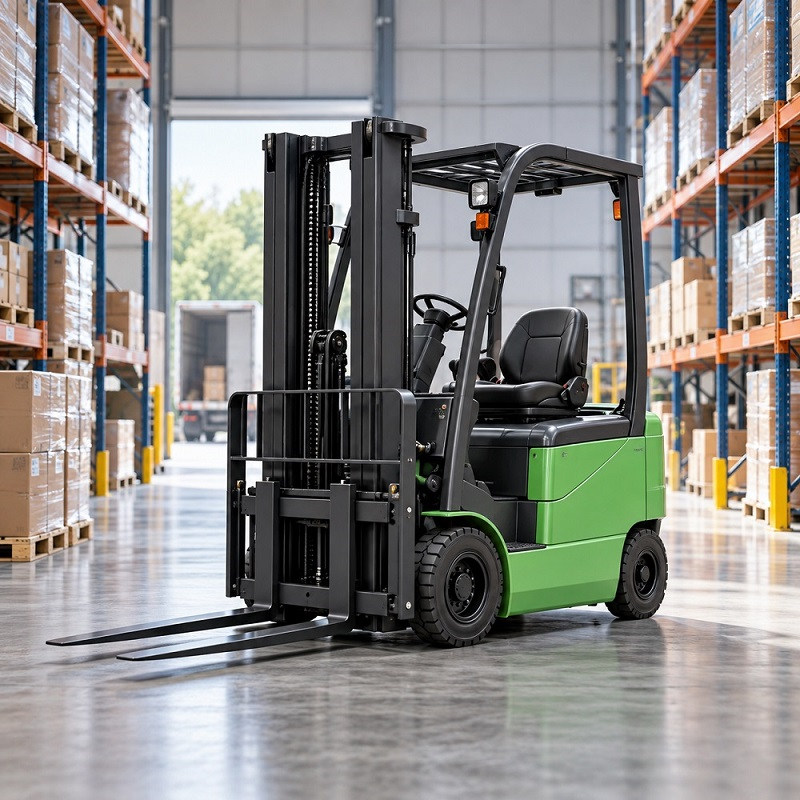
Assess your warehouse needs first. Measure load weight, lift height, aisle width, and daily hours.
Match equipment type and battery to your needs. Choose the right forklift for your tasks.
Consider total cost and supplier support. A good supplier helps you save money and time.
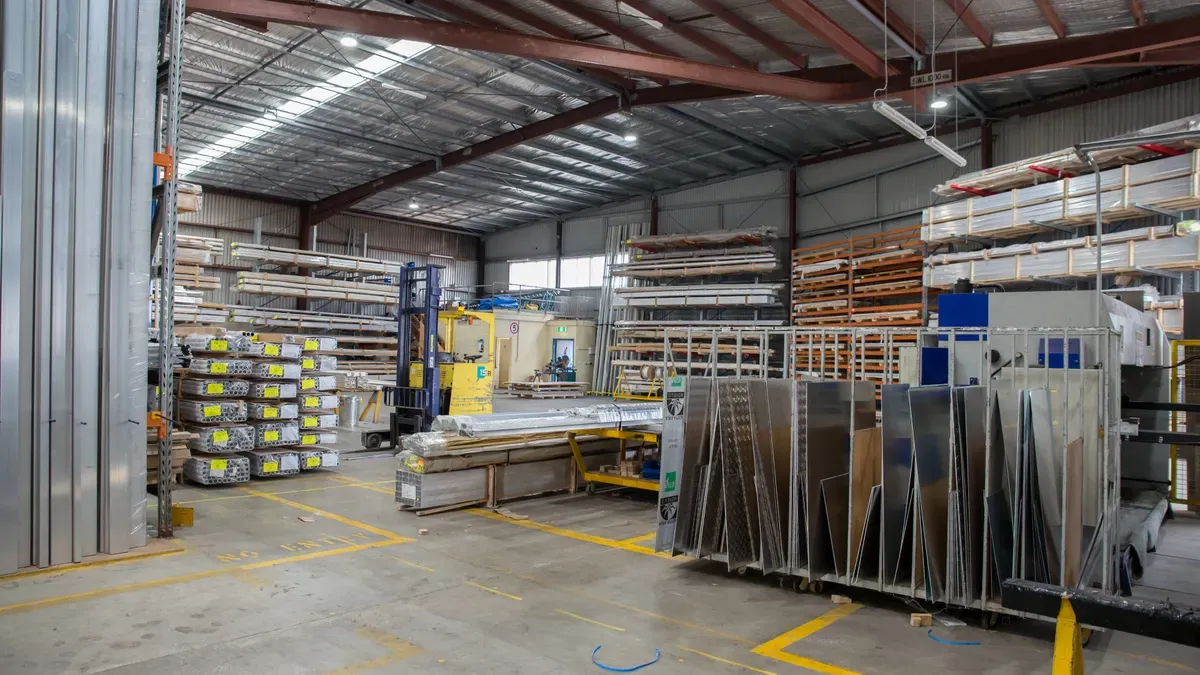
You cannot select the right machine from a spec sheet alone. The warehouse itself sets the requirements. Load weight, lift height, aisle width, operating hours, and the indoor or outdoor environment all shape which electric forklift for warehouse use will perform reliably. Walk your facility and record real numbers before you talk to any supplier.
Start with the heaviest load you move on a routine basis. Add the weight of the pallet, the racking, and any attachments. That total becomes your minimum rated capacity target.
Load center matters just as much as total weight. The load center is the horizontal distance from the face of the forks to the center of gravity of the load. A standard rating assumes a 24-inch load center. Move that center forward, and capacity drops fast.
|
Load Center |
Maximum Capacity |
|---|---|
|
24 inches |
3000 kg |
|
36 inches |
~2000 kg |
|
48 inches |
~1500 kg |
The data plate rating only applies at a 24-inch load center, ground level, and vertical mast. Moving from 24 to 36 inches drops capacity by 33% on a standard 5,000 lb forklift. At maximum elevation, a forklift retains only 60 to 70% of its ground-level capacity.
According to safety data, a forward shift in load center significantly increases the risk of tipping accidents. Industry guidelines show that increasing the load center distance can dramatically reduce lifting capacity, sometimes by more than 30–50% depending on the situation.
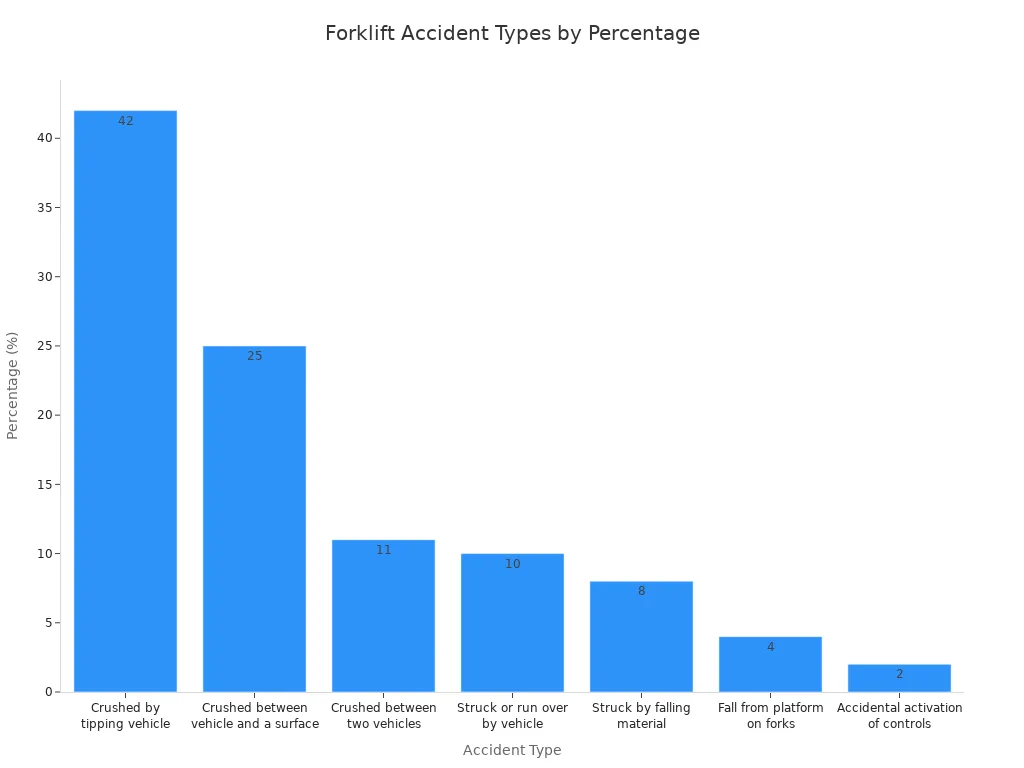
Tip-over accidents dominate forklift incident statistics. Crushed by tipping vehicle accounts for 42% of accidents, crushed between vehicle and a surface accounts for 25%, and struck by falling material accounts for 8%.
Measure your actual load dimensions. Note any long, wide, or off-center loads. These loads shift the center of gravity and demand a higher capacity rating or a different attachment.
Lift height follows directly from your racking system. Measure the top beam of your highest shelf and add clearance for safe insertion and withdrawal. Most operations need 6 to 12 inches of free lift above the beam.
|
Racking Category |
Standard Lift Height Range |
|---|---|
|
Low-level racking |
2–4 meters (manual handling or small warehouses) |
|
Medium-height racking |
5–8 meters (standard forklift operations) |
|
High-level racking |
8–12 meters (high-density storage systems) |
|
High-bay warehouses |
12–30 meters (automated or AS/RS systems) |
|
Most conventional warehouses |
3–12 meters (most common) |
Different rack types carry different upright heights. Selective racking runs 8–30 feet, drive-in and drive-through systems run 12–30 feet, and cantilever racking runs 8–20 feet. Push-back and pallet flow systems offer adjustable heights. Selective pallet racking can reach heights up to 40+ feet with proper engineering and anchoring, and it works with standard counterbalance, reach, and stand-up forklifts.
Industry also shapes the numbers. E-commerce warehouses typically run 6–8 meters tall with 5–7 meter racking. Manufacturing facilities run 8–12 meters with 7–10 meter racking. Cold storage stays lower at 4–6 meters with 3–5 meter racking. Food and beverage operations run 6–10 meters with 6–8 meter racking.
Higher lift heights reduce capacity. A machine rated at 3,000 kg at ground level may only handle 2,000 kg at full elevation. Always check the capacity chart at your specific lift height, not just the headline number.
Aisle width determines which forklift types can physically work in your building. Measure the narrowest aisle between rack uprights. Then measure the space at aisle ends where the truck must turn.
Narrow aisle forklifts such as reach trucks operate in aisles less than 10.5 feet. Single-reach reach trucks require a minimum aisle width of 8 to 9 feet. Deep-reach reach trucks require a minimum aisle width of 9 to 10 feet. A 10-foot aisle width suits narrow-aisle forklifts such as the Clark NPX20 reach truck with 46-inch right-angle-stack.
Counterbalance trucks need wider aisles because they turn with the load in front. A typical counterbalance requires 12 to 15 feet for a 90-degree turn. Measure your actual turning radius needs at each intersection and doorway.
Account for future changes. If you plan to add racking or shift layout, leave room for a narrower aisle configuration. A reach truck today may save floor space you cannot recover later.
Track how many hours each truck runs per shift. Multiply that by the number of shifts. This number drives battery selection and charging strategy.
A single-shift operation running 6 to 8 hours per day can often use one battery per truck with opportunity charging. A two-shift or three-shift operation needs either multiple batteries or a fast-charging lithium system.
Consider peak periods. Seasonal spikes, receiving days, and shipping deadlines push trucks harder than average days. Size your fleet for the peak, not the average.
Record the number of pallets moved per hour. This throughput number tells you whether you need one truck or several. It also reveals whether your operation needs a fast truck or simply more trucks.
The environment determines tire type, IP rating, and chassis protection. Indoor electric forklifts use cushion tires. These solid rubber tires bond to a steel band and work best on smooth, dry indoor floors. They offer a smaller turning circle, lower chassis height, and typically lower cost. They lose traction on rough, uneven, or wet surfaces and provide lower ground clearance.
Outdoor electric forklifts use pneumatic tires. These air-filled or solid pneumatic tires have a larger diameter and handle outdoor, uneven, or debris-laden surfaces, ramps, and gravel. They provide better shock absorption, traction, and ground clearance. Air-filled versions risk punctures, while solid pneumatics cost more but reduce flats.
|
Feature |
Indoor Electric Forklifts |
Outdoor Electric Forklifts |
|---|---|---|
|
Tire type |
Cushion tires (solid rubber, smaller profile, lower ground clearance) for smooth warehouse floors and tight turning |
Pneumatic tires (air-filled or solid pneumatic, larger diameter) for gravel, cracked pavement, wet/uneven terrain, better shock absorption and traction |
|
IP rating |
Generally lack outdoor protections; should stay away from outdoor environments, especially rain or wet conditions |
Often IP54 or IPX4 rated, indicating protection against dust and water splashes; suitable for many outdoor environments and wet conditions |
|
Key limitation |
Cushion tires struggle outdoors on gravel, cracked pavement, wet surfaces, and uneven terrain due to limited shock absorption and reduced traction |
Water resistance is not waterproof; heavy rain, flooding, deep puddles, or prolonged moisture exposure can still damage electrical systems and batteries |
Never mix tire types on the same axle. If your facility spans smooth indoor floors and outdoor yard work, consider a dual-fleet approach with cushion tires inside and pneumatic tires outside. You can also configure electrics with pneumatic or solid pneumatic tires where appropriate. Many outdoor electric forklifts carry ratings for outdoor use with proper enclosures and pneumatic or solid pneumatic tires. Confirm the IP or weather rating and avoid standing water.
You must select your electric forklift based on your daily warehouse workflow. Review your aisle width, racking height, floor condition, pallet size, working route, loading frequency, and daily operating hours. These factors determine the right equipment type for your operation.
Counterbalance trucks form the backbone of most warehouse fleets. They handle heavy loads across wide aisles and rough surfaces. You need a counterbalance when your aisles exceed 10 to 12 feet wide. These trucks carry the load in front of the front wheels. This design provides stability but requires more turning space.
Three-wheel electric counterbalance trucks offer an extremely small turning radius. They turn in about 1.3 to 1.5 meters. These trucks excel in narrow aisles, container loading, and dense storage. Four-wheel models provide greater stability. They have a larger turning radius near 2.0 meters. These models suit wider aisles and heavier loads.
You should choose a counterbalance truck for loads that require versatility. These trucks work with many attachment types. They handle pallets, long materials, and bulky items. Your decision depends on your typical load weight and the available turning space.
Reach trucks serve narrow aisles and high racking systems. They operate in aisles as narrow as 8 to 10 feet. Their design reaches racking heights far beyond standard counterbalance models. Modern reach trucks comfortably reach 12 meters or more. Typical lift heights range from 30 to 45 feet.
A reach truck uses a pantograph mechanism to extend its forks forward. This design keeps the truck stable while placing loads at height. You gain more storage space per square foot of floor area. Your warehouse becomes more efficient with higher racking and narrower aisles.
Choose a reach truck when your primary need is vertical storage density. These trucks work best in warehouses with consistent aisle widths and high racking systems. They require smooth, level floors for stable operation at maximum height.
Pallet stackers and walkie trucks handle lighter workloads. These machines cover short distances and lower lift heights. You use them for loading docks, staging areas, and order picking. They operate on 24V battery systems designed for smaller electric lift equipment.
A walkie pallet jack moves pallets at floor level. An operator walks behind the truck and controls it with a tiller arm. A pallet stacker adds the ability to lift loads to low racking heights. These machines are simple, affordable, and require less operator training.
Use these machines for secondary material handling. They free up your larger forklifts for heavier duties. You should consider them for tasks that do not require high lift or long travel distances.
You must understand rated capacity and load center before selecting a machine. Most standard forklifts carry a rating using a 24-inch load center. This rating assumes the load's center of gravity sits 24 inches from the fork face. If your actual load center differs, your lifting capacity changes.
|
Item |
Value |
|---|---|
|
Rated load center |
24 inches |
|
Actual load center |
36 inches |
|
Rated capacity |
5,000 lbs |
|
Calculation |
24 ÷ 36 = 0.667; 0.667 × 5,000 = 3,333 lbs |
|
Result |
The forklift can lift only about 3,333 lbs |
This principle applies across all electric forklift models. When selecting an electric forklift for warehouse use, you must evaluate capacity against your real load dimensions. Oversized loads, long materials, and attachments reduce the safe lifting capacity. You should size your truck around the maximum realistic daily load. Always add a sensible safety margin. Check the capacity chart at your specific lift height, not just the ground level rating.
Your mast choice directly affects your reach and clearance. Simplex masts offer a single stage. Duplex masts provide two stages for higher lift. Triplex masts offer three stages and the highest lift ranges.
|
Mast Stage |
Maximum Fork Height (inches) |
|---|---|
|
Duplex |
up to 157 |
|
Triplex |
131 - 300 |
Triplex masts cover the widest range of lift heights. You need a triplex mast for high racking operations. The mast must also provide adequate free lift - the height it can raise before the mast itself extends. This feature matters for low-clearance doorways and stacking in trailers.
An electric forklift for warehouse operations must match its mast height to your racking layout. Measure your top beam height and add clearance. Consider the lowered height for doorways and loading areas. Your mast selection affects both your reach and your ability to move through the facility.
Your battery choice impacts your daily operations and long-term costs. Forklift battery packs come in four common voltage options. These options are 24V, 36V, 48V, and 80V. Smaller equipment uses lower voltages. Larger counterbalance trucks require 48V or 80V systems.
Lead-acid batteries have a lower upfront purchase price. They require regular maintenance including water level checks and equalization charges. They also need cool-down periods after charging. You need a dedicated charging area with ventilation.
Lithium-ion batteries require much less maintenance. They equalize automatically and need no fluid level management. They perform well in higher temperatures. Lithium batteries support opportunity charging - you can charge them during breaks and shift changes. This feature eliminates battery change-outs. A lithium battery can charge from depleted to full in one hour using a 25 kW charger.
When you consider total costs, lithium batteries deliver significant savings. They are more energy efficient. They eliminate water maintenance. They improve productivity by reducing downtime. Although the upfront cost is higher, the long-term savings offset the initial investment.
Your charging setup must match your daily operating schedule. A single-shift operation running 6 to 8 hours often uses one battery with opportunity charging. A two-shift or three-shift operation needs either multiple batteries or a fast-charging lithium system.
|
Battery Type |
Capacity |
Charger Power |
Charge Time |
|---|---|---|---|
|
Flooded Lead-Acid |
48V, 500 Ah |
5 kW |
8 hours |
|
Lithium-ion |
48V, 500 Ah |
25 kW |
1 hour |
Charger power directly affects charge time. The recommended charger-to-equipment ratio is 1:1. This ratio allows charging during shared breaks. A 2:1 ratio is acceptable if breaks are staggered or fleet utilization stays between 50 and 100 percent.
Multi-voltage battery configurations are available for opportunity charging. A 48V battery can use a 48/96 setup. The charger voltage sets to twice the operating voltage. The battery electronics step it down. This setup cuts charge time by 50 percent. You benefit from faster turnaround between shifts.
Your floor surface dictates your tire choice. Indoor operations on smooth concrete require cushion tires. These tires offer a smaller turning circle and lower chassis height. They wear slowly on clean surfaces.
Polyurethane tires last three to four times longer than rubber on clean concrete. They resist cutting and tearing. Rubber tires provide superior traction, especially on wet floors. Rubber offers 30 to 40 percent more stopping force on wet surfaces.
|
Aspect |
Polyurethane |
Rubber |
|---|---|---|
|
Floor wear life on clean concrete |
3-4 times longer than rubber |
Wears faster, requires replacement every few months |
|
Traction on wet floors |
Fair to good if siped |
30-40% more stopping force on wet floors |
If your warehouse floors are clean and dry, choose polyurethane tires. If you have wet floors or outdoor travel, choose rubber tires. Never mix tire types on the same axle. This practice causes uneven wear and stability problems.
Attachments expand your forklift's capabilities. You can handle non-standard loads with the right attachment. Common attachments include drum handlers, coil handlers, and paper roll clamps.
Drum handlers and drum clamps provide secure clamping for safe drum lifting. They handle steel and plastic drums. You can lift, tilt, and transport drums without manual handling. Coil and reel handlers use custom cradles and mandrels. They lift and transport coils, reels, and rolls without damage.
Paper roll clamps lift weighty rolls of paper with accuracy. They minimize damage to the product. A coil ram attachment inserts a solid tube into hollow steel coils or concrete pipes. You can lift and transport these items safely.
Forklift clamp attachments enable handling of bales, slabs, and building materials. Most attachments include a rotation function. You can efficiently move drums or paper rolls without crushing or denting them. Your attachment choice depends on your specific load types.
Safety features protect your operators and your inventory. Modern electric forklifts include stability systems, operator presence detection, and load moment indicators. These features alert the operator when the truck approaches unsafe conditions.
Operator training is the most important safety investment you can make. OSHA estimates that around 70 percent of forklift accidents could be prevented through proactive measures. Training reduces accident rates by improving operator knowledge and skill. It strengthens safety culture and personal accountability. It lowers costs associated with accidents, OSHA fines, and higher insurance rates.
Operators must be trained on the specific type of forklift they will use. They must be certified to operate it. Training combines classroom instruction with hands-on practice. Operators must receive refresher training every three years to maintain certification. Refresher training is also required after incidents or near-misses. It is required whenever you introduce a new type of forklift or job conditions change.
To operate a forklift, an individual must be properly trained, licensed, and at least 18 years old. Certification requires passing a written knowledge test and a hands-on practical skills evaluation. You must keep operator names and training dates documented on file.
Purchase price accounts for only 30 to 40 percent of total cost over three years. The average total cost of ownership for a forklift over five years is four to five times its initial purchase price. A $35,000 purchase can become $175,000 in total spend including energy, labor, and maintenance.
Electric forklifts save money over time. They have 70 percent fewer moving parts than internal combustion models. They eliminate engine oil changes, spark plugs, and transmission flushes. Maintenance cycles are two to three times longer than diesel models. They often exceed 1,000 hours between services.
A 3.5-ton electric forklift running two shifts saves approximately $3,000 to $5,000 per year in energy and maintenance compared to an internal combustion model. Electricity cost is roughly 70 percent lower than diesel or LPG. One customer saved $82,000 over five years by converting a fleet of 12 electric forklifts. That averages approximately $6,833 per truck.
Labor accounts for up to 70 percent of total material handling costs. Equipment that is slow or uncomfortable increases labor cost per pallet. You should consider operator productivity as part of your total cost analysis. A faster, more comfortable truck reduces your labor cost per move.
Lead-acid batteries need replacement every two to three years under average shift conditions. Lithium batteries come with a five-year warranty and last 3,500 to 4,000 cycles. They cover nearly the entire forklift service life. A new lithium battery can cost up to $20,000. You must factor this cost into your total ownership calculation.
Your supplier choice affects your long-term success. You need a supplier who provides real solutions, not just fast replies. Test your supplier before you commit. Request a wiring diagram, a parts number, a fault-code explanation, a technical procedure, and a spare-parts quotation. See if the supplier provides thorough answers.
|
After-Sales Service Metric |
What It Means |
|---|---|
|
Response time |
Industry benchmark is within 4 hours for critical breakdowns |
|
Parts inventory |
Dealer maintains stock of high-turnover parts |
|
Technician certification |
Factory-trained technicians with diagnostic capabilities |
|
Fleet management services |
Telematics, predictive maintenance, fleet reporting |
Identify which spare parts you should stock locally. Common items include filters, belts, relays, fuses, seals, sensors, switches, hoses, and brake service items. Discuss a one- or two-year recommended spare-parts package before your bulk shipment. Do not wait for the first breakdown.
Evaluate local serviceability. Ask whether local workshops can service the forklift. Ask whether filters are available locally. Ask whether diagnostic tools are required. Ask whether wiring diagrams and fault codes are provided. Ask whether the supplier can provide remote technical support.
Judge supplier reliability using failure frequency plus repair time plus parts lead time. Do not judge by failure frequency alone. Test local technicians. Check whether they can understand the electrical system. Check whether they can diagnose basic faults. Check whether they can access service items easily. Check whether they can identify parts correctly. Check whether they can use special diagnostic tools if needed. Check whether they can receive remote guidance from the supplier.
A reliable supplier reduces your downtime and your long-term costs. Choose a partner who invests in local service capability.
Start by assessing load weight, lift height, aisle width, daily hours, and indoor or outdoor conditions. Then match equipment type, rated capacity, battery, and tires directly to those needs. Finally, weigh total cost of ownership and supplier support before you buy an electric forklift for warehouse operations.
Check the data plate at your actual load center and lift height. Capacity drops as load center extends or lift height increases. Always test with your heaviest daily load.
Choose lead-acid for single shifts with dedicated charging rooms. Select lithium for multi-shift operations needing fast charging and minimal maintenance. Match battery voltage to your truck's requirements.
Measure your narrowest aisle between rack uprights. Single-reach trucks need 8 to 9 feet minimum. Deep-reach models require 9 to 10 feet for safe operation.
Add:No.609 Tahui Road , Shihudang Town, Songjiang District ,Shanghai, China


Friendly Links :
© 2026 Shanghai Zon-Cho Huge Science And Technology Co., Ltd. All Rights Reserved.
|Sitemap|Xml |Privacy Policy




