7 Factors to Consider Before Buying an Electric Counterbalance Forklift
Sep 16, 2026
Choosing the wrong electric counterbalance forklift drains your budget through downtime, rework, and safety incidents. The right machine matches your loads, layout, runtime, and support network from day one. These seven factors turn a complex purchase into a clear, step-by-step decision.
Match your forklift's load capacity and battery type to your heaviest loads and shift schedule to prevent downtime.
Measure your warehouse aisles and headroom first; choose a compact model if space is tight.
Invest in operator comfort and a strong dealer network to cut turnover and keep your fleet running.
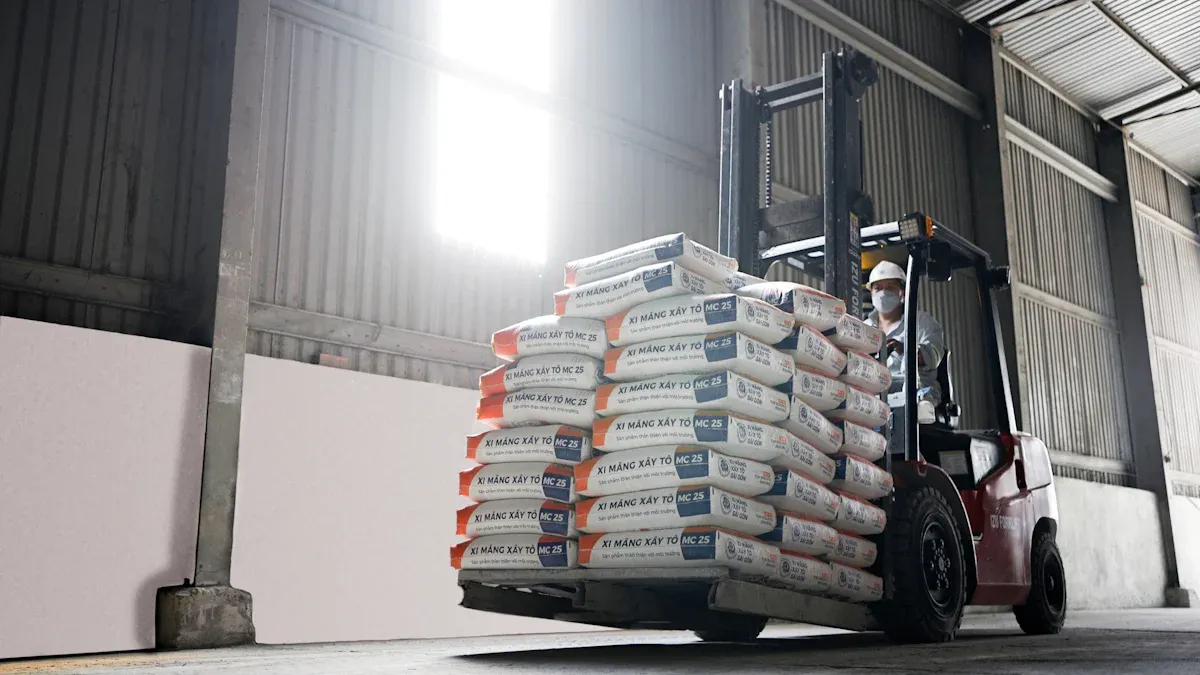
You must match the rated capacity of your electric counterbalance forklift to the heaviest load you handle on a regular basis. Every forklift has a maximum safe lifting weight. Exceeding that limit can cause the machine to tip forward, lose steering control, or drop its load. These outcomes lead to equipment damage and serious injuries.
A forklift works like a lever system. The front axle acts as the fulcrum. The forklift's own weight and counterweight create a rear stabilizing moment. The cargo creates an overturning moment. If the overturning moment becomes greater than the rear stabilizing moment, the forklift tips forward. Using the full rated capacity under unfavorable conditions can cause the rear wheels to lift off the ground.
Adding too much counterweight shifts the forklift's center of gravity. When turning sharply or working on slopes, lateral stability can become worse, which raises the chance of tip-overs. Operators should follow the rated lifting capacity and must not add counterweights themselves to make up for overloading.
Load center distance is the key link between nominal specifications and actual operational capacity. The load center is the distance from the load's center of gravity to the front face of the forks. If the actual load center is larger than the rated value, the forklift's lifting capacity decreases. When the load center increases, the load moves further away from the forklift's front axle. This increases the leverage force acting on the forklift and reduces the safe lifting capacity.
|
Factor |
Effect on Lifting Capacity |
|---|---|
|
Load Center |
A greater distance from the load's center of gravity to the fork face lowers capacity due to increased leverage |
|
Mast Height |
Lifting to greater heights can reduce stability and the usable/safe capacity |
|
Attachments |
Extra weight and a shifted load center can lower the rated capacity |
|
Load Characteristics |
Shape, size, and weight distribution impact safety and balance |
A forklift may be rated for a certain capacity at a lower height, but the safe capacity at full lift may be lower. Always check the rated capacity at the required lifting height.
You face a clear choice between lead-acid and lithium-ion batteries. Lead-acid costs less upfront by $4,000 to $9,000. Lithium-ion costs more at purchase. Over five years, the total cost of ownership picture changes.
|
Cost Dimension |
Lead-Acid |
Lithium-Ion |
|---|---|---|
|
5-Year TCO (high use) |
Higher (hidden costs) |
30–50% lower |
|
Watering & equalization labor |
$1,200/yr |
$0 |
|
Equalization downtime |
4–8 hrs/wk |
None |
|
Heated/ventilated battery room |
$5K–$10K + $1K–$2K/yr |
Usually none |
|
Replacement frequency |
Every 1,000–1,500 cycles |
3,500–6,000 cycles |
Lead-acid wins on acquisition price. Lithium-ion wins on energy efficiency, labor, infrastructure, and replacement life. For single-shift, light-duty use, lead-acid can remain competitive. For two- and three-shift operations, lithium's lower operating costs typically overtake its higher purchase price within a few years.
A total savings of $6.3M can be realized, per battery, over a 5-year period. If a fleet consists of 10 forklifts, that's a savings of $63M over 5 years.
For most multi-shift, high-throughput, cold-storage, and rental electric counterbalance forklift fleets, the payback period for upgrading to lithium-ion compared with lead-acid typically falls between 18 and 30 months.
|
Operating Scenario |
Average Payback Period for Lithium-Ion Upgrade vs. Lead-Acid |
|---|---|
|
24/7 operations, third-party logistics, high-throughput distribution centers |
Often under 18 months |
|
Single-shift, light-duty operations (e.g., about 3 hours/day) |
May extend beyond 5 years |
A heavy-duty lead-acid battery delivers roughly one 8-hour shift of runtime. It then requires 16 hours of charging and cooling before you can use it again.
|
Phase |
Duration |
|---|---|
|
Charging |
~8 hours |
|
Cooling |
~8 hours |
|
Operational use |
~8 hours |
This "8-8-8" cycle forces facilities to keep multiple batteries per forklift. Opportunity charging offers a better path for multi-shift warehouses.
Opportunity charging = recharging during short downtimes (15-min breaks, lunch, shift changes, loading delays) instead of waiting for full depletion.
Lead-acid limitations under frequent partial charging: sulfation, heat buildup, reduced cycle life, incomplete-charge degradation.
LiFePO₄ advantages: tolerates frequent/partial/rapid charging, no memory effect, maintains lifecycle under continuous opportunity charging.
Operational benefit: eliminates battery swapping, battery rooms, and handling equipment, increasing storage density and uptime.
Opportunity charging has revolutionized forklift fleet management because it allows for the continuous use of the same battery throughout multiple shifts. For a warehouse using multi-shift operations where there is no 8-hour downtime period for battery charging, opportunity charging is the best method to maximize equipment uptime.
Opportunity charging uses lower charging rates than fast charging. You apply it in multi-shift warehouses where average usage is about 1.5 times the battery's usable daily capacity. This approach reduces battery-change requirements, eliminates battery rooms and changing equipment, and improves forklift uptime and productivity.
Your aisle width determines which electric counterbalance forklift models can work in your facility. Measure every aisle before you shop. A machine that cannot turn in your narrowest aisle creates bottlenecks and safety risks.
Calculate the minimum aisle width with a simple formula:
Start with the basic right-angle stacking width. This number accounts for the forklift's turning radius.
Add the load length. A standard pallet measures 48 inches.
Add 12 inches for clearance.
For example, a forklift with a basic right-angle stack of 94.3 inches requires an aisle of 154.3 inches (12.85 feet) for a 48-inch pallet. Measure your tightest aisle and compare it to this figure. If your aisle falls short, you need a more compact model.
You also need to look up. Measure your door headers and any overhead obstructions like sprinklers or heaters. This is where collapsed mast height becomes critical. If your mast is too tall when lowered, you'll be restricted to a single room. Choosing the right forklift for a small warehouse means finding a machine that clears every doorway while still reaching your highest rack level.
This small electric forklift truck is equipped with a 48V/150Ah Li-ion battery and an integrated charger, which enables charging convenience and longer uptime to facilitate multi shifts applications. It has a small height (<2.0m) which makes it an ideal tool to perform the tasks in space with low ceilings such as malls, old factories, underground parking garage, cargo lifts and older warehouses – even with a 3F4350 mast.
Check "full free lift" specs to avoid ceiling obstructions in low-clearance areas.
Operational Safety Clearance: Allow 30–50 cm of clearance on each side.
Right-angle stacking demands extra space at rack ends. Confirm your layout supports the turning arc your operators need.
Your operating environment dictates the tire type you need. An electric counterbalance forklift used only on smooth indoor floors performs well with cushion tires. These solid rubber tires resist punctures and handle abrasive warehouse surfaces with ease. However, cushion tires struggle on rough terrain. They offer limited traction outdoors and provide less shock absorption. In a fleet initially equipped with cushion tires, operators reported traction issues and accelerated wear when forklifts were used on outdoor loading zones, especially during wet conditions. If your operation moves between indoor racks and outdoor docks, you need a tire built for both worlds.
Pneumatic and solid pneumatic tires suit mixed indoor-outdoor use. They provide deeper tread for loose ground, and solid pneumatics offer puncture immunity. For wet outdoor loading docks, check these specifications:
Traction tires: Deep grooves provide enhanced grip on wet, slippery outdoor surfaces.
Ribbed tread: Circumferential ribs and grooves channel water away, preventing aquaplaning on wet surfaces.
Load index: Must equal or exceed the maximum static load. For a 3-tonne counterbalance forklift, the drive axle may carry 7–9 tonnes during a full lift.
Tire type: Pneumatic or solid pneumatic tires are required for outdoor and wet surfaces.
Tire lifespan also differs by type. On abrasive warehouse floors, cushion tires typically last 2,000–3,000 hours. Pneumatic tires last 1,000–2,000 hours. Match your tire choice to your floor conditions and ramp usage.
Your operators spend entire shifts in the cab. A well-designed seat and control layout directly reduce fatigue and keep your team productive. Modern electric counterbalance forklift models offer several ergonomic features that address common pain points.
|
Ergonomic Feature |
How It Reduces Operator Fatigue |
|---|---|
|
Suspension and adjustable seating |
Reduces vibration and supports posture, lowering back and spine strain over an 8-hour shift |
|
Swivel seating |
Limits awkward twisting when reversing, reducing neck and back strain |
|
Intuitive and adjustable controls |
Positions levers and joysticks within comfortable reach, reducing repetitive reaching and wrist stress |
|
Improved visibility |
Lower dashboards, narrow masts, wide-view guards, cameras, and LED lighting reduce leaning and neck strain |
|
Vibration reduction |
Advanced suspension and dampening systems reduce vibration-related back pain and muscle fatigue |
|
Climate-controlled cabs |
Heating, air conditioning, and airflow help operators stay comfortable in extreme temperatures |
|
Quieter electric operation |
Electric forklifts run quieter and smoother than internal combustion models |
Seats with side bolsters, head and neck guards, armrests, and swiveling bases further reduce discomfort during long periods of seated operation. Mini lever and joystick controls placed closer to the operator cut strain from repeated leaning. Well-designed entry and exit steps with cabin handles protect knees and ankles. A rear handle horn helps operators drive in reverse without twisting.
Comfort drives retention. An operator who fights fatigue and pain every shift will look for another job. High turnover forces you to spend money on recruiting and training. It also creates safety risks when inexperienced workers operate heavy equipment.
A comfortable cab keeps experienced operators on your team. They work faster, make fewer mistakes, and take fewer sick days. The investment in ergonomic features pays back through lower labor costs and steadier productivity. Involve your operators in the buying decision. They know which features matter most for your specific tasks.
Modern safety systems protect your operators and your inventory. Load stability sensors monitor the load on the forklift. These sensors prevent tipping by alerting the driver when the load is unbalanced or lifted at an unsafe angle.
Tilt alarms alert the driver if the forklift is in danger of tipping. You can set these alarms to sound at different angles.
Anti-slip and warning systems detect changes in the stability triangle. They alert the operator if the load center falls outside the stability triangle or if the forklift risks tipping.
Load sensors provide real-time feedback on whether the weight of the load exceeds safe limits. Overloading an electric counterbalance forklift can cause it to tip over. This creates danger for the operator and anyone nearby. Load sensors help operators avoid this risk and keep everyone in the warehouse safe.
Visibility packages also matter. Wide-view masts, cameras, and LED lights help operators see their surroundings clearly. These features reduce blind spots and prevent accidents.
OSHA sets strict standards for powered industrial trucks. Your electric counterbalance forklift must meet these requirements before it enters service. Check that the manufacturer provides compliance documentation with your purchase.
Operator training is equally important. OSHA requires formal instruction, practical training, and evaluation for every forklift operator. You must train operators on your specific equipment and warehouse conditions. Refresher training is required when operators demonstrate unsafe practices or when workplace conditions change.
Document all training sessions. Keep records of operator certifications. These records protect your business during inspections and demonstrate your commitment to safety.
Your electric counterbalance forklift only performs as well as the support behind it. A strong local dealer network keeps your fleet running when breakdowns happen. You need fast response times and easy access to critical spare parts.
Get your forklifts back up and running quickly thanks to our 4-hour emergency response times and a nationwide team of 850+ technicians
Response times vary based on your service agreement. Fleet program clients typically receive priority dispatch within four hours during business hours. Non-program clients work on a first-come, first-served basis with same-day or next-business-day service.
|
Client Type |
Emergency Response Time |
|---|---|
|
Fleet program clients |
Typically within four hours during business hours; response times are written into the program contract; priority dispatch |
|
Non-program clients |
First-come-first-served; same-day during business hours and next-business-day after hours; no guaranteed SLAs outside program contracts |
Local dealer proximity directly affects how long you wait for parts. A nearby service center keeps high-demand components in regional warehouses. Critical components not stocked locally can take one to two weeks to arrive. Standard parts ship in two to seven days, or one to three days with expedited shipping.
Warranty coverage protects your investment. Powertrain warranties range from three years or 6,000 hours to five years or 10,000 hours depending on the manufacturer. Battery warranties often come from separate vendors. Always review the specific terms before you sign.
Service agreements lock in response times and maintenance schedules. These contracts reduce unexpected repair costs and keep your equipment in peak condition. Financing options spread the purchase cost over time. Many dealers offer lease-to-own programs and flexible payment plans. Ask about these options early in your buying process.
Choose your Electric Counterbalance Forklift by matching your loads, layout, and runtime first—not the lowest sticker price. Treat these seven factors as your checklist before you commit. Involve your operators and maintenance staff in the final choice. A well-matched unit delivers lower costs and safer shifts for years.
Match battery type to your shift schedule. Single-shift operations work well with lead-acid. Multi-shift operations benefit from lithium-ion. Lithium-ion handles opportunity charging and eliminates battery swapping.
Measure your narrowest aisle first. Add the load length and twelve inches for clearance to the basic right-angle stacking width. Compare this total to your actual aisle. Choose a compact model if your aisle falls short.
Operators know your daily tasks and pain points. They identify which ergonomic features matter most. Their input reduces turnover and improves safety. A comfortable operator works faster and makes fewer mistakes.
Add:No.609 Tahui Road , Shihudang Town, Songjiang District ,Shanghai, China


Friendly Links :
© 2026 Shanghai Zon-Cho Huge Science And Technology Co., Ltd. All Rights Reserved.
|Sitemap|Xml |Privacy Policy




